





 Portuguese
  English
  Spanish
  3 min of reading
  0 comments


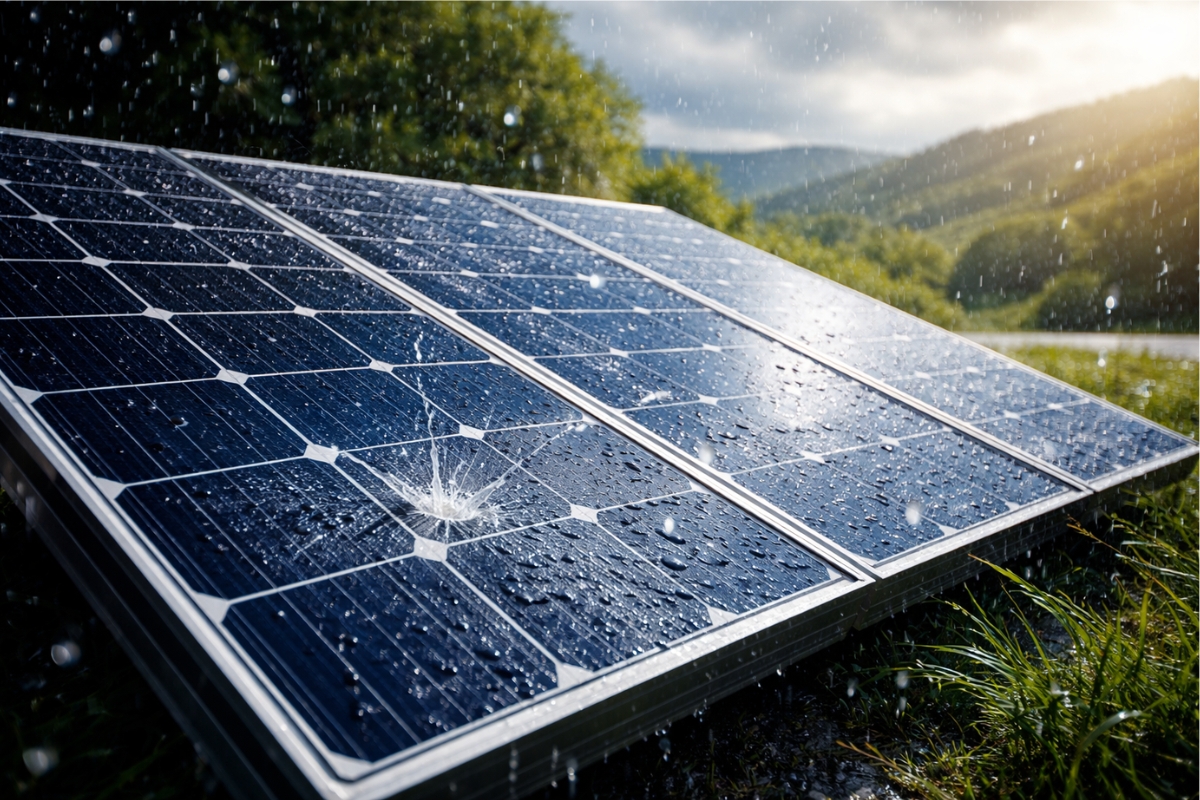
With a layer of just 100 nanometers, the new solar module can resist moisture, capture energy from rain, and maintain operation on cloudy days, changing the role of bad weather in electrical production
More than a technical advancement, the new technology changes a historical limitation of solar energy. On cloudy or rainy days, production has always dropped sharply, reducing system efficiency.
Now, this scenario begins to transform. A solution developed in Spain allows rain to cease being an obstacle and instead act as an additional source of electricity, increasing generation even when the sun does not shine.
Seville Institute develops solution with ultrathin layer
The advancement was created by the Institute of Materials Science of Seville, responsible for developing a layer of just 100 nanometers applied over perovskite solar cells.
-
Considered almost extinct and found in only three municipalities in Ceará, one of the rarest birds on the planet has just recorded 12 nests and the birth of healthy chicks in the Chapada do Araripe, renewing hope that the species can still be saved.

-
The coffee that has already been repurposed into biofuel, concrete, and roadworks now takes on a new unexpected function: becoming a sustainable insulator with six times greater capacity and real potential to replace petroleum-derived foams.

-
Hidden in a 75-hectare forest within a university in Minas Gerais, a newly discovered fungus reprograms the brains of spiders, turns the victims into obedient zombies, and forces them to die exactly where it needs to spread its spores.

-
The largest oil field in the United States had entire layers that no one knew existed, and the U.S. government has just confirmed 1.6 billion barrels hidden in rocks that have been invisible for decades.

This material was already seen as an alternative to silicon for combining low cost and high efficiency. The problem has always been its fragility in the face of moisture and temperature variations.
Plasma techniques reinforce resistance and generation

To solve this limitation, researchers used plasma techniques capable of forming a protective barrier more resistant to external conditions.
In addition to protection, this layer adds triboelectric properties. In practice, the panel begins to convert the impact of raindrops into electrical energy, creating a second source of generation in the same equipment.
Impact of the drops can generate up to 110 volts
Each time water hits the surface of the panel, a small electric discharge occurs. In tests, the system produced up to 110 volts per impact, transforming rain into an energy resource.
According to ScienceDirect, an international platform that gathers peer-reviewed scientific studies, the performance indicates that the combination of solar energy and the triboelectric effect can expand the use of these modules in different environments.
Application in sensors and remote areas gains prominence
According to researcher Fernando Núñez, the technology proves especially useful for powering sensors and weather stations in isolated locations.
In these scenarios, changing batteries is expensive and often unfeasible. With the new solution, devices can operate continuously, regardless of weather conditions.
Continuous energy strengthens connected systems

The ability to generate energy from both sun and rain simultaneously expands the potential for use in Internet of Things systems.
Scientific equipment, environmental sensors, and remote structures gain greater autonomy. The weather ceases to be a risk factor and begins to contribute to energy stability.
How sunlight continues to generate electricity
Even with the gain brought by rain, the traditional operation of solar energy remains essential. Photovoltaic cells use silicon treated with positive and negative charges to create an internal electric field.
When light hits the panel, particles called photons transfer energy to the electrons. This movement generates an electric current in the form of direct current.
For household use, this energy needs to be converted into alternating current through an inverter, allowing it to power equipment, lighting, and appliances.
The combination of solar capture and rain energy expands the reach of renewable generation. The system begins to operate with greater stability and less dependence on ideal weather.
By transforming a limitation into an advantage, the technology repositions how clean energy can be applied and changes the strategic outlook.







Seja o primeiro a reagir!