






 Portuguese


Special snow trains spring into action when blizzards block railway lines and standard equipment is no longer effective, combining front blades, side wings, blowers, and rotors to remove tons of snow; in 2017, Donner Pass required rotary machines after more than 13 feet covered the Sierras and blocked the passage.
Special trains used against heavy snowfall spring into action when snow covers tracks, blocks rail corridors, and turns a locomotive’s journey into a battle against towering white walls. In various regions of the United States, Canada, Norway, Japan, and France, machines equipped with plows, blowers, side wings, and rotors are deployed to clear lines affected by extreme winters.
According to the YouTube channel AutoMundo, in a video published on August 23, 2025, the most extreme case presented occurred at Donner Pass, U.S., in 2017, when over 13 feet of snow accumulated in the Sierras, leading to the return of large rotary plows that rarely leave the depots.
Special trains operate where standard locomotives struggle

Accumulated snow on a railway can present challenges much larger than just a simple layer over the tracks. In some of the footage shown, the white wall surpasses the height of the locomotive itself, forcing operators to use specialized equipment or combine several machines to push and remove the material from the tracks.
-
Two snakes rescued from a circus, a boa constrictor and an albino python, become stars of the world’s largest freshwater aquarium in Campo Grande, roaming the halls of 19,000 square meters with 5 million liters and 239 tanks

-
At 13, Boy Gets R$ 3,500 3D Printer, Leverages World Cup to Create Sticker Boxes, Sells Each for R$ 30 to R$ 50, and Uses Profits to Pay for Design Class

-
Job Offer of Approximately R$ 5,000 in São Paulo Ends in Complaints After Workers Report Two Months Without Pay, 22-Hour Shifts, and Poor Conditions
-
Nine-Year-Old Maria Clara Turns Leather Scraps Into Bracelets, Builds Her Own Brand in Paraíba, and Boosts Family Income by About R$ 2,000 Monthly


The special trains are designed specifically for this task. Depending on the amount and type of snow, a locomotive can be fitted with a large front plow or work with equipment capable of throwing the material far away from the track. In more severe situations, the force required goes beyond horizontal pushing and necessitates systems that cut, shred, or project the snow off the rail corridor.
Front plows turn locomotives into huge snow pushers
Among the simplest solutions are the large plows installed at the front of the trains. The principle relies on using the weight and pulling power of the train to break through the accumulation and push the snow to the sides as the locomotive moves forward.
Footage shows operations where the front of the train nearly disappears into the white mass before reappearing several meters ahead. In Saskatchewan, Canada, a train is shown facing snow higher than the locomotive itself, while another example from Colorado reveals that brute force is not always enough: two locomotives became stuck in front of a compacted barrier.
Steel Wings Expand the Width of the Path Cleared by Plows

Some equipment utilizes more than one front blade. The so-called Russell plows presented in the material have steel side wings that can open to throw snow even further away from the railway bed, increasing the width of the corridor cleared during passage.
This system requires special attention at points along the line where there are crossings or other structures near the tracks. In these locations, the wings need to be retracted and certain components raised to avoid impacts. In Japan, a video shows this type of operation amidst falling snow, with the train advancing as large white waves are projected to both sides.
Japan Uses Smaller Machines to Keep Lines Open in Winter
Not every operation requires gigantic equipment. In Fukushima, the footage shows a smaller Russell plow advancing through the area around Yunokamen station, using a front blade to push blocks of snow out of the way.
Despite smaller dimensions compared to machines used in larger corridors, the goal is equally important: to maintain conditions for passenger trains to continue running. The necessary capacity varies based on the railway, the accumulated volume, and the intensity of the snowstorms faced in each section.
Blowers Transform Accumulated Snow into Large Columns Launched Upward

Another solution presented is equipment capable of launching snow off the tracks instead of just pushing it. In Norway, the footage shows a blower identified as Balehack in operation, projecting two large columns of snow away from the railway.
Machines of this type are used in regions where intense snowstorms are part of the railway routine. The visual effect resembles a huge white fountain, but its function is operational: to quickly remove the accumulated material and prevent the cleared snow from remaining close enough to re-occupy the track.
Donner Pass Required One of the Railroad’s Most Extreme Machines

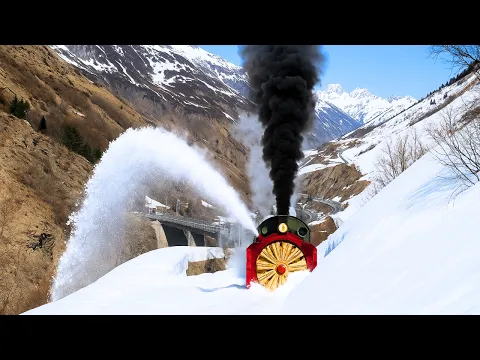
When conventional equipment is no longer sufficient, the large rotary plows come into play. In Donner Pass, the video highlights the Rotary Snow Plow, a machine equipped with a massive front rotor capable of directly tackling large volumes of snow.
Its operation differs from a traditional plow. The rotor spins and slices through the accumulated mass, throwing tons of snow off the tracks, while other locomotives provide the necessary force for the entire system to advance. Due to their size, operational costs, and very specific needs, these machines remain stored for long periods and are activated only in exceptional situations.
More than Four Meters of Snow Made Rare Machines Return to the Tracks in 2017
It was precisely an exceptional situation that occurred in 2017. According to the material, more than four meters of snow accumulated in the Sierras affected the Donner Pass region, prompting Union Pacific to resort once again to the large rotary plows known in the video as “War Wagons.”
These machines are described as equipment that can go years without being needed. However, when snow completely blocks the corridor, they become one of the few options capable of addressing such a large volume. The mission is to restore a vital rail link in the U.S. system and enable other trains to resume operation.
France Also Deployed Trow-Equipped Trains After Exceptional Snowfall
The video also features an episode that took place in Normandy in March 2013, when an exceptional snowfall covered roads and railways. Faced with the accumulation, SNCF deployed trains equipped with front plows to try to maintain circulation.
From the cab’s view, the train appears to move through a completely white corridor, pushing the snow aside as it travels along the line. The scene highlights one of the difficulties of this type of operation: the engineer must continue moving forward in an environment where the railway track itself can practically disappear beneath the accumulated layer.
Not Even the Combination of Multiple Locomotives Guarantees Overcoming a Compact Wall

The amount of available power does not mean that every barrier can be overcome. Between Genoa and Limon in Colorado, an operation by Kyle Railroad featured in the video used two locomotives at the front to tackle a significant accumulation.
This time, the compacted snow managed to halt progress and left the train stranded. The incident illustrates why different technologies exist for distinct situations: depending on the depth, density, and extent of the blockage, simply pushing may no longer be sufficient and specific equipment may be required to assist.
When snow engulfs the tracks, keeping the railway open becomes an engineering operation
Traditional plows, side wings, blowers, and giant rotors serve different functions but share the same goal. The special trains need to clear a path that often has become invisible, allowing passenger or freight lines to resume operations after heavy snowfalls.
Donner Pass represents the extreme of this challenge: machines that can stay stored for years return to the railway when meters of snow close the corridor and conventional solutions are no longer enough. Did you imagine there were locomotives equipped with giant rotors just to handle snow of this magnitude? Which of these machines caught your attention the most? Share your thoughts in the comments.


