





 Portuguese
  English
  Spanish
  6 min of reading
  0 comments


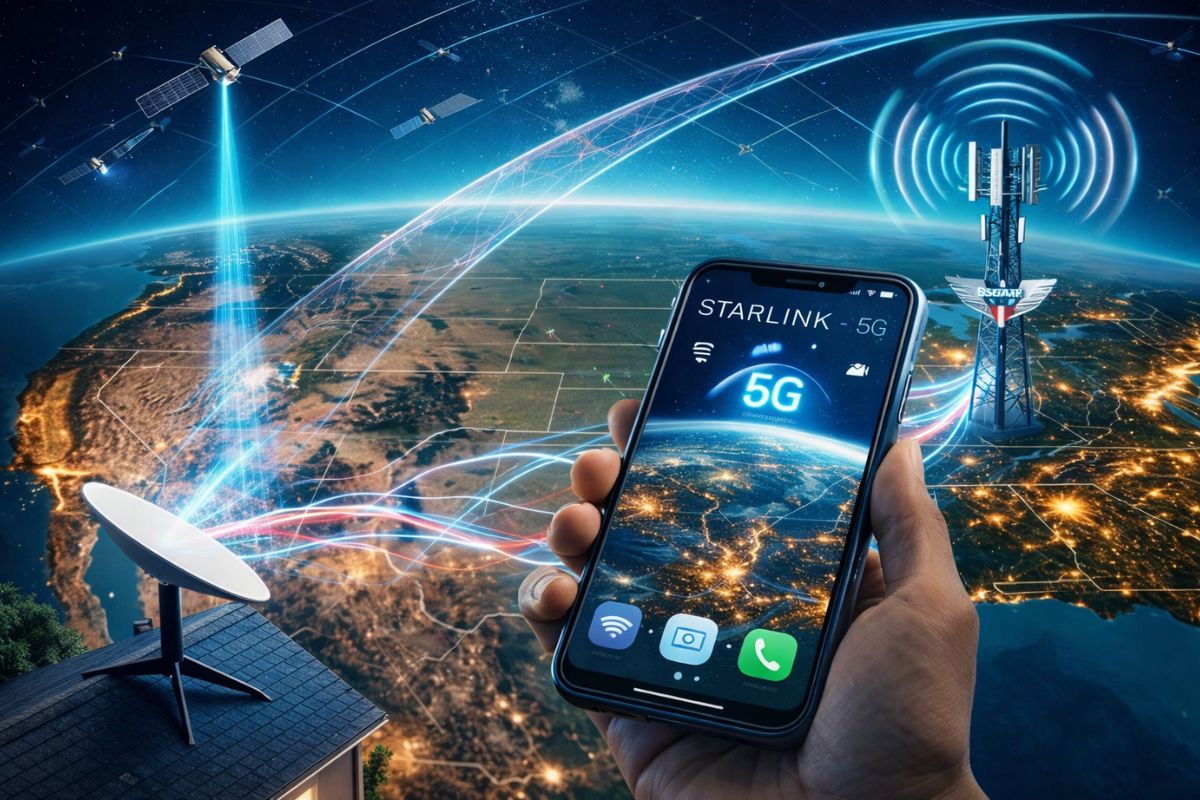
US Mobile has partnered with Starlink and launched the Starlink One package, which combines residential satellite internet with unlimited cellular coverage on the three largest networks in the United States for less than $50 per month, creating an unprecedented alternative to traditional carriers.
Starlink has just gained a new distribution channel and American consumers a proposal that no traditional carrier has offered until now. US Mobile, a virtual operator (MVNO) known for its flexible prepaid plans, announced the launch of Starlink One, a package that combines Starlink’s residential satellite internet and an unlimited cellular plan with access to T-Mobile, AT&T, and Verizon networks on a single bill. The starting price is below $50 per month, an aggressive range considering that Starlink’s basic residential plan alone already costs between $49 and $69 per month in the United States.
The partnership represents one of the first attempts to integrate, in a single commercial product, terrestrial cellular coverage with SpaceX’s low-earth orbit satellite broadband. While competitors like AT&T and Mint Mobile combine fiber optics with 5G, US Mobile has taken a different path: using Starlink’s satellite network to deliver high-speed internet to areas where conventional connections still face limitations. US Mobile’s CEO, Ahmed Khattak, summarized the proposal in a Reddit post: “Imagine a plan for under $50 that covers all the major networks in the United States, extends to Canada and Mexico, and includes internet from space in your home.”
How Starlink One works and what is included in the package
According to information from the portal Tudo Celular, Starlink One combines two services that normally require separate contracts: Starlink’s residential satellite connection and US Mobile’s unlimited cellular plan. The package offers three speed tiers for residential internet: 100 Mbps, 200 Mbps, and 400 Mbps.
-
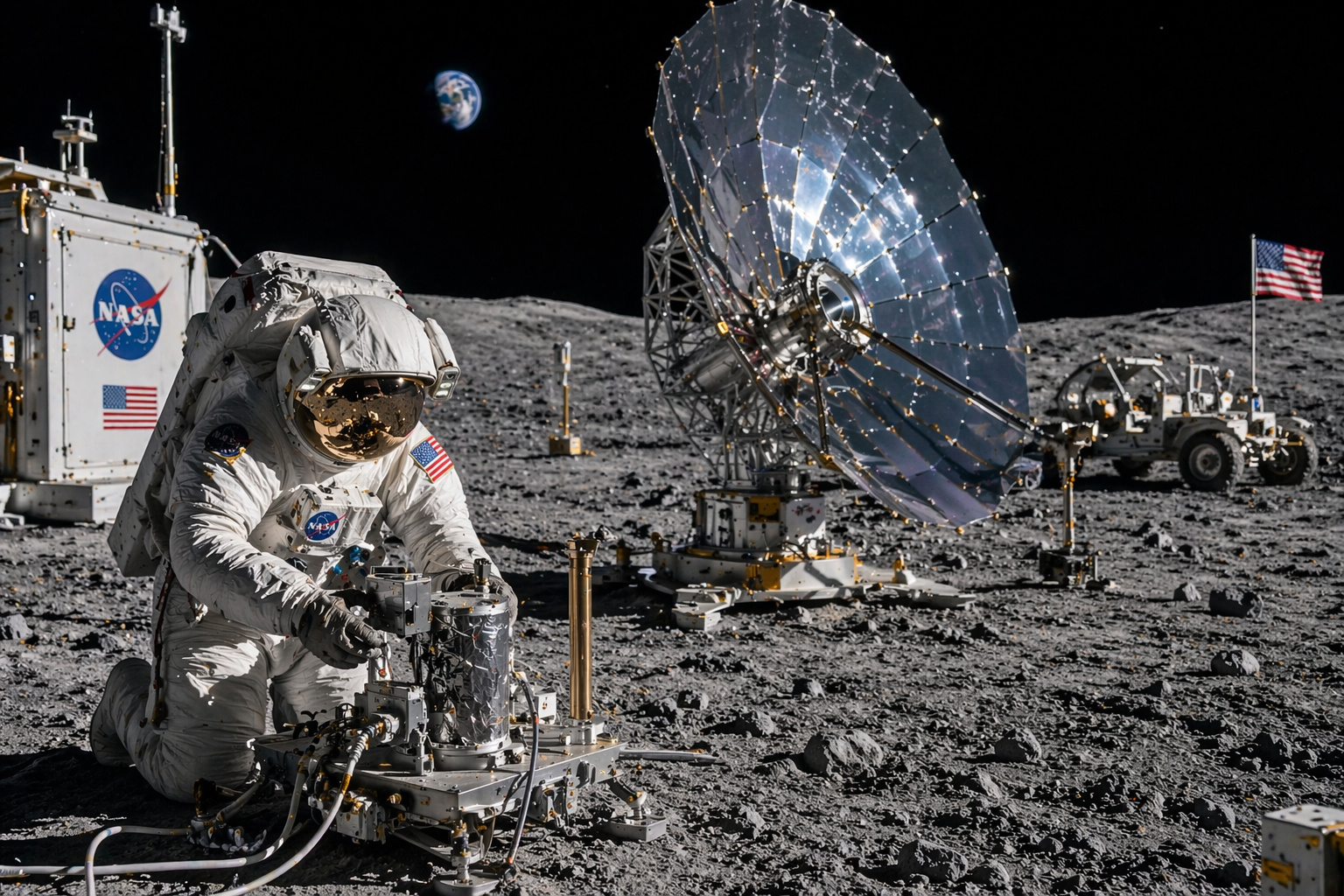
NASA advances in oxygen production on the Moon using concentrated solar energy, eliminating logistical barriers and bringing the scenario of permanent human bases closer with less dependence on Earth shipments.
-
How a central pivot works inside: from the pump house to the 500 m rotation, 150 hp motor, 75 hectares irrigated in 16 to 24 hours, sensors, nozzles, and maintenance.

-
Why is the ship’s command bridge located at the back: engine and rudder at the stern, more space for cargo, safer maneuvers, more stable crew, and laws that sometimes require it to be in the center or bow?

-
Advancement in health: UNB and FAPDF develop new technology that reduces Parkinson’s tremors and shows significant results by increasing movement stability and improving patients’ quality of life.

The most affordable plan starts at $47 per month with a speed of 100 Mbps, while the top-tier plan, with 400 Mbps, reaches $117 per month. For new customers, the $349 fee for Starlink equipment is waived, a significant incentive considering that the antenna is essential for the service to function.
For existing US Mobile customers, adding Starlink as residential internet costs between $30 and $100 per month additional, depending on the chosen speed tier. The cellular plan included in the package provides unlimited access to the three major American networks, allowing the user to switch between T-Mobile, Verizon, and AT&T based on coverage in each area.
Starlink also promises to offer the service with no data limits on the residential connection, an important differentiator in a market where many broadband providers impose caps. According to US Mobile, the model is simple: one account, one app, and one company that answers the phone.
Why US Mobile chose Starlink instead of fiber or 5G
The decision to bet on Starlink instead of following the path of fiber optics or fixed 5G is not accidental. US Mobile is a virtual operator and does not have its own network infrastructure. Building or leasing fiber networks would require investments that an MVNO simply cannot afford.
Starlink, on the other hand, offers a ready-made solution: a global network of low-earth orbit satellites that delivers broadband anywhere there is open sky, without the need for cables, poles, or towers.
Ahmed Khattak was direct in justifying the choice in his Reddit post. He acknowledged that Starlink may not be US Mobile’s permanent partner if better low-earth orbit satellite networks emerge in the future, the company will be open to switching suppliers.
But for now, Starlink is considered the best option available. The logic is pragmatic: providing the best possible connectivity to consumers takes priority over loyalty to any brand. This flexibility is a competitive advantage that traditional carriers, tied to long-term contracts with their own networks, find difficult to replicate.
What has not yet been answered about the Starlink plan with US Mobile
Despite the enthusiasm generated by the partnership, several important questions remain unanswered. The most obvious is how exactly the $47 monthly price is sustainable, considering that Starlink’s cheapest residential plan alone already costs between $49 and $69. The math suggests that US Mobile may be subsidizing part of the cost or that there are specific undisclosed conditions such as speed limitations during peak hours or geographical restrictions.
Another unknown involves the equipment. Starlink requires an antenna and a router to function, and the standard residential kit costs $349. Although US Mobile has announced that this fee will be waived for new customers, it is unclear whether this applies only to the fixed kit or also to the portable version (Starlink Mini), which the CEO mentioned as an option to “take anywhere.” There are also missing details about technical support: when something fails in the satellite connection, does the customer call US Mobile or Starlink? In a package that combines two fundamentally different technologies, the chain of responsibility can become a nightmare for the consumer.
How the partnership challenges the major American carriers
The launch of Starlink One puts US Mobile on a direct collision course with the largest carriers in the United States. AT&T, T-Mobile, and Verizon already offer packages that combine cellular with residential internet, but rely on fixed infrastructure fiber, cable, or 5G that does not reach vast rural and suburban areas of the country. Starlink, by definition, does not have this problem: its satellites cover any point with an unobstructed view of the sky.
Industry analysts see the move as part of a broader trend. Starlink has already begun selling its residential plans in 120 Boost Mobile stores (a subsidiary of T-Mobile) as part of a pilot program.
If Starlink is negotiating distribution channels with US Mobile and Boost simultaneously, it is likely that it is also talking to other MVNOs, according to Jeff Moore, an analyst at Wave7 Research. The result could be a fragmentation of the broadband market that the major carriers did not expect to face so soon.
US Mobile, with its lean model and no own infrastructure, may just be the first of many to use Starlink as a springboard to compete with the giants.
Who makes sense to hire the Starlink package from US Mobile
Starlink One is not for everyone, and US Mobile seems to know this. The most obvious target audience is residents of rural or suburban areas where conventional broadband is slow, expensive, or simply nonexistent.
In these locations, the combination of satellite internet with a cellular plan on a single bill solves two problems at once, eliminating the need to deal with multiple providers and separate accounts.
There is also potential for digital nomads and frequent travelers, especially if US Mobile confirms that the package includes access to Starlink Roam, the portable version of the service designed to work on the go.
The CEO of US Mobile mentioned that Roam plans will be added at a later stage, along with direct satellite-to-cell service (no antenna required), which Starlink is already testing in partnership with T-Mobile. For those living in large urban centers with high-speed fiber optics available, the package makes less sense as the latency of Starlink, although low for a satellite service, still does not compete with fiber under ideal conditions.
What this partnership means for the future of connectivity
The alliance between US Mobile and Starlink is, above all, a sign that the telecommunications market is moving towards total convergence between terrestrial and satellite networks. The idea that a single plan can cover cellular, residential internet, and eventually connectivity on the go — all via a mix of cell towers and satellites was science fiction a decade ago. Now, it is being sold for less than $50 per month.
Starlink, which started as an ambitious project by Elon Musk to bring internet to remote areas, is rapidly evolving into an infrastructure platform that other companies can use as a basis for their own products.
US Mobile is proof of this: a carrier without a single meter of fiber optics offering residential internet of up to 400 Mbps. If the model works and customer support proves to be up to par, the pressure on major carriers will increase significantly. The question is no longer whether Starlink will compete with traditional broadband but how many companies will use it to do so.
The partnership between Starlink and US Mobile could change the way Americans hire internet and cellular services, but would you trust such a cheap package with so many questions still unanswered? Do you think this partnership model between satellite and virtual carrier would make sense in Brazil? Leave your opinion in the comments.








Seja o primeiro a reagir!