Portuguese
  Spanish


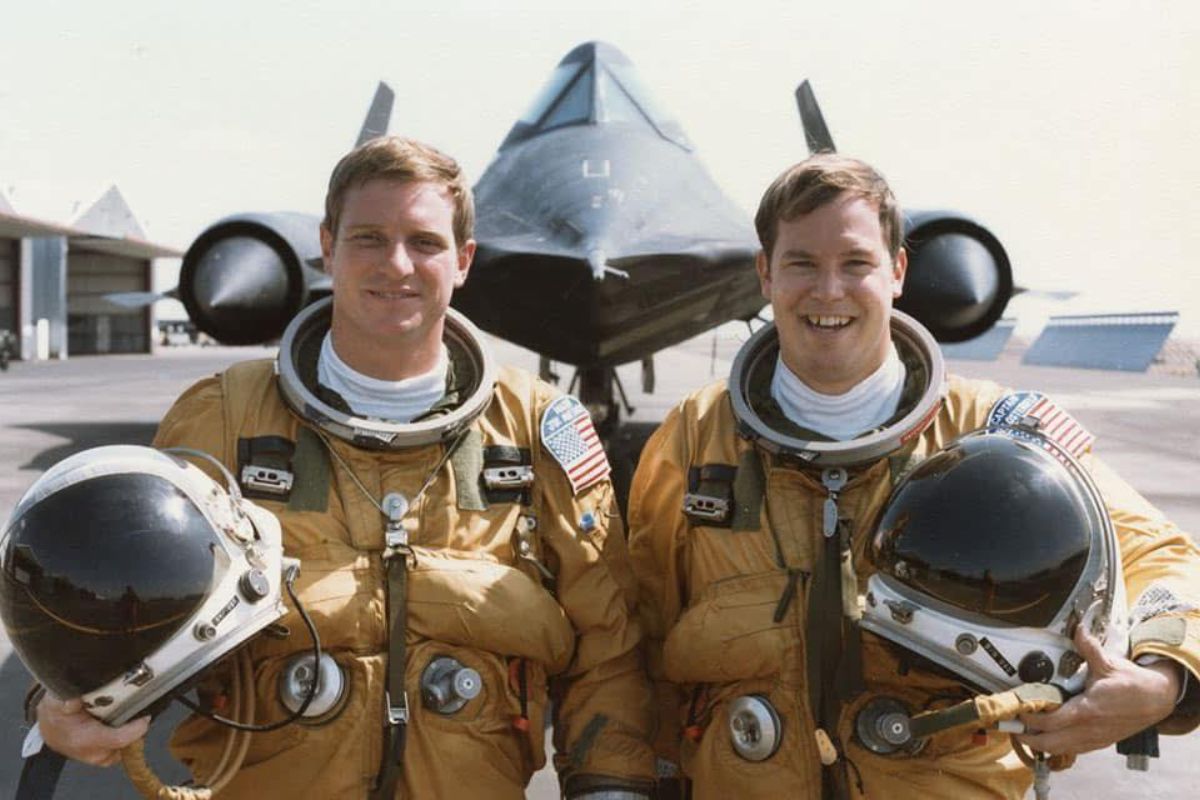

The airplane number 61-7974 was flying at Mach 3 over the Kola Peninsula when the right engine suffered an “unstart,” a violent failure that made the aircraft yaw sideways as if it had hit a wall, and pilot Joseph Matthews turned off the second engine on purpose to stabilize the airplane, being without any thrust at 83 thousand feet altitude
At 83 thousand feet altitude, the sky is not blue. It is dark purple. The brightest stars appear even during the day. The curvature of the Earth is visible. And the air is so thin that no conventional airplane can fly there. The SR-71 Blackbird was not a conventional airplane.
In the summer of 1984, the Blackbird number 61-7974 took off from Mildenhall base in England, with a specific mission: to fly over the Kola Peninsula, in the far north of the Soviet Union, and photograph the Typhoon-class nuclear submarines stationed in Murmansk. The Atlantic Command wanted to know how many were at the base and how many were at sea.
The pilot was Joseph E. Matthews. Behind him, in a separate cockpit, reconnaissance officer Curt Osterheld operated the ASARS-1 imaging radar. The two were flying at Mach 3.2, over 3,500 km/h, at an altitude where the external temperature of the fuselage exceeded 270°C.
-
Brazilian Construction Worker Moves to France, Earns Up to €2,500 Monthly with Home Renovations, Gains Social Media Attention

-
US Navy Sinks USS Oriskany with 230 kg of C-4, Creating World’s Largest Artificial Reef in 37 Minutes

-
U.S. Dumped Tanks, Jeeps, and Coca-Cola into the Pacific in 1945 After British and French Lowball Offer, Creating “Million Dollar Point”
-
WHO Warns of Unnecessary Interventions in Natural Births Worldwide, Advocates for More Human-Centered Care, Reigniting Debate on Medicalization




What is an “unstart” and why did it almost kill the crew?

The SR-71 used Pratt & Whitney J58 engines that operated as turbojets at low speed and as ramjets above Mach 2. For this, a shock wave needed to be perfectly positioned within the engine’s air intake. If this wave shifted, the engine would lose all thrust instantly. The pilots called this an “unstart.”
Osterheld described the sensation: “The airplane yawed to the right so far and so fast that it felt like it was flying sideways.”
At 83 thousand feet, flying at Mach 3, the right engine suffered a violent unstart. The thrust from that side disappeared and was replaced by pure drag. The airplane began to spin. Matthews had seconds to decide.
Why did the pilot turn off the second engine on purpose?
With one engine pushing and the other braking, the airplane was in uncontrolled rotation. Matthews did what seemed crazy: he turned off the left engine too. Without thrust from either side, the drag became symmetrical and the aircraft stopped spinning.
But now the SR-71 was without any propulsion at 25 thousand meters altitude, over Soviet territory, falling towards the Barents Sea. The crew had two options: eject over the USSR and be captured, or try to restart the engines during the fall.
The Blackbird fell for minutes while Matthews tried to restart the turbines. With each thousand feet lost, the air became denser and the chances of reigniting the engines increased. But time was running out.
How did the crew manage to return?
Matthews managed to restart at least one engine before the altitude became critical. The Blackbird regained thrust, stabilized, and exited Soviet airspace back to the international corridor over Norway.
The airplane landed in Mildenhall. The crew was alive. And no one outside the intelligence community knew about the incident for decades.
In the following four days, Lockheed technicians disassembled the air intake control systems of the 974. The only conclusion was that the failure seemed to be related to heat, something difficult to reproduce on the ground. Each SR-71 was handmade and behaved differently from the others. The 974, which previously had a reputation for flying well, was never the same after this mission.
What does this incident reveal about the SR-71?
The Blackbird was the fastest airplane ever operated by any air force. It flew so high and so fast that no missile of the time could reach it. But the greatest danger never came from the Soviets. It came from within the airplane itself.
The tires were reinforced with aluminum, inflated to 425 psi with nitrogen, and lasted only 15 landings. The JP-7 fuel was so stable that it could not be ignited with a normal spark; it required a separate chemical injection. The fuselage expanded up to 15 centimeters in flight due to heat. And the engines could enter unstart at any moment, without warning.
Osterheld recounted that the crew heated their food, which came in a tube like toothpaste, by resting the tube against the cockpit window for two minutes, where the external temperature exceeded 270°C. “But you couldn’t take your eyes off the instruments for too long,” he said. “The airplane knew when you weren’t paying attention, and that was when the warning light would come on.”
No SR-71 was shot down in combat. Of the 32 built, 12 were lost in accidents. The 974 did not make that list, but it came close enough for the crew to taste the Barents Sea rising towards them.
With information from 19FortyFive, Aviation History, and HistoryNet.