





 Portuguese
  English
  Spanish
  4 min of reading
  0 comments



Brazil Still Allocates Billions in Subsidies to Oil, Despite Promises for Energy Transition. Even with a 42% Decrease in Fossil Fuel Incentives, the Country Invests More in the Sector Than in Renewable Sources
The expansion of oil and gas production in Brazil cannot be explained solely by the large pre-salt fields or technological advancements. There is also an essential economic component: tax incentives and special regimes that reduce costs and spur investments in the sector.
An article from Nexo highlights that “one of the pillars that supports the expansion of oil production in Brazil is the significant amount of subsidies granted.”
These benefits include exemptions from corporate income tax and social contribution tax, as well as regimes like Repetro, which suspends taxes on the importation of equipment for exploration and production.
-
Petrobras evaluates suspension of sales to distributors and considers canceling the cooking gas auction following guidelines from the Federal Government.
-
Lula reveals a masterstroke by Petrobras to undo a deal made by Bolsonaro, which involves the return of an important refinery that currently produces less than half of what was expected and makes Brazil dependent on international diesel.
-
A study confirms that the natural gas sector will reduce greenhouse gas emissions in Brazil by 0.5% and accelerate the energy transition by 2026.

-
Petrobras implements a severe adjustment and confirms a 55% increase in the price of aviation kerosene with a proposal for installment payments for the companies.


The logic is clear: by reducing the tax burden, the government encourages exploration and maintains the competitiveness of projects in high-cost areas, such as ultra-deep waters. However, this model brings a contradiction: while it supports the growth of the fossil fuel sector, it hampers the progress of the energy transition.
An Unequal Landscape
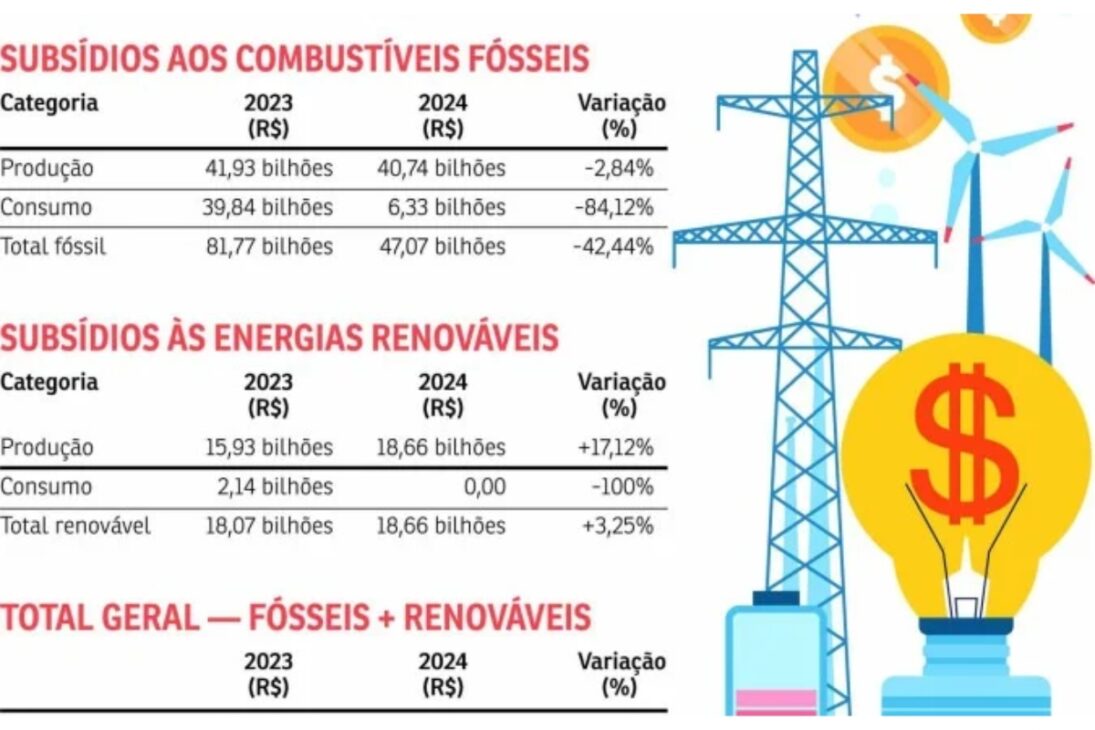
According to the Institute for Socioeconomic Studies (Inesc), in 2023, subsidies for fossil fuels reached R$ 81.7 billion, compared to only R$ 18 billion allocated to renewable sources.
Still, there are signs of change. In 2024, fossil fuel subsidies fell by 42%, totaling R$ 47 billion, according to Correio Braziliense.
Despite this reduction, the imbalance persists: for every R$ 2.52 allocated to oil and gas, only R$ 1 goes to clean energy. This shows that the country still heavily relies on incentives that favor fossil fuels, even amid promises of carbon neutrality.
Economic and Strategic Impacts
For companies in the sector, subsidies offer clear advantages: they increase profit margins, reduce risks, and ensure the viability of complex fields, especially in the pre-salt.
From the government’s perspective, defending this model often comes with the argument of energy sovereignty: a strong oil industry boosts the trade balance, generates jobs, and reduces external dependency.
However, there is a little-discussed side effect. When the economic structure heavily depends on tax incentives, the country becomes vulnerable to political decisions and market fluctuations.
Additionally, the budgetary burden of subsidies can limit investments in research, innovation, and renewable sources — crucial areas for Brazil’s energy future.
From a national defense perspective, oil is viewed as a strategic asset, capable of ensuring technological autonomy, logistical infrastructure, and geopolitical presence.
But in the long term, if the world rapidly shifts to clean sources, maintaining an excessive focus on fossil fuels could leave the country trapped in a declining model.
The Challenges of Transition
The main contradiction of the current model lies in the difficulty of reconciling fossil incentives with the climate goals assumed by Brasília.
The Inesc study warns that, without a thorough review, emissions from the energy sector could grow more than 20% by 2050, compared to 2022 levels.
At the same time, the global decrease in the cost of renewable energy increases pressure on oil and gas.
As the world accelerates the use of biofuels, green hydrogen, and carbon capture, Brazilian incentive models remain focused on maintaining the traditional structure.
In addition to internal criticisms, there is international pressure. Multilateral organizations and investors demand more transparency and fewer subsidies for polluting activities.
Maintaining large-scale benefits for the fossil sector could pose a reputational and economic risk, reducing Brazil’s access to green financing and technological partnerships.
Possible Paths
The challenge is to design a gradual transition model without causing economic shocks or losing competitiveness.
Three paths seem fundamental:
1. Reform Tax Incentive Regimes
Programs like Repetro and the Fuel Consumption Account need to be periodically reviewed, ensuring that subsidies have a defined timeline and align with national energy policy.
The new tax reform, approved in 2024, already provides for all special regimes to be re-evaluated every five years.
2. Direct Incentives Toward Clean Technologies
The country can use part of these resources to finance green hydrogen projects, advanced biofuels, and carbon capture.
Thus, subsidies cease to be merely a cost and become an investment in long-term energy innovation and security.
3. Involve the Oil Sector in the Transition
Companies in the industry possess technical capital and robust infrastructure, and can lead the development of low-carbon solutions.
The future of the industry may rely less on exploring new fields and more on adapting platforms, refineries, and logistical networks to meet new energy demands.
The Brazilian dilemma is clear: how can a country rich in oil move towards a sustainable model without relinquishing its primary source of revenue?
Subsidies have helped Brazil become an oil powerhouse, but they have also created a structural dependency that threatens fiscal and environmental balance.
The good news is that there are signs of change. The 42% reduction in fossil fuel incentives in 2024 shows that the government has begun to adjust its course.
The challenge now is to ensure that this transition is not only fiscal but also strategic — capable of repositioning Brazil as an energy leader in a transforming world.
And you, what do you think about oil subsidies in Brazil?
Do you believe that maintaining these incentives is still necessary or that it is time to fully invest in clean energy?
Leave your opinion in the comments and join the debate.










-

-

2 pessoas reagiram a isso.