





 Portuguese
  English
  Spanish
  6 min of reading
  0 comments


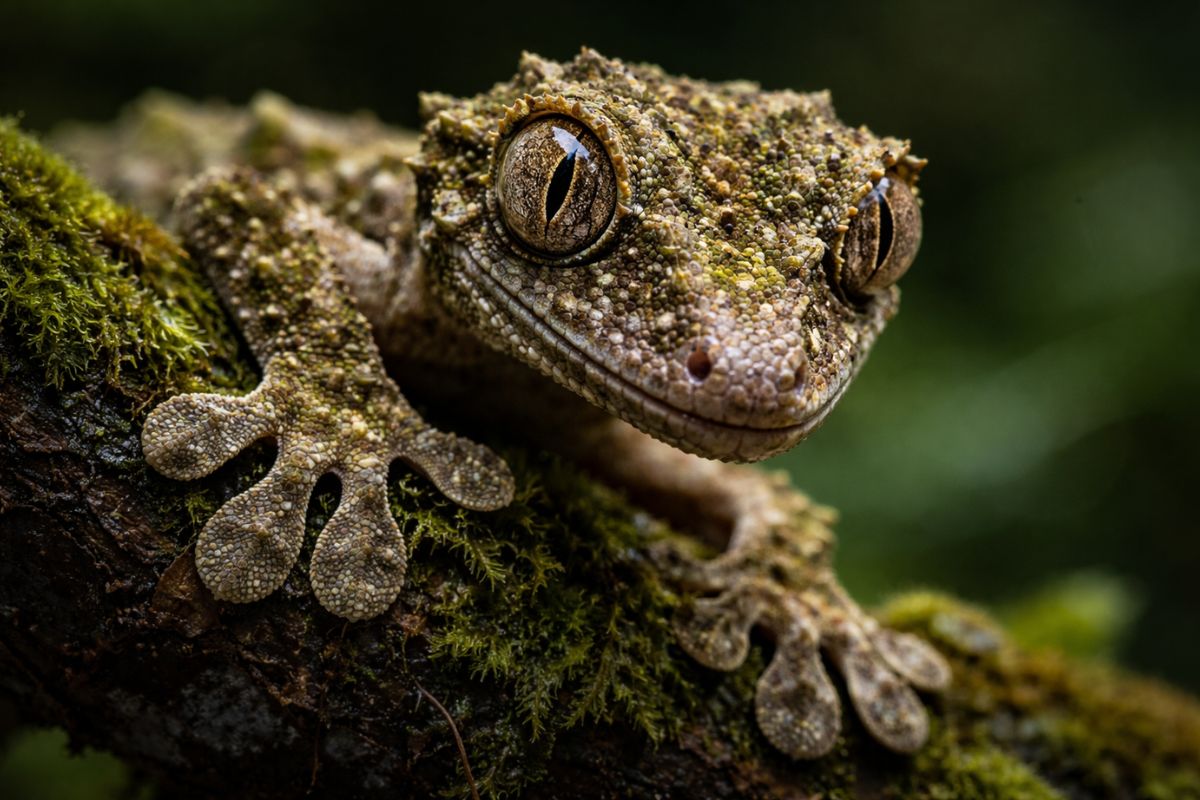
Thought to Be Extinct Based on 5,000-Year-Old Fossils, The Tiny Gecko Phyllodactylus Maresi Was Found Again on Rábida Island in the Galapagos After a Project Started in 2011 to Eliminate Invasive Rodents. Tail and DNA Samples Confirmed the Species and Distinct Lineage in 2021, Reinforcing the Recovery of the Ecosystem.
The tiny gecko that had seemed to exist only as a fossil memory for decades reappeared where no one expected: alive, discreet, and hidden in the vegetation and crevices of an island in the archipelago. On Rábida Island in the Galapagos, off the coast of Ecuador, the rediscovery disrupted an old consensus and ignited a simple yet uncomfortable question: how could something deemed extinct manage to stay out of human sight for so long?
The return of the tiny gecko was not an isolated stroke of luck. It followed a concrete change in the environment: in 2011, an effort began to eliminate exotic and invasive rodents introduced to the island. As control progressed, native life began to reorganize, and a year later, biologists spotted a little-known gecko, photographed it, and even collected a specimen, which ended up lost before it could be studied properly.
When a Species Becomes “Fossil” in People’s Heads

For a long time, what was known about the leaf-toed gecko known as Phyllodactylus maresi came from fossil remains dated around 5,000 years.
-
Harvard scientists have created a tissue exoskeleton that does not look like an exoskeleton, with no rigid parts and reduced weight, using flexible cables and miniaturized motors to assist the ankle and hip, reducing the effort of walking by up to 23% in controlled tests.

-
The Caspian Sea intrigues scientists as it is neither officially a sea nor a lake: the largest lake on the planet holds a hybrid crust, submerged cities, mud volcanoes, and billions of barrels of oil hidden at the bottom.

-
Why did the sky turn blood red in the west of Australia and it wasn’t sunset? Discover what is behind the change that took over the horizon for miles.

-
The most feared warplane of the United States is over 70 years old, carries 32 tons of explosives, flies 14,000 kilometers nonstop, and has just been sent to the United Kingdom amid escalating tensions with Iran.


The animal is less than 10 centimeters long and has nocturnal habits, a perfect profile for disappearing quietly, especially in an insular environment with hard-to-access nooks and limited human activity.
The idea of extinction was strengthened because the absence seemed absolute. Researchers believed that the gecko had disappeared from Rábida even before humans arrived on the island in the 16th century.
When a species disappears before the modern human gaze is fixed on it, the “disappearance” becomes a closed narrative, and science begins to operate with absence as if it were an undisputed fact.
What Invasive Rodents Do to Islands and Why It Matters Here

Islands function as natural laboratories: native species tend to have specific adaptations, smaller populations, and a fragile balance among predators, prey, and resources.
In such scenarios, the introduction of invasive rodents often represents a significant disruption because they can prey on eggs and hatchlings, compete for food, disturb seeds, and alter microhabitats at a pace that local fauna cannot keep up with.
It was in this context that, in 2011, the project to exterminate exotic rodents on Rábida was initiated. This is not a bureaucratic detail.
The removal of an invading pressure can open up space for nature to “breathe” again, and, on islands, this breathing sometimes appears quickly: plants resprout, birds return to nest more successfully, and discreet species get a chance to persist without being crushed by a recent enemy.
The First Sign, the Lost Specimen, and the Decision to Return

Photo: Courtesy of Island Conservation
With the success of rodent control, in 2012, the first modern sign of what seemed impossible emerged: a small gecko was spotted by biologists. They recorded it, collected it, and attempted to bring the material for study, but the specimen was lost.
This type of episode is often frustrating, but it’s also revealing: if a rare animal appears once, it can appear again, as long as there is method and persistence.
Seven years later, scientists returned to Rábida with a clear mission: to find the mysterious gecko again and document it rigorously. And they succeeded.
New individuals were located, and the work shifted from being a “report” to well-constructed evidence. Samples from the tails of nine specimens were collected, a procedure that allows for genetic analysis without having to sacrifice the animal, something especially important when dealing with a rare species.
DNA, Anatomy, and the Confirmation That Closes the Doubt
The confirmation did not come from a single test, and this is part of what gives strength to the finding. DNA tests and comparisons of anatomical characteristics were used to ensure that it was not a similar species or a variation already known from other islands.
In 2021, on a new trip, ten more individuals were collected, reinforcing the sampling and reducing the chance of error.
This series of steps matters because rediscoveries can be deceptive when relying solely on appearance. Geckos may have similar body patterns among islands, and what seems “the same” at night may not be the same at the genomic level.
By combining genetics and morphology, the conclusion became solid: the reappeared species corresponded to the leaf-toed geckos that had been treated as absent from the local nature.
The Unique Genetic Lineage and What It Says About Isolation
The most intriguing result came from the laboratory: the leaf-toed geckos of Rábida belong to a different lineage than those observed on the other islands of the archipelago.
This genetic difference suggests prolonged isolation, a unique evolutionary history, and a species that, even while living in a group of nearby islands, has followed a particular path.
This changes the ecological reading. A unique genetic lineage is not just “a curiosity”: it represents diversity that can disappear without a replacement.
When an insular population carries an exclusive branch of the evolutionary tree, losing it means erasing an entire history of adaptation, selection, and survival under specific conditions.
The “Cure” of the Ecosystem and What the Rediscovery Really Proves
For Paula Castaño, manager of the Impact Program at Island Conservation, the return of the gecko highlights the power of nature to recover when given the opportunity, citing the rapid recovery observed on islands after ecological rebalancing.
The central message is that by reducing an invasive pressure, the system can respond in a visible and even surprising manner.
But the rediscovery also proves another thing: the invisible is not the nonexistent. A small, nocturnal, and discreet species can persist in pockets, in micro-refuges, in places where human searches haven’t reached for years.
The difference is that when the environment stops “pushing” against it, these pockets cease to be mere survival and return to being a population.
Science as a Condition for Surprise and the Weight of Funding
The curator of reptiles at the Catholic University of Ecuador’s Zoology Museum, Omar Torres-Carvajal, emphasizes a sensitive point: the value of specimen collection and genomic sampling for both scientific discovery and conservation.
He points out a bottleneck that often goes unreported but determines the future: adequate funding continues to be a significant challenge.
This statement fits perfectly into the story of a gecko that almost got lost again in 2012 when the collected specimen disappeared.
Without investment, science relies too much on chance. With investment, it turns rare encounters into accumulated knowledge, creates protocols, monitors populations, guides conservation policies, and increases the chance that the next “surprise” is not just a scare, but a real opportunity for protection.
The return of the tiny gecko in Rábida reorganizes certainties and shows how fragile but also reversible environmental balance can be.
A rodent control project initiated in 2011 opened up space for a nocturnal reptile, less than 10 centimeters long and known only from 5,000-year-old fossils, to reappear alive, confirmed by DNA, and even revealing a unique genetic lineage. The story is not just about a rediscovered animal; it’s about what happens when nature gets a chance to recompose itself and when science insists on searching.







-

-

-

-

-

-

15 pessoas reagiram a isso.