





 Portuguese
  English
  Spanish
  3 min of reading
  0 comments


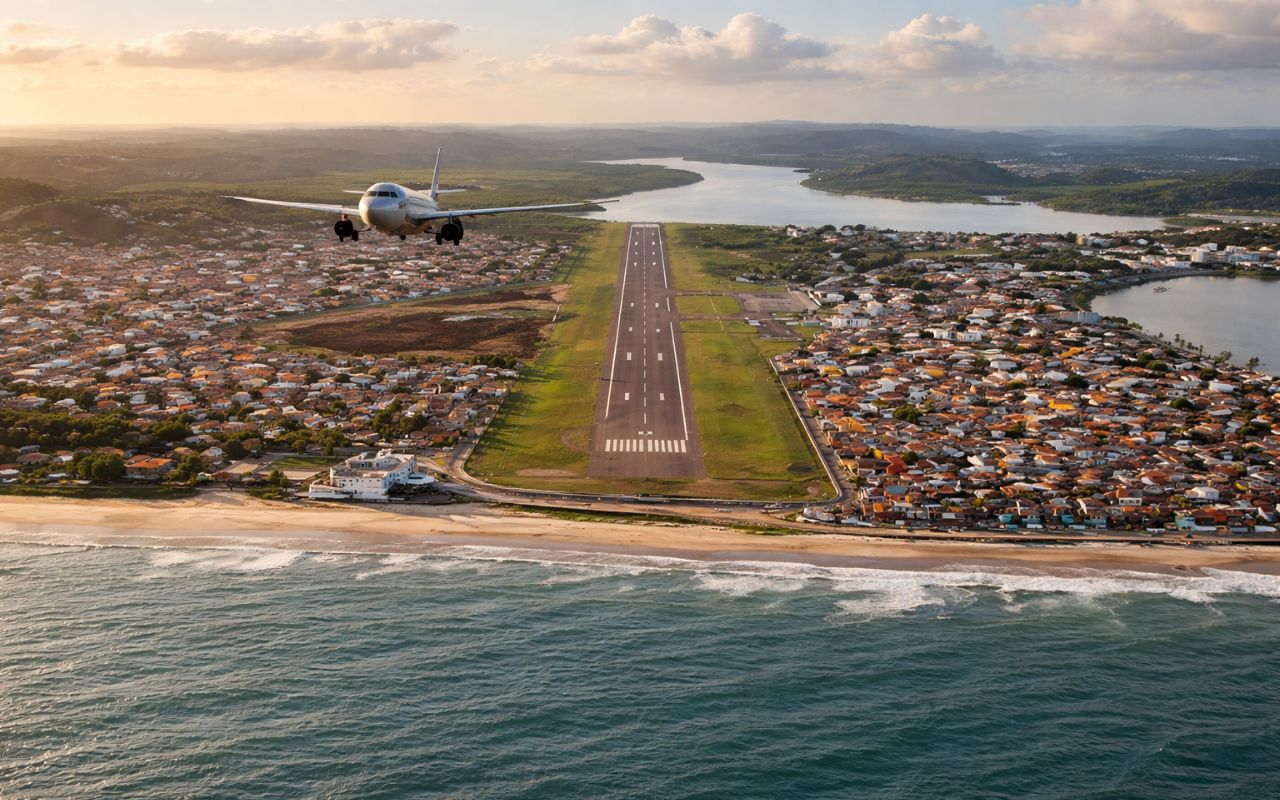
The Ilhéus Airport will have a system to prevent planes from falling into the water. Understand how the technology works and the impact of the investment of R$ 70 million.
The Jorge Amado Airport in Ilhéus (BA) will be equipped with a system to prevent planes from falling into the water, in a project financed by the Federal Government with an investment of R$ 70 million.
The initiative is part of the New PAC and aims to enhance the operational safety of the terminal, which faces limitations for physical expansion of the runway.
The chosen technology is EMAS (Engineered Material Arresting System), used internationally to contain aircraft in emergency situations.
-
With a cost per shot close to zero, the DragonFire laser could change naval warfare in 2027 and provide British ships with nearly unlimited defense against drones.

-
A British startup creates tires that generate electricity in electric vehicles when passing over potholes, speed bumps, and cracks.

-
Scientists have created robots made with living cells that have their own nervous system, swim on their own, explore the environment, and self-organize without any genetic engineering, and now they want to do the same with human cells.

-
Students create a solar-powered ambulance that operates without a plug, without fuel, and still keeps medical equipment running in remote areas.


The goal is to prevent accidents and ensure safer operations in a region strategic for tourism and the economy of southern Bahia.
Additionally, the project arises amid the continuous growth of demand for flights in the region.
System to prevent planes from falling into the water accompanies airport growth
The increase in passenger flow has been one of the main factors for the modernization of the terminal. In 2024, the airport recorded over 669,000 passengers.
The expectation is that this number will exceed 1 million by 2031. Thus, the need to reinforce safety becomes even more evident.
Therefore, the system to prevent planes from falling into the water will be essential to ensure efficient and safe operations.
Investment strengthens safety and regional aviation
The investment of R$ 70 million is part of a national strategy to strengthen regional aviation. The initiative seeks to bring more technology and safety to Brazilian airports.
According to the then Minister of Ports and Airports, Silvio Costa Filho:
“We are working to bring more safety and technology to our airports. The EMAS system in Ilhéus is a modern solution that allows the terminal to operate smoothly, even in areas with physical restrictions. This investment from the New PAC is an example of President Lula’s commitment to strengthening regional aviation and ensuring that development reaches all parts of Brazil efficiently and responsibly.”

Thus, the project also reinforces the commitment to passenger protection.
Structural limitations require new system
The Ilhéus Airport has characteristics that hinder traditional runway expansion.
The terminal is surrounded by urban areas and natural obstacles.
This condition prevents the physical expansion of the structure. As a result, conventional solutions become unfeasible.
Thus, the system to prevent planes from falling into the water emerges as an efficient alternative to maintain operational safety.
How does the system to prevent planes from falling into the water work?
The EMAS acts as an escape area installed at the end of the runway. It is composed of materials designed to absorb the impact of aircraft.
When exceeding the runway limit, the plane enters this area and has its speed gradually reduced. This prevents more serious accidents.
For this reason, the system is widely adopted in international airports with similar restrictions.
The modernization of the airport also brings positive impacts for the regional economy. The terminal is essential for tourism and for productive sectors such as the cocoa chain.
Additionally, the increase in safety may attract more flights and airlines. This strengthens the hotel sector and local commerce.
Thus, the system to prevent planes from falling into the water directly contributes to the economic development of the region.
Project integrates a larger airport modernization plan
The initiative is part of a national plan aimed at airports capable of receiving 4C category aircraft. This standard requires a higher level of safety and efficiency.
The investment will be made without additional costs to the concessionaire. This is because the improvement was not foreseen in the original contract.
Furthermore, the project reinforces the importance of cooperation between the federal government and the municipality for controlling the airport’s surroundings.
See how the airport is currently


Source: AEROIN








Seja o primeiro a reagir!