





 Portuguese
  English
  Spanish
  5 min of reading
  0 comments


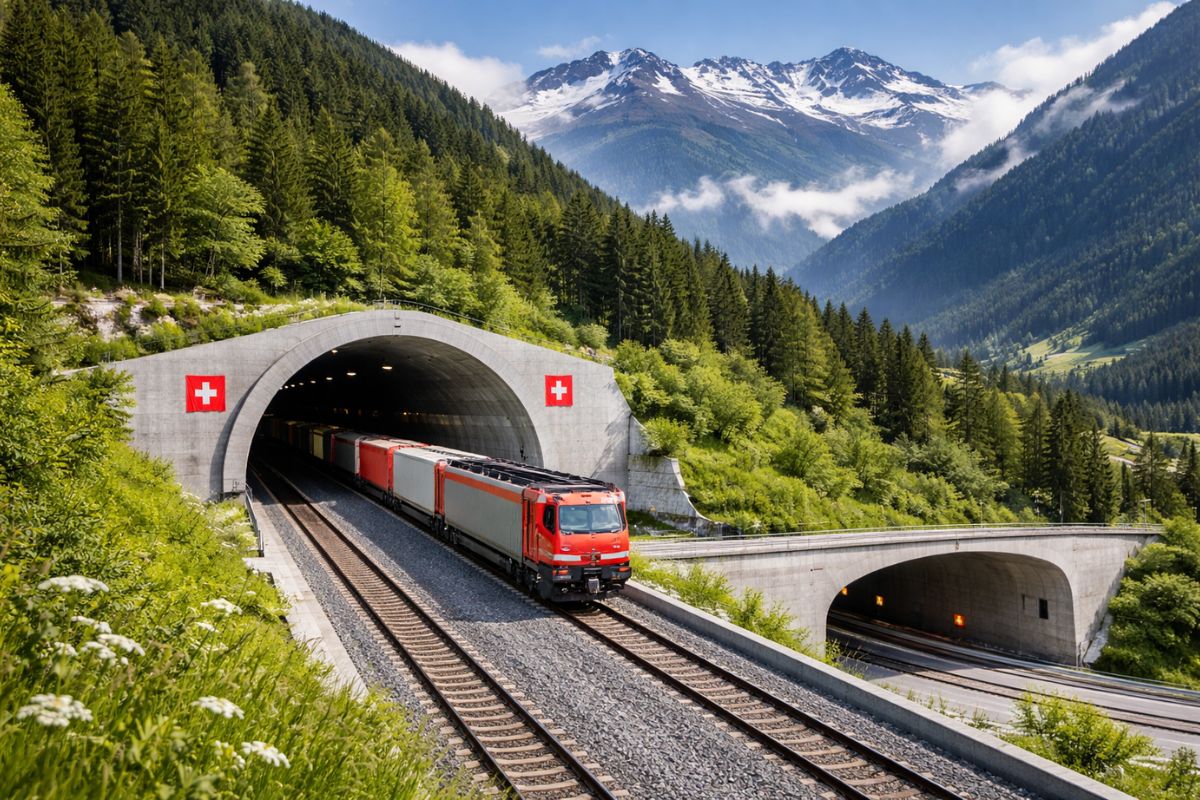
Switzerland has built more than 1,400 tunnels under the Alps with a total length exceeding 2,000 kilometers, including the Gotthard Base Tunnel at 57 km, transferring 74% of freight to trains and avoiding at least 700,000 tons of CO2 while passengers hardly notice they are part of a climate project.
If you travel by train in Switzerland, there will come a moment when daylight disappears, your ears pop, and your reflection floats in the window. For most passengers, it’s just the quiet part of the journey, but outside that glass you are inside one of the largest environmental projects ever built: more than 1,400 tunnels excavated under the Alps that form an underground network of over 2,000 kilometers of railway, road, and infrastructure galleries. In terms of length, these tunnels rival the largest urban transportation systems in the world.
The most impressive work of this tunnel network is the New Alpine Railway Link (NRLA), a megaproject that combines three underground passages into a flat railway corridor beneath the mountains. The Gotthard Base Tunnel, the most famous among Swiss tunnels, stretches for 57 kilometers and is the longest railway tunnel on the planet, crossed by a passenger train in approximately 20 minutes. The Swiss government describes the NRLA as a way to “transfer traffic from roadways to railways in order to protect the Alps.”
Why Switzerland decided to build more than 1,400 tunnels under the mountains

Before the tunnels, heavy trucks crossed the Alpine valleys in ever-increasing numbers, according to ECONEWS. This meant diesel smoke in narrow villages, air pollution trapped between steep slopes in summer, and an increasing risk of accidents on winding roads.
-
Recycled material costs less than half of concrete, pollutes much less, and gives the garage entrance a flawless appearance, but almost no one knows about this ecological alternative that has existed for years.

-
The company transforms discarded clothing into eco-friendly bricks that are resistant to fire and moisture; FabBRICK has already reused more than 12 tons of fabric.

-
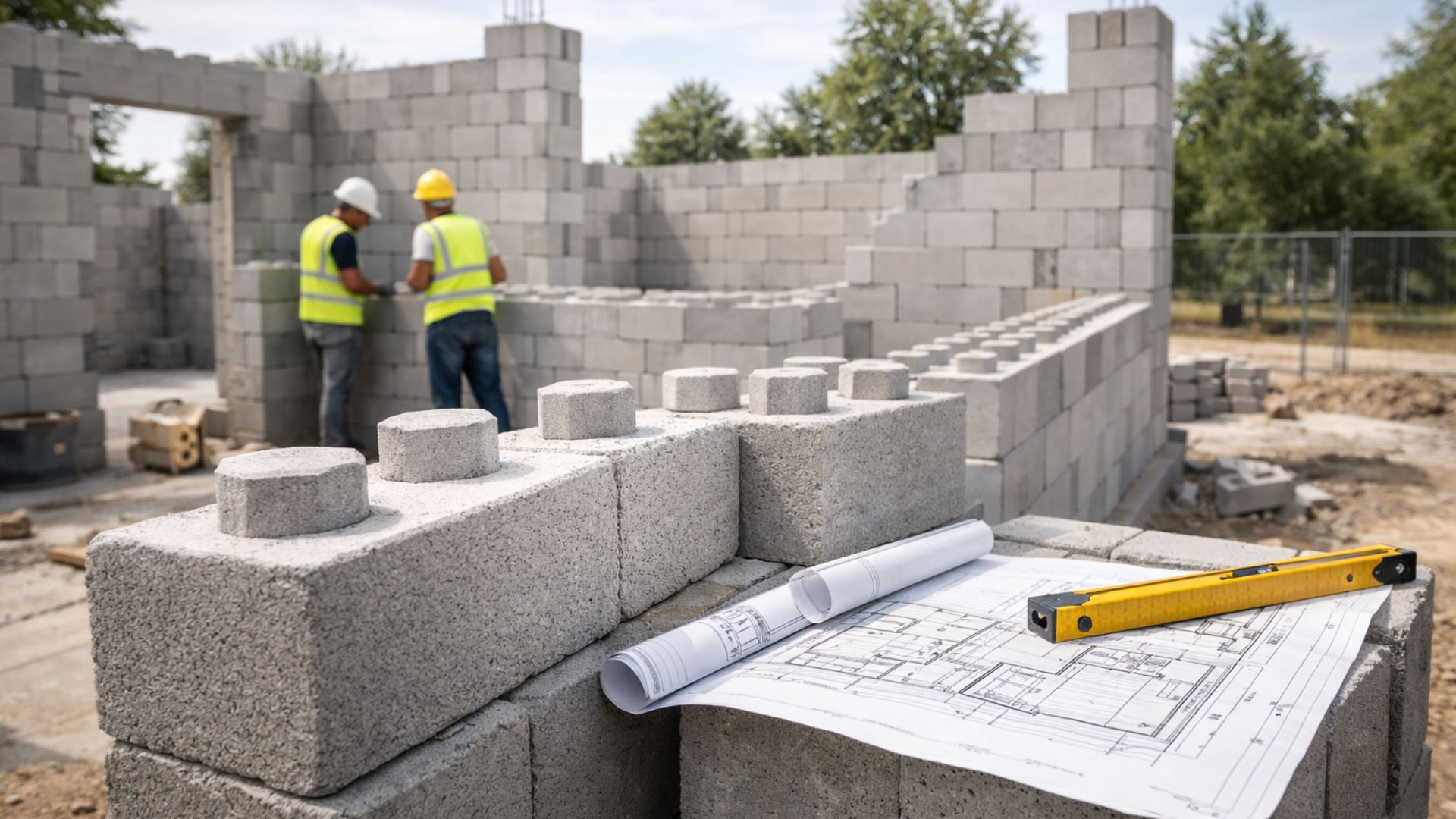
How to build an entire house in just a few days using LEGO concrete blocks and reduce construction time by up to 60%, without mortar, with precise fitting, lower labor costs, and high thermal and acoustic insulation.
-
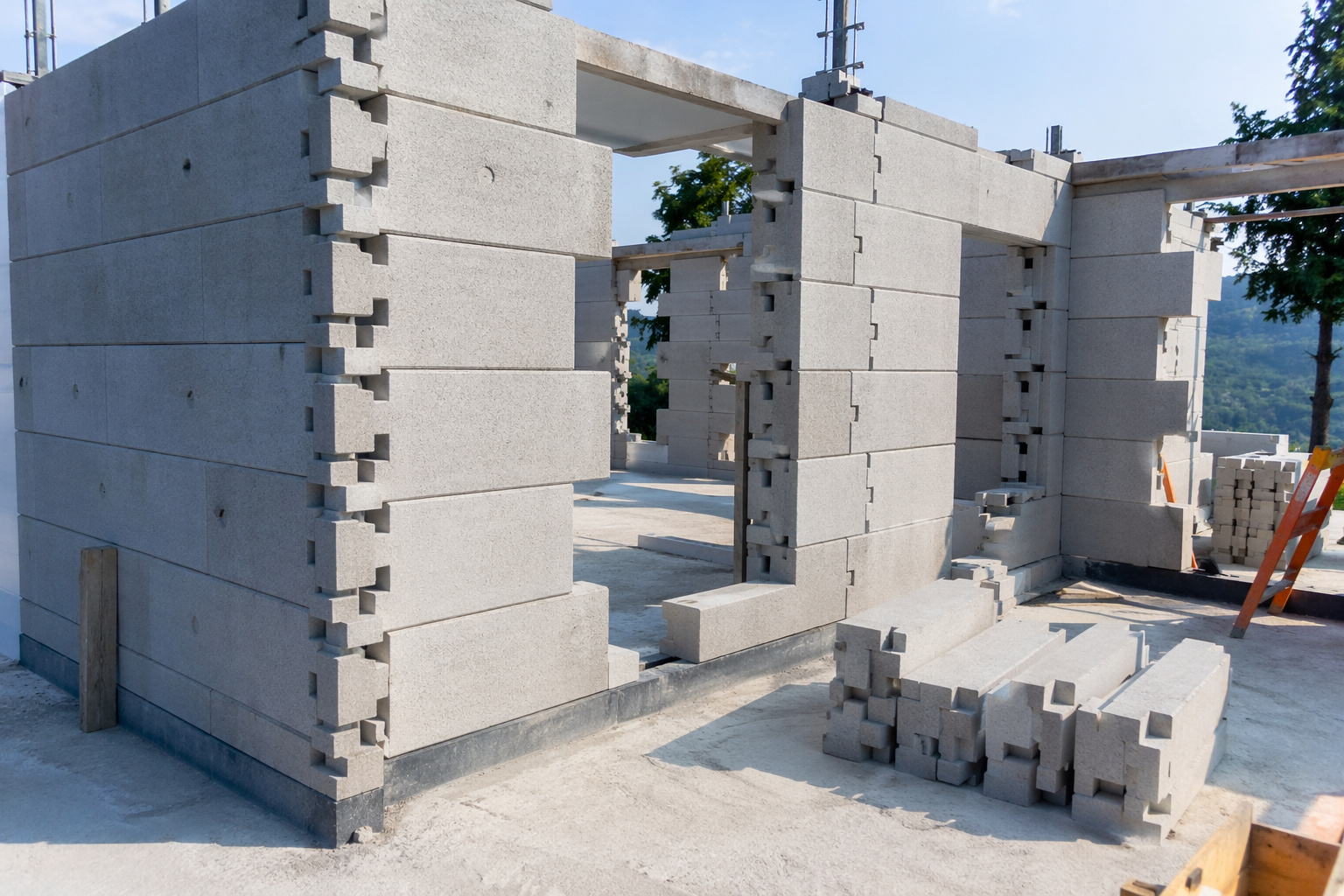
Cement-free interlocking system revolutionizes the construction industry by allowing entire houses to be built with interlocking blocks, reducing costs, speeding up projects, and transforming the standards of efficiency and sustainability in the sector.
The Alpine Initiative, approved by Swiss voters in the 1990s, set a national goal to transfer long-distance freight transport from roadways to railways.
The tunnels are the infrastructure that made this promise a reality. A flat route under the mountains allows for longer and heavier freight trains with much lower energy consumption, as locomotives no longer need to overcome steep gradients.
Studies on freight transport in the eurozone show that trains typically require about one-fifth of the energy and emit approximately one-quarter of greenhouse gases per ton-kilometer compared to heavy trucks.
The numbers that show the impact of Swiss tunnels on CO2 emissions

The results are measurable. Currently, more than 72% of the freight transport crossing the Swiss Alps is done by rail, a percentage that rises to about 74% in the most recent data.
In 2018, approximately 941,000 trucks crossed the Swiss Alps, about one-third less than in the year 2000. Without the modal transfer policy supported by the tunnels, analysts estimate that 651,000 additional trucks would have crossed the mountains in 2016.
The direct environmental impact is significant: at least 700,000 tons of CO2 were avoided in 2017 compared to a scenario without the tunnels and transfer policies. For people living in the Alpine valleys, each freight train that replaces a convoy of trucks means quieter nights, less exhaust smoke, and fewer risks on the roads.
The tunnels have not solved the problem completely, as in 2022 there were still about 880,000 truck trips across the Alps, but they have significantly flattened the curve.
How the Gotthard Tunnel became the largest among the railway tunnels in the world
The construction of the Gotthard Base Tunnel involved the excavation of approximately 28 million tons of rock over years of work. At 57 kilometers long, the Gotthard is the longest of all railway tunnels on the planet and is part of the NRLA corridor along with the Lötschberg and Ceneri base tunnels.
Together, the three create a flat passage under the Alps that eliminates the climbs and descents that made rail freight transport inefficient on mountain routes.
The scale of the work required environmental care that is documented in official reports. Construction materials were transported by train or ship whenever possible, machines were fitted with particle filters, sewage was treated and cooled before reaching rivers, and neighboring communities received sound barriers.
After the completion of the works, riverbanks were restored, streams redirected to natural beds, and dry stone walls rebuilt as shelters for reptiles and small animals. The tunnels were dug deep, but the surface was compensated.
What the Swiss tunnel network teaches other countries about climate and transport
The Swiss project did not come about overnight. Voters supported the Alpine Initiative and the NRLA decades ago, engineers spent years refining routes and safety systems, and a federal railway fund ensures long-term financing for improvements and new connections, regardless of political cycles.
The combination of tunnel infrastructure, fees for heavy vehicles, and ongoing investment in railways is what produces measurable results.
For countries facing congestion, pollution, and rising emissions from the logistics sector, the lesson from the Swiss tunnels is clear: underground infrastructure alone does not solve.
It needs to be part of a package that includes robust investment in railways, pricing that reflects the true environmental costs of road transport, and rules that encourage freight companies to adopt cleaner modes. The tunnels are the hardware. The policies are the software. Without both together, the equation does not add up.
The tunnels as protection against extreme weather events in the Alps
The Swiss tunnel network offers an additional benefit that gains relevance with global warming. Underground galleries and protected passages already serve as barriers against avalanches, rockfalls, and landslides that block surface roads and railways.
With the increase in heavy rain and extreme weather events in the Alps, underground routes keep main roads open when conventional roads become impassable.
The tunnel infrastructure transforms the resilience of the Swiss transport system into something that other countries are still trying to achieve. While mountain roads are closed by storms, trains continue to pass under the rock, on time, carrying goods and passengers as if nothing is happening on the surface.
It is this quiet reliability that gives people the confidence to leave the car at home and trust the railway system. Swiss tunnels are not just engineering. They are the physical foundation of a behavioral change that has already avoided hundreds of thousands of tons of carbon.
Did you know that Switzerland has more than 1,400 tunnels under the Alps and that 74% of freight already travels by train? What could your country learn from this model? Share in the comments. Climate solutions exist, but they require decades of investment and political will that few countries demonstrate.






Seja o primeiro a reagir!