





 Portuguese
  English
  Spanish
  3 min of reading
  2 comments


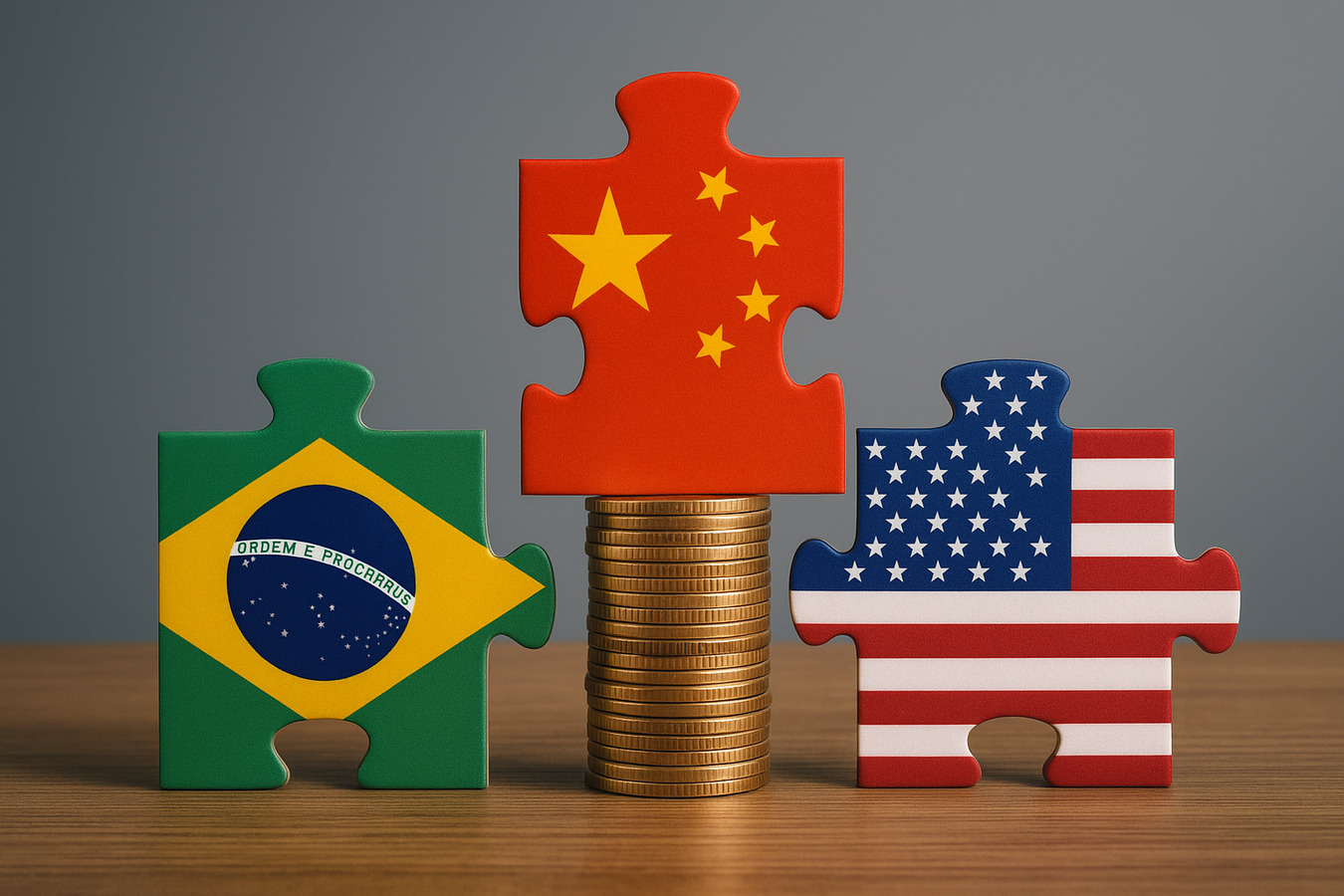


US Increases Tariffs on Brazilian Exports, Pressuring Economy and Domestic Consumption, While China Gains Ground and Strengthens Trade Dependency
The trade relationship between Brazil and the United States entered turbulence starting in April 2025. On the 2nd, the US imposed tariffs of 10% on Brazilian products. A little over two months later, on July 9, the percentage rose to 50%, a measure that took effect on August 6, 2025.
The change was significant. The high taxation impacted strategic sectors of the Brazilian economy, such as coffee, meat, textiles, footwear, fruits, and electronics.
Estimates from J.P. Morgan and research centers indicate that each increase of 10 percentage points in tariffs can reduce Brazil’s GDP by between 0.2% and 0.3%. With the tariff at the level of 50%, the forecast for contraction reaches 1.2% of economic activity.
-
China alone accounts for 70% of trade within the BRICS, while Brazil establishes itself as an essential supplier of food and minerals: understand how the group, which already represents nearly 40% of the world’s GDP, is changing the game.
-
Starting in May, those who do not have registered biometrics will not be able to apply for Bolsa Família, sickness benefits, or unemployment insurance: understand the new rule that changes access to benefits for millions of Brazilians.

-
A new law being voted on in Brazil proposes a minimum fare of R$ 10 per trip and R$ 2.50 per kilometer for Uber and 99 drivers, and promises to ensure they earn as well as taxi drivers did during the golden age of taxis in the country.

-
Bauer Group collapses after failed judicial recovery: 25 years, 800 vehicles, and a network of gas stations leave a debt of R$ 50 million and 100 layoffs, exposing costs, tight margins, and expensive credit in Brazil.

Brazilian Reaction
To mitigate the damage, the government announced, on August 13, the “Sovereignty-Brazil” package. The program allocates R$ 30 billion in credit lines through the Export Guarantee Fund, in addition to R$ 4.5 billion in support for small businesses.
There are also tax exemptions and strategic public purchases to absorb part of the affected production.
The goal is to provide relief to exporters, especially those who relied heavily on the US market.
The Brazilian government bets that credit and tax incentives can prevent a sharp decline in production and employment.
Impacts in the US
If the measure aims to protect the American internal industry, it also has domestic effects. Products like coffee, which already hold an important place in consumers’ routines, become more expensive. This pressures inflation and increases the cost of living.
Moreover, sectors such as food and coffee shop chains claim they cannot absorb a 50% increase without passing part of the cost onto customers. The expectation is for visible price adjustments.
The Chinese Opportunity
Amid this dispute, China emerges as a major beneficiary. In 2024, the country already led the purchase of Brazilian agricultural products, accounting for 73% of the exported soybeans, 49% of cellulose, 46% of beef, 33% of cotton, 29% of sugar, 19% of pork, and 11% of chicken.
With the tariffs imposed by the US, Brazilian exporters redirected shipments that were previously destined for the American market to the Chinese market. This applies to items like coffee and meat, which find a growing demand in China.
In the case of coffee, the US purchases about 8 million bags of Brazilian coffee per year. Now, a significant portion of that quantity is expected to go to the Chinese market, where consumption grows by about 20% annually.
For soybeans, the shift is even more pronounced. Chinese buyers have closed contracts with Brazil for about 8 million tons in September and 4 million in October.
This volume represents almost half of the expected demand and weakens the position of American producers in the traditional sales season.
Who Loses, Who Wins
Brazil feels the direct impact of the drop in exports to its second-largest trading partner. The US, in turn, faces rising costs, loss of competitiveness, and increased inflation pressure.
Meanwhile, China takes the opportunity to expand its share of Brazilian product imports, further consolidating its dependence on this supply.
In the end, the American tariff, intended to protect its economy, undermines both Brazil and the US itself, while strengthening China’s position in global trade.
The main sources consulted for the preparation of this article were:






Do jeito que está escrita, a manchete pode dar a entender que o Brasil está ativamente prejudicando os EUA, o que absolutamente não é o caso. O eventual prejuízo aos EUA se deve exclusivamente aos efeitos provocados pelas iniciativas adotadas pelo governo deles mesmos. Acho que todo mundo foi pego meio que “de surpresa” por essas tarifas surpreendentes, que muito mais punem os parceiros comerciais dos EUA do que corrigem eventuais distorções pré-existentes. É uma infeliz demonstração da incapacidade americana de dialogar serenamente com outros países, ao invés de impor à força suas enviesada visão imperialista nas relações mundiais. Espero que corrijam a tempo esse equívoco.
Que assim seja