





 Português
  Inglês
  Espanhol
  4 min de leitura
  0 comentários


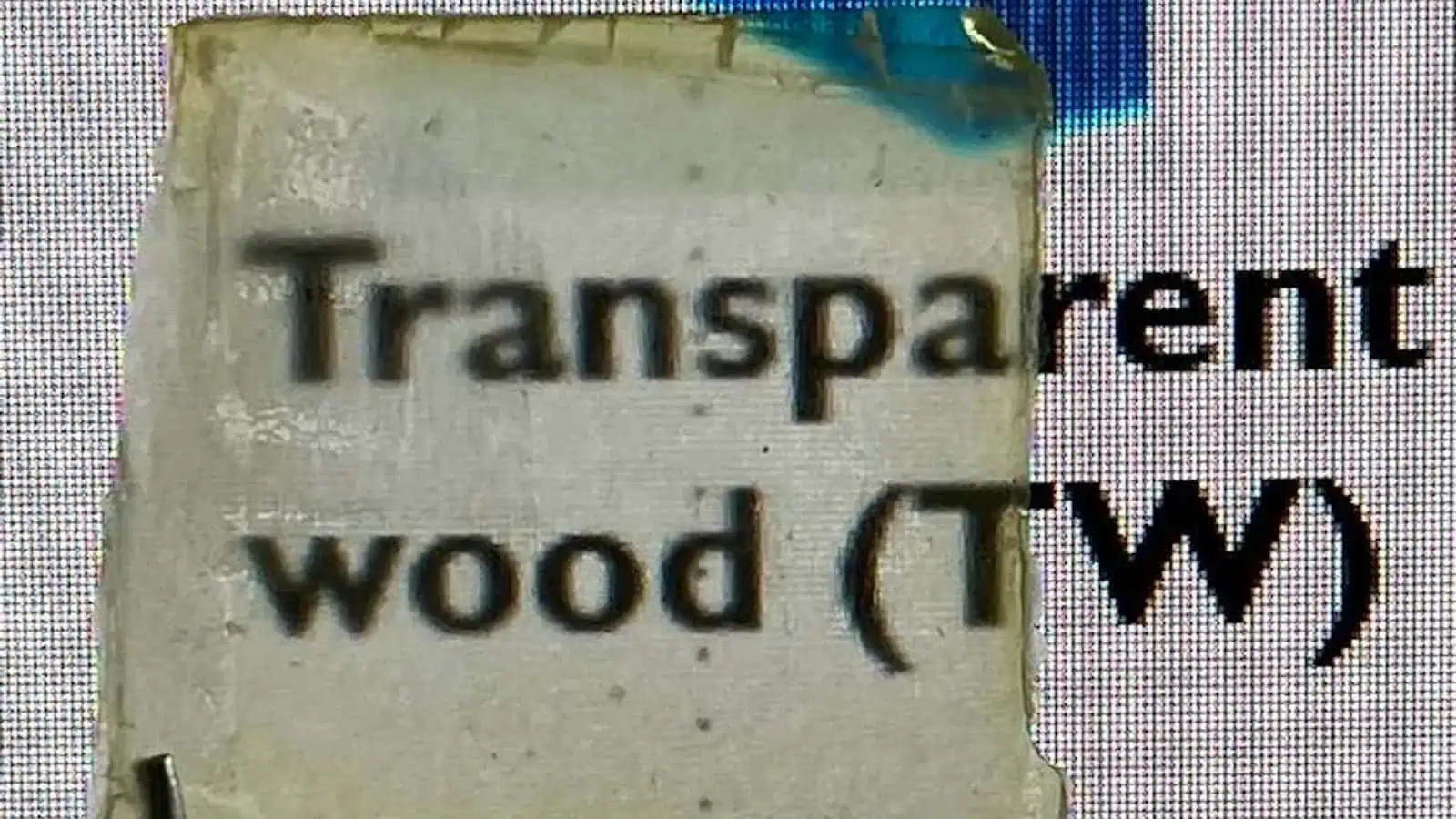
Wood, Rice, and Egg White Windows Are Scientists’ Bet for the Future. Sustainable Material Could Replace Glass with Environmental and Thermal Advantages
A seemingly impossible idea began to take shape in a laboratory in the United States. Bharat Baruah, a chemistry professor at Kennesaw State University in Georgia, decided to combine two passions — woodworking and science — to answer a curious question: what if the future of windows didn’t lie in glass or plastic, but in translucent wood?
Wood is naturally opaque. But with the help of his undergraduate student, Ridham Raval, Baruah was able to create a new material: translucent wood, reinforced not by modern or industrial methods, but inspired by an ancient construction technique from northeastern India. The result is a biodegradable, durable, and flexible composite that could have various uses in the future.
A New, Old Material: The Emergence of Transparent Wood
The idea of making wood transparent is not new. Scientists have been working on it for nearly a decade. The initial methods involved removing lignin, the component that gives wood its color, and filling the pores with epoxy resin, a substance derived from plastic. The resulting material was strong and transparent, but it did not decompose easily in nature.
-
A traffic police robot has started operating at a school, technology from Omoda & Jaecoo expands the use of artificial intelligence in smart cities.

-
44 minutes on the cosmic scale: mysterious object in the Milky Way emits simultaneous radio and X-ray signals and raises an intriguing question about what is really happening in deep space.

-
Omoda & Jaecoo and AiMOGA Robotics advance in industrial artificial intelligence with a strategic debut in Thailand and a focus on advanced automation.

-
In a scenario of rising fuel prices, Omoda & Jaecoo enhance value for consumers with a range of up to 1,200 km, energy efficiency, and a new concept of worry-free mobility.


That’s when Professor Baruah decided to take another path. He wanted to create something that was more sustainable, affordable, and could be naturally recycled.
His inspiration came from his childhood in Assam, India, where some 16th-century buildings still stand. These old houses used a type of cement made from sand, glutinous rice, and egg white. This detail stuck with him for years.
“They are still there after more than four or five centuries, and that has always fascinated me,” Baruah told NewScientist magazine.
From Laboratory to Workshop
To turn this memory into science, the team chose to work with balsa, a soft, lightweight wood that grows quickly. The process started with a vacuum chamber and the use of a combination of chemicals — sodium sulfite, sodium hydroxide, and diluted bleach.
The goal was to remove lignin and hemicellulose from the wood. What remained was a fragile cellulose structure, similar to paper.
After that, the wood was filled with a natural mixture: egg white and rice extract. The material was then dried in an oven at 60 degrees Celsius. The result was a light brown, translucent sheet that was surprisingly strong.
“It’s not 100% transparent, but it is translucent,” Baruah explained. “And it is biodegradable.”
Practical and Promising Tests of the New Translucent Wood
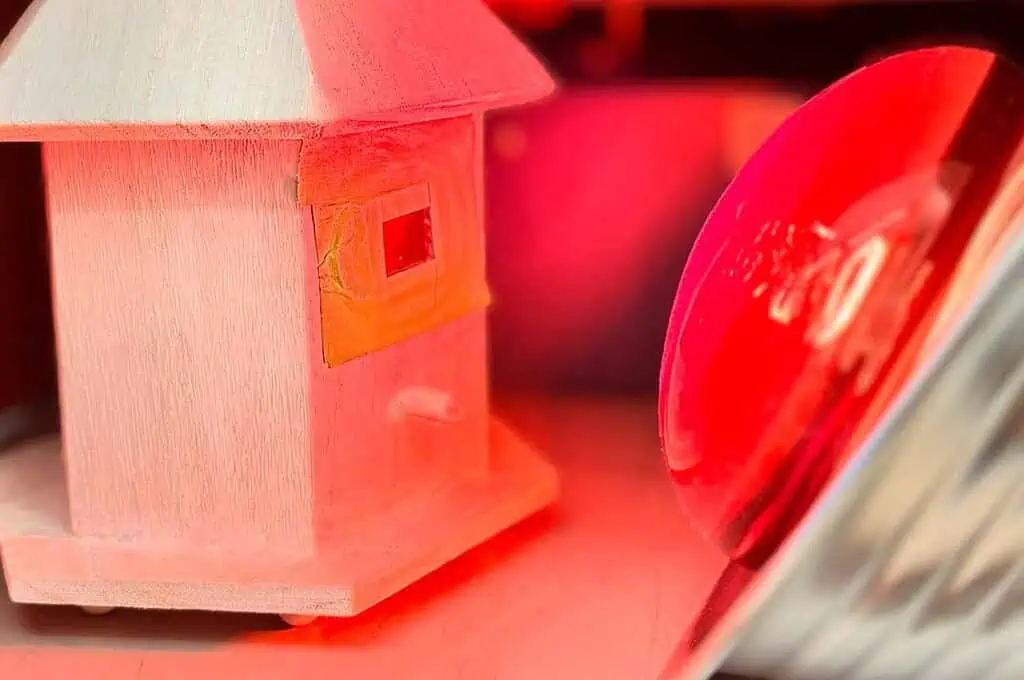
To test the new material, the team built two miniature birdhouses. One had a glass window. The other used the new wood panel. When both were placed under a heat lamp, the wooden house remained cooler inside.
This small experiment showed that translucent wood can offer better thermal insulation than traditional glass.
The cellulose structure helps scatter light while also reducing heat transmission. This could be useful in buildings, decreasing the need for air conditioning and saving energy without sacrificing natural light. But the possibilities don’t end there.
From Architecture to Technology
In another phase of the project, the team decided to incorporate silver nanowires into the wood. With this, the material began to conduct electricity. This new feature paves the way for using the material in electronic products, such as flexible screens, wearables, and even solar panels.
“In modern days, plastic is everywhere, including our devices that we carry around. And it’s a problem when we reach the end of a device’s lifespan. It is not biodegradable,” Baruah said in a press release. “So, I asked, what if we could create something natural and biodegradable instead?”
The silver nanowires, for now, are still not biodegradable. But the professor is already thinking of replacing them with more sustainable materials, like graphene. The idea is to have a functional product that can also decompose without impacting the environment.
Still in Development
Even with so many advances, the project still needs adjustments. The main limitation is transparency. The wood still does not achieve the full clarity of glass. And this is an important point for more demanding applications, such as residential windows or high-definition screens.
Another challenge is the large-scale production process. The team used small quantities of chemicals, but repeating this process in large volumes would require greater care regarding environmental impact.
Despite the challenges, the professor believes that the project already plays an important role. It shows that it is possible to innovate using simple techniques and accessible resources. “I want to send a message to my undergraduate students that you can do interesting research without spending thousands of dollars,” he stated.
The translucent wood is not yet ready for commercial use. But the idea of transforming a childhood memory into a new type of material shows how science can arise from simple questions — and the will to do things differently.
With information from ZME Science.






Seja o primeiro a reagir!