Portuguese
  Spanish


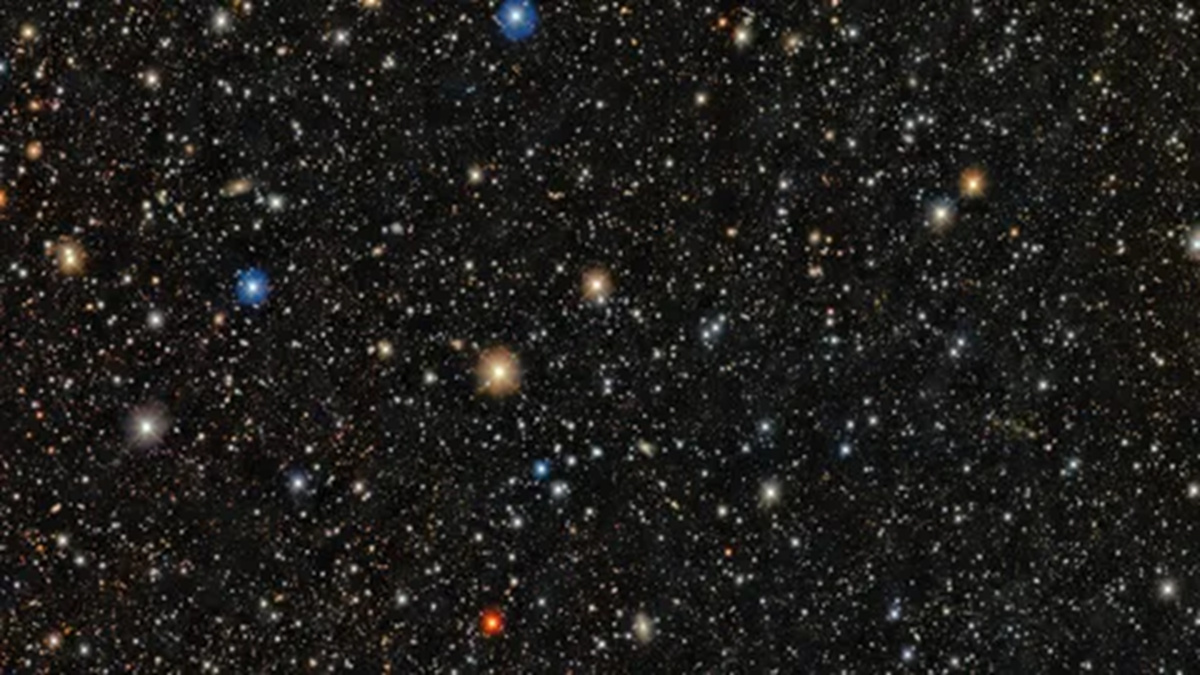

Discovery in a dwarf galaxy over 10 billion years old, the star PicII-503 has little iron, much carbon, and may help scientists understand how essential elements for life spread through the primitive universe.
An extremely ancient star identified within the dwarf galaxy Pictor II may help astronomers clarify a central question about the origin of the ingredients for life in the universe. Recorded in an image obtained by the Dark Energy Camera (DECam) at the Víctor M. Blanco Telescope in Chile, the star PicII-503 stands out for its unusual composition.
The photograph shows a bright star field within Pictor II, a dwarf galaxy over 10 billion years old. At the center of scientific interest is PicII-503, described as a Population II star, also known as a second-generation star.
Ancient star preserved in primordial galaxy
Population II stars formed when the cosmos was still young and heavier elements were still scarce. Therefore, they are composed mainly of hydrogen and helium, with very reduced amounts of metals compared to younger stars.
-
Canada Makes Historic Decision to Purchase New German Submarines in $70 Billion Defense Program, Replacing Aging Victoria-Class Fleet by 2033

-
4,000-Year-Old Stone Circle Discovered Near Belfast, Unveiling Prehistoric Ritual Complex in Irish Countryside

-
Brazilian Innovator Transforms 1962 Mercury Comet with Nissan Leaf Electric Motor, Achieving 125 km Range for Under $6,000
-
China Tests Giant 582-Ton Magnets to Contain Plasma Hotter Than the Sun’s Core, Aiming to Cut Superconductor Costs and Generate First Electricity from “Artificial Sun” by 2030


In the case of PicII-503, this characteristic appears in an extreme form. According to the presented data, it has approximately only 1/40,000 of the iron found in the Sun, which is much younger.
Excess carbon catches astronomers’ attention
Although it has little iron, the star exhibits a very high abundance of carbon. Researchers reported that the ratio of carbon to iron in PicII-503 is more than 1,500 times higher than that observed in the Sun.
This pattern also appears in many other Population II stars. Still, scientists have faced difficulties in confirming the proposed explanations for this phenomenon because many of these stars had already moved away from their original locations when they were detected.
Star composition helps test theories
The situation of PicII-503 is different because it remains within its primordial dwarf galaxy. This has allowed astronomers to act as “stellar archaeologists,” analyzing its composition to test hypotheses about the formation and dispersion of elements in the universe.
The carbon-rich composition reinforces the idea that during the supernova explosion that marks the end of a star’s life, the carbon present in the outer layers can be ejected to greater distances than other elements. This dynamic would help explain why carbon has spread widely throughout the universe.
The importance of this result goes beyond the description of a rare star. As carbon is pointed out as an element especially suitable to act as a main component of life, the observation of PicII-503 offers a concrete clue about how this material may have distributed itself throughout the cosmos since its earliest periods.