





 Portuguese
  English
  Spanish
  3 min of reading
  0 comments


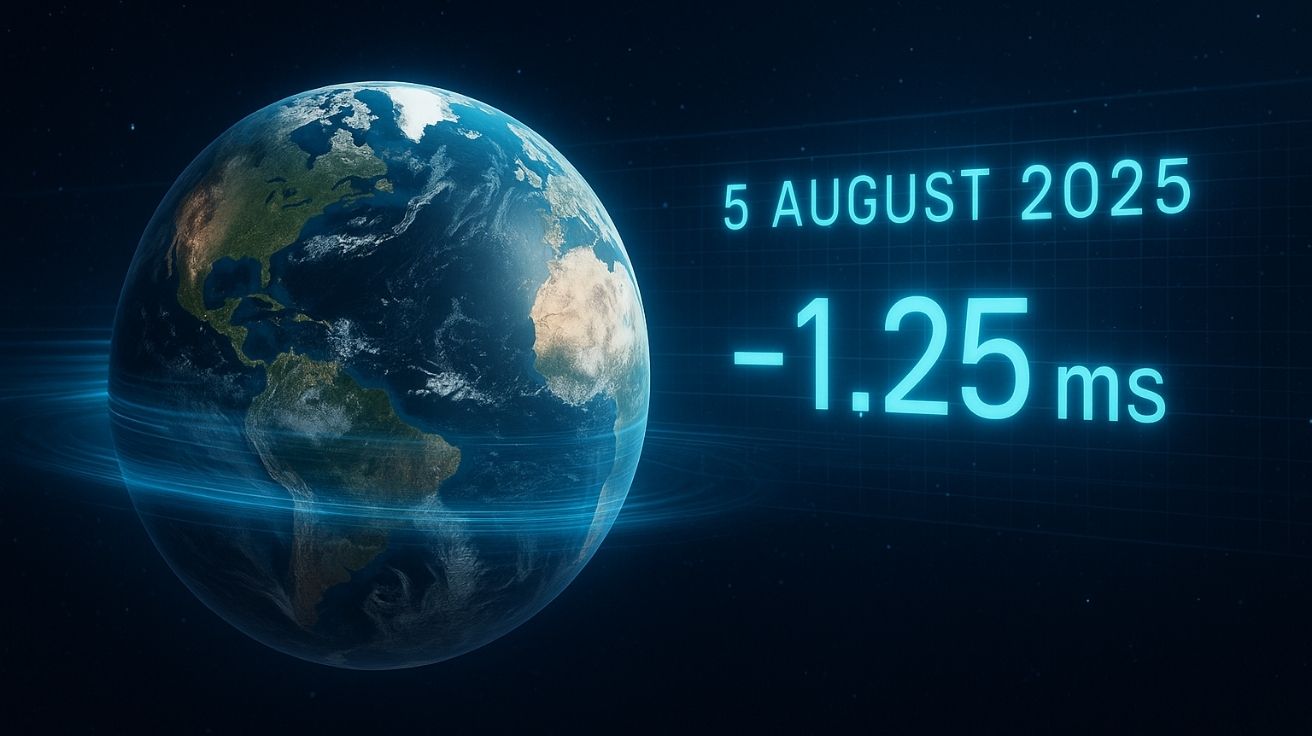
Increase in Earth’s Speed Surprises Scientists and Shortens August 5, 2025 by 1.25 Millisecond, Surpassing Last Year’s Mark and Reinforcing a Phenomenon Still Without Definitive Explanation
August 5, 2025 Will Be Shorter Than 2024 Due to Earth’s Speed, Which Is Accelerating Unusually
This Tuesday, August 5, the Earth will complete its rotation 1.25 milliseconds faster than usual, making the day slightly shorter than the traditional 86,400 seconds. The phenomenon is attributed to an acceleration in Earth’s speed, which has intrigued scientists since a reversal in the historical pattern of deceleration was identified.
Since 1973, when official records began, days have been getting longer, a direct result of the friction caused by the Moon’s gravity, which gradually transfers energy from the Earth to the natural satellite. However, in recent years, this trend has reversed, with some days showing increasingly shorter durations.
According to measurements made by international institutions like Timeanddate.com, this will be one of the shortest dates of 2025. The previous record belonged to July 5, 2024, when the day had a reduction of 1.66 milliseconds, now surpassed by the fastest rotation recorded this month.
-
At the bottom of the sea, scientists have found a true underwater cathedral measuring 62 meters at the base, 31 meters at the top, and 1,347 square meters of giant coral in the Maug Islands, estimated to be 2,050 years old.

-
Surrounded by the sea, the airport will have a system to prevent airplanes from falling into the water; technology will be installed in Ilhéus (BA), with an investment of R$ 70 million.

-
With a cost per shot close to zero, the DragonFire laser could change naval warfare in 2027 and provide British ships with nearly unlimited defense against drones.

-
A British startup creates tires that generate electricity in electric vehicles when passing over potholes, speed bumps, and cracks.


Earth’s Speed Is Increasing After Decades of Deceleration Caused by the Moon
What makes this phenomenon even more mysterious is that, historically, Earth’s rotation has been decreasing due to the effects of the tidal forces caused by the Moon. This gravitational friction acts like a natural brake, making days gradually longer.
However, in recent years, this logic has been challenged. Scientists observe that Earth’s speed has been increasing, but there is still no consensus on the causes. Possible explanations include the deceleration of the planet’s liquid inner core or even indirect impacts from global climate change.
In addition to August 5, two other dates in 2025 also experienced reductions in day durations: July 9 (1.23 milliseconds) and July 22 (1.36 milliseconds). All of them coincide with specific positions of the Moon in relation to the Earth’s equator, which influences variations in tides and, consequently, the planet’s rotation.
Phenomenon May Lead to the Introduction of a Negative Leap Second by 2029
Although imperceptible to people’s daily lives, this change in Earth’s speed may have direct impacts on systems that depend on extreme temporal precision, such as satellites, telecommunications, and GPS.
If the trend continues in the coming years, it will be necessary to adopt an unprecedented adjustment: a negative leap second, meaning the removal of an entire second from global atomic clocks. This would be the first time in modern history that this occurs, requiring international coordination among timekeeping services.
It is important to highlight that the measurement of time takes into account two distinct concepts: the sideral day, which lasts 23h56min, measured against the stars, and the solar day, of 24 hours, calculated based on the position of the Sun. This latter one has been affected by the recent changes in Earth’s rotation.
Researchers Are Still Seeking to Understand the Causes Behind the Acceleration of the Planet
Despite the efforts of the scientific community, there is no definitive explanation for the phenomenon. While some suggest the influence of the Earth’s inner core and others point to possible interferences caused by the melting of polar ice caps, no theory has been validated so far.
This type of variation can also occur due to geological events, such as earthquakes or changes in the ice mass of the poles, which redistribute the weight of the Earth’s crust. Small changes in these structures affect the rotation axis and speed of the planet.
The information used to compile this content was gathered from sources such as the portal Space.com and the magazine Planeta, based on data provided by institutions like Timeanddate.com and EarthSky.org. All measurements are made with extremely precise instruments, based on atomic clocks.








-

2 pessoas reagiram a isso.