





 Portuguese
  English
  Spanish
  4 min of reading
  0 comments


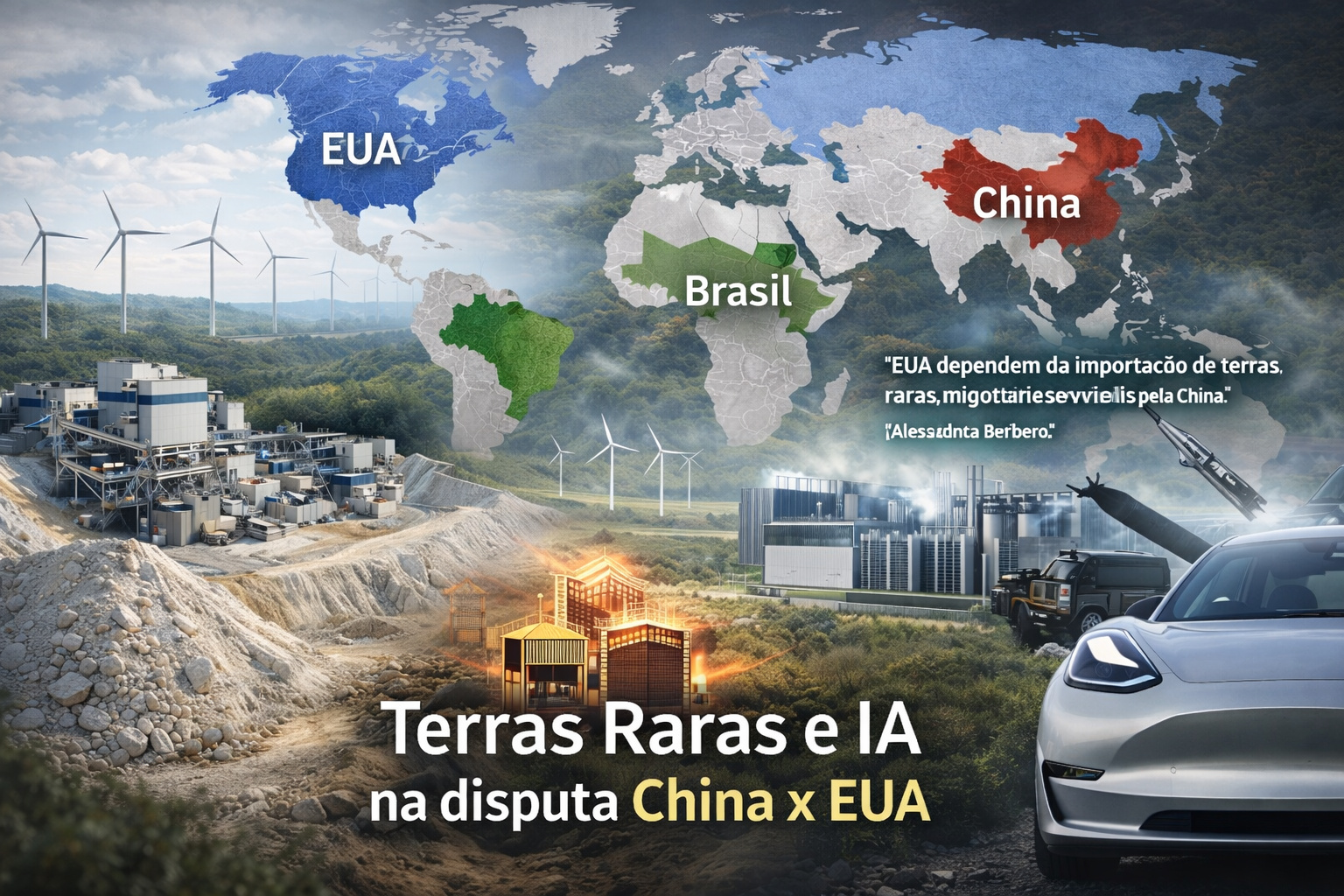
Rare Earths And AI Reposition Brazil In The Dispute Between China And The US, But Tax Barriers And Lack Of Strategy Hinder Investments.
Rare Earths, AI, And Geopolitics Redefine The Global Landscape
In the midst of technological escalation and the rivalry between China and the US, Brazil gains relevance by concentrating Rare Earths, clean energy, and a neutral diplomatic position, especially as AI redefines global supply chains. However, internal barriers prevent the country from transforming these assets into development, as the window of opportunity narrows.
“Brazil, by distancing itself from this geopolitically confusing world, tends to have a favorable scenario for attracting direct investment, as it has important assets and some political stability,” says Sergio Vale, chief economist at MB Associados.
Dispute Between China And The US Pressures Global Supply Chains
The race for Rare Earths has gained centrality because these 17 elements sustain wind turbines, electric vehicles, defense systems, and the chips that power AI. Today, China controls about 60% of global extraction and nearly 90% of refining, creating structural dependence for the US.
-
“No one will make us change the Pix,” says Lula after the US report.

-
Lula responds directly to Trump and says that Pix is from Brazil and will not change under pressure from anyone, after a report from the United States pointed out the Brazilian payment system as an American trade barrier.

-
Amazon has just announced a new fee on all deliveries, and your online purchases will become more expensive starting April 17, including for those buying from the United States here in Brazil.

-
He sold his share for R$ 4 thousand, saw the company become a giant worth R$ 19 trillion, and missed the opportunity of a lifetime.

“To arm itself and contain China, the United States relies on importing rare earths, mostly supplied by China itself,” summarizes Thomas Wu, chief economist at Itaú Asset Management.
Furthermore, the tension surrounding Taiwan, a leader in advanced semiconductor production, raises systemic risk. A rupture would increase costs and accelerate the regionalization of supply chains. “A bigger problem there also has significant global repercussions,” warns Alessandra Ribeiro of Tendências Consultoria.
Brazil Has Reserves, But Exports Low Value
Brazil has the second-largest global reserve of Rare Earths, behind only China, with deposits of ionic clays that reduce costs and environmental impact, especially in Minas Gerais.
José Marques Braga Júnior of Viridis states, “The company’s Colossus project in Minas Gerais has no dam or definitive waste piles, representing significant technological advancement.”
Nonetheless, the country exports low-value concentrates because it does not dominate chemical separation. While mixed concentrates are worth around US$ 10 per kilogram, separated oxides can reach US$ 200, transferring income and technology abroad.
Lack Of Industrial Policy Maintains Bottlenecks
The main barrier is the absence of a coordinated industrial strategy. The separation of Rare Earths requires technology, scale, and continuous investment—exactly what China has built with long-term policies such as Made in China 2025.
“Without a coordinated industrial policy that adds value locally, the country risks repeating the colonial error of exporting raw wealth,” warns Alexandre Uehara of ESPM. The Brazilian Mining Institute emphasizes that the challenge is to transform geological wealth into national development through a state policy.
Clean Energy Could Boost AI In Brazil
In addition to Rare Earths, Brazil has abundant clean energy, a crucial asset in the era of AI. Data centers require increasing amounts of energy and water, and while natural gas meets part of the demand, renewable sources are gaining ground.
The country combines hydroelectric and wind power in competitive volumes, which could attract investments in digital infrastructure.
However, the lack of fiscal predictability and high interest rates deter capital. “For Brazil to benefit from the transformation of AI and its geopolitical potential, it is necessary to unlock investments by offering friendly conditions and a development plan,” says Luciano Telo, investment director at UBS in Brazil.
Fragile Fiscal Situation And High Interest Rates Hinder Investments
The fiscal vicious circle remains an obstacle. Public debt exceeds 78% of GDP and is expected to approach 84% by 2026. The absence of consistent primary surpluses keeps the Selic rate high, making productive investment expensive.
“The prolongation of such high interest rates generates costs, such as the retraction of productive investment,” warns Hugo Garbe of Mackenzie Presbyterian University.
In addition, legal insecurity—with retroactive changes and tax disputes—reduces predictability. On the external front, exchange rate volatility pressures inflation and complicates long-term planning.
Global Window Is Short And Competition Advances
Meanwhile, countries like Australia, Chile, and Vietnam are advancing in alternative supply chains to China. According to the International Energy Agency, demand for Rare Earths is expected to grow sevenfold by 2040, driven by the energy transition and the technological race. Thus, the delay is costly.
Three Fronts For Brazil To Act Now
To take advantage of the dispute between China, the US, and the expansion of AI, Brazil needs to act on three fronts: fiscal adjustment with spending restraint, legal security, and an integrated industrial strategy.
The National Policy on Critical Minerals is advancing in Congress, but it will only be effective with firm execution and a long-term vision. Without this, the country will lose the global race, despite having Rare Earths, clean energy, and geopolitical relevance.









-

-

-

-

-

8 pessoas reagiram a isso.