





 Portuguese
  English
  Spanish
  7 min of reading
  0 comments


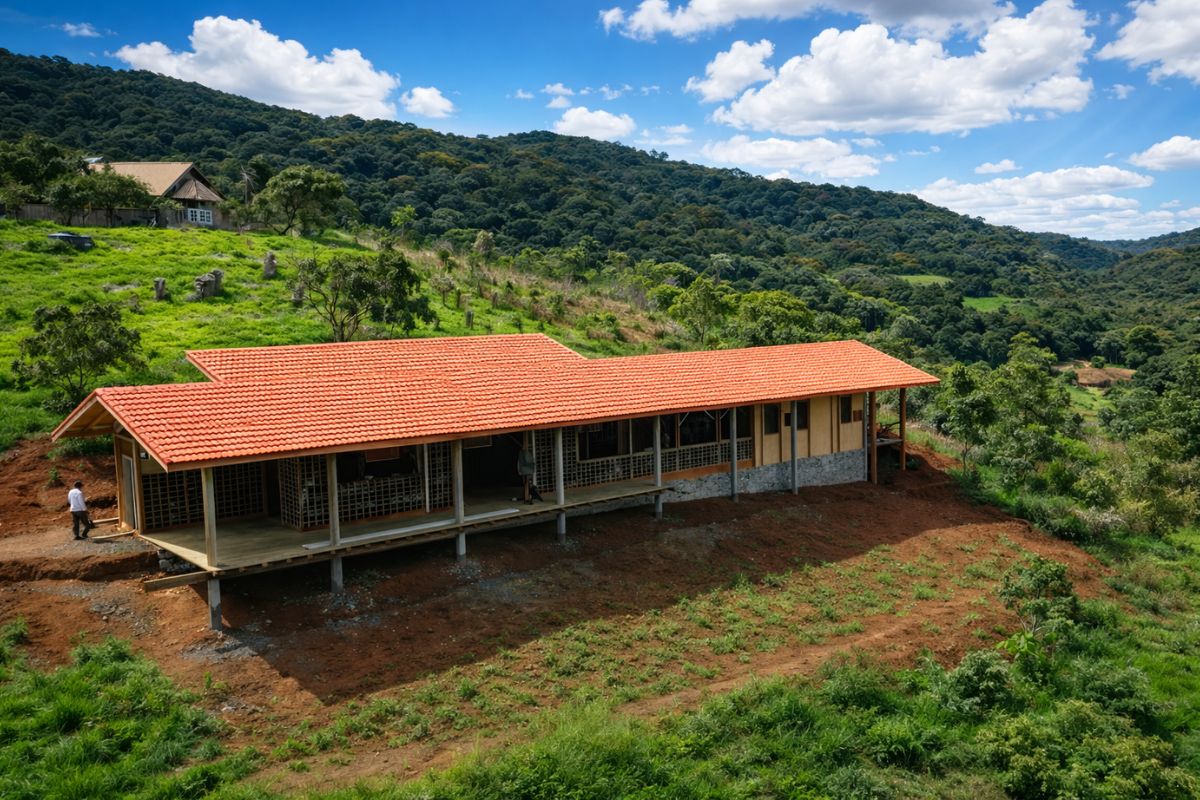
In this house, the wattle and daub uses bamboo and earth from the land with lime coating to withstand wind, normal cracking, and deliver the finish of a common house
The house of wattle and daub taking shape in Monteiro Lobato shows a dream coming to life with a traditional method, but with very current decisions. The bamboo weave, the earth from the land itself, and the care with wind and sunlight appear as the heart of the work, which aims to be accessible and contemporary without losing the essence of bioconstruction.
The project of this house starts from a real challenge: the land is sloped and the construction needed to be all on one level. To achieve this, the house follows the contour line, mixing technical solutions with local labor and already anticipating embedded installations. The result promises a house that looks common on the outside, but has a different logic inside.
Implementation on the sloped land and the search for accessibility
Since the land is sloped, the house was designed to be longer, following the contour line to maintain accessibility on a single level.
-
Italian giant of 130 tons arrives at the Senna Tower construction site and accelerates foundations: Mite CFA 3436 drills up to 50 m, 750 hp engine, investment of R$ 20 million, unique in Latin America.
-
Four friends with over 30 years of friendship built a “mini village” by the banks of a river in Texas to grow old together, with houses of just 32 m² and a shared common space. The Bestie Row project has become a model of alternative living that is starting to spread around the world.
-
The ancient Japanese capital, planned over 1,200 years ago, still withstands earthquakes with colossal wooden temples and palaces, built without concrete or modern steel, by masters who created engineering capable of enduring centuries.

-
The lack of welders, electricians, and operators becomes a structural threat in 2025, with the construction industry and manufacturing already suffering from delays, cost pressures, and labor shortages in Brazil.

One part of the house is set on the ground and another part is suspended outward, a solution that respects the terrain and reduces unnecessary interventions.
The wind is another dominant factor. To avoid wind interference, the roof has the minimum number of cuts possible, and still, the project includes a balcony to enjoy the view.
There is also a cut designed to receive the morning sun, and around 9 a.m. the light already enters inside the house.
Bamboo, earth, and what makes the weave the “skeleton” of the house
The structure of the wattle and daub appears as a weave of bamboo tied with wire, which receives the earth in the plastering stage.
The house grows as a set of layers, where the weave supports and the earth fills, forming the walls that will later receive finishing.
The proposal is clear: to deliver a house that, in the end, looks conventional to a contemporary audience, but made with more sustainable materials.
Local earth and bamboo close to the work reduce dependence on industrialized materials and reinforce the identity of the project.
Choice of earth, tests, and why there is no one-size-fits-all recipe

The earth used in the plaster comes from the land itself, taken from the cut of the slope and sifted before becoming a paste.
In the work, it is mixed with sand when it becomes “sticky,” indicating a higher presence of clay. The adjustment is made in practice, with tests on the wall and feeling in the hand, because each earth reacts differently.
If the earth is too sandy, it may need more clay to “bind” the material. If it has too much clay, more sand is added to balance.
The central point is that the house is born from a mixture made to fit the local soil, not from a ready-made formula.
Why does the wall crack and why is this normal in the wattle and daub house
The cracks appear as an expected part of the process. The earth is stomped and softened with water to gain cohesion, but this water needs to dry afterward.
When the water evaporates, the volume decreases and cracks appear, without meaning that there is something wrong with the wall.
The important care is the finishing. There is concern that insects may settle in crevices, but this can also happen in a brick house with gaps. Here, the wall will receive coating and, without warning, may even look like masonry.
The idea is for the final house to look like a normal house, and therefore it is even considered leaving a small window apparent to show that it is wattle and daub.
Lime coating and the finish that transforms the house
The final coating uses the same earth mixed with hydrated lime on site, as well as sand. The proportions vary according to the available earth, maintaining the logic of adaptation.
The process is designed to be simple for the mason, who can apply the paste with a trowel and smooth it as he is used to.
The work also values local labor. If support is needed, the worker is nearby and can call for help.
In the end, lime paint is applied, and if color is desired, the lime can be mixed with earth to create a more earthy tone. This finish is what gives the house the effect of a “common house”, even though it is a different construction technique.
Electrical, plumbing, and maintenance planned within the house

The installations are planned in advance and pass through the weave. The electrical conduits are already embedded in the wall, with a hidden electrical panel planned.
On the other side, the sink and washing machine also appear as elements planned to stay within the wall of the house, avoiding improvisation later.
The foundation in stone helps with this planning. The sewage piping is already left in the foundation so that it does not need to be broken later, and the paths for electrical and plumbing are also anticipated from the beginning.
If maintenance is ever needed, the logic follows that of a common house: break where necessary and restore. The difference is that the reconstruction tends to be simpler because the material is easier to redo.
Balcony, roof, and structure to deal with strong winds

To deal with the wind, the wall was set back, creating a balcony within a large two-slope shed.
This way, the roof maintains a more “clean” shape and the house becomes more aerodynamic. The structure uses treated eucalyptus pillars, beams, and trusses, and the deck is made of treated pine.
Instead of just supporting, some pillars were buried due to the wind. To reduce the risk of moisture, they are placed on a bed of gravel, preventing moisture from stagnating.
This is a construction detail that protects the house over time, especially in a location where the wind is constant.
Floor and base without cement: stone, gravel, and lime, sand, and earth paste
The floor of the house will be 30×30 ceramic tiles, laid without cement, using the same paste of lime, sand, and earth over a bed of gravel.
The intention is to avoid rising moisture. Channel blocks and fillings with lime, sand, and earth also appear, reinforcing that the base does not depend on cement.
Inside, the ceramic receives baseboards and finishing, and some of the stones may be brushed to highlight the texture.
There are also sections with solid bricks laid without cement, also with lime, sand, and earth. In the master suite bathroom, the choice was for bricks, not due to limitation, but due to the clients’ preference.
Interior tour: morning light, view, and a house open to the landscape
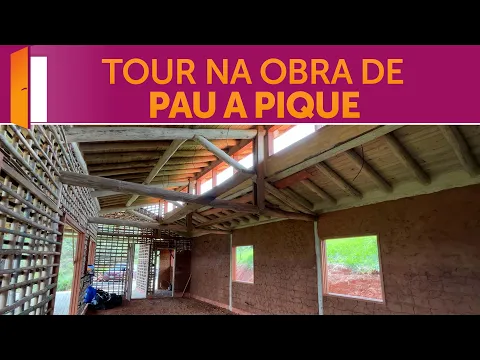

The main access enters through a porch-shaped balcony and leads to the kitchen, designed to take advantage of a wide view.
The house opens up to the landscape and considers the east-west orientation, which requires care with sunlight. Therefore, the balcony and eaves were extended.
An interesting point is the slanted wall, which is intentionally not parallel. The slope opened space for an office facing the view and helped gain volume in the master suite bathroom, as well as creating a large workbench. The couple’s suite also gains a view and a private balcony separate from the social balcony.
In the living room, the residents wanted more morning light than conventional windows would provide. Therefore, the roof solution was adjusted to allow light entry, reinforcing how the house was designed in dialogue with the desire for comfort.
Why the owners decided to leave São Paulo and invest in this house

The owners report fatigue with São Paulo, mainly due to the distances measured in time and the feeling of a city out of human scale.
The pandemic served as a moment to rethink choices. They learned about the place through friends who bought a farm and divided it into lots, and they were enchanted by the view and the mountains.
The search was for natural light, thermal quality, and a house that brought the feeling of life connected to the earth and clay.
The land was purchased in 2022, there was research on construction processes for about two years, and work with professionals began at the end of 2024. They also mention reforestation and planting on site as part of the path to the house.
In the end, what emerges is a life decision: to build a house with a more vibrant method, choosing wattle and daub after comparing options like cob and ecological brick, always paying attention to the wind and the context of the land.
Would you live in a wattle and daub house if the final finish looked like a common house?







Seja o primeiro a reagir!