





 Portuguese
  English
  Spanish
  5 min of reading
  0 comments


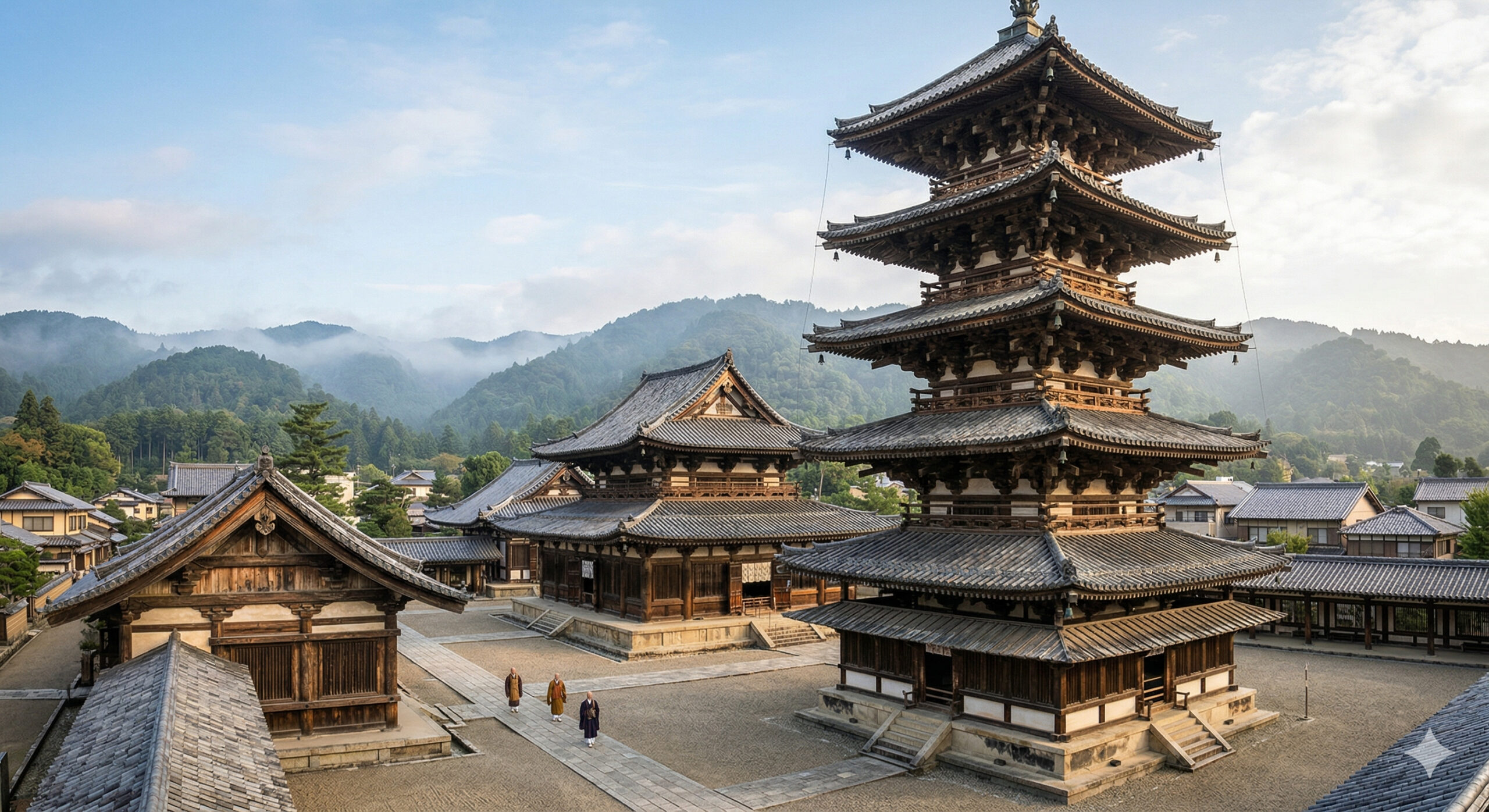
Ancient capital of Japan reveals wooden engineering capable of withstanding centuries and earthquakes, with monumental temples built without concrete or steel.
In the year 794, during the reign of Emperor Kanmu, the capital of Japan was moved to Heian-kyō, present-day Kyoto, marking the beginning of one of the most important periods in Japanese history. According to the Encyclopaedia Britannica and UNESCO, which describes Kyoto as a city built in 794 based on the model of ancient Chinese capitals, the new capital was planned with an urban layout inspired by Chang’an, the capital of the Tang dynasty, and established itself as one of the main political and cultural centers of Japan for over a thousand years.
This fact alone positions Kyoto as one of the most relevant urban centers in Japanese history. But what truly differentiates the city is not just its political importance, but the level of engineering applied in the construction of temples, palaces, and monumental structures predominantly made of wood. According to UNESCO itself, Kyoto “illustrates the development of Japanese wooden architecture, particularly religious architecture”, which helps explain why the ancient capital became a global reference in construction techniques that have endured for centuries.
Kyoto was not just a political capital. It was also an architectural laboratory where advanced construction techniques were developed and refined over generations, creating a legacy that still intrigues engineers, architects, and historians today.
-
The lack of welders, electricians, and operators becomes a structural threat in 2025, with the construction industry and manufacturing already suffering from delays, cost pressures, and labor shortages in Brazil.
-
Brazil and Paraguay are just 46 meters away from a historic union on the bioceanic bridge that promises to revolutionize trade between the Atlantic and the Pacific.

-
With 55 km over the sea, a cost of US$ 20 billion, and enough steel to build 60 Eiffel Towers, China’s largest project has connected Hong Kong, Zhuhai, and Macau in a colossal bridge that defies the logic of engineering.

-
A trick with joint compound transforms a Styrofoam ceiling into a plaster-like ceiling: leveled panels, wires and mesh at the joints, sand, paint, and change the environment while spending little today.


Japanese wooden engineering dispenses with concrete and steel and creates resilient structures
Unlike what occurred in other civilizations, which based their monumental architecture on stone or concrete, Japan developed a construction tradition centered on wood. This is due to geographical and environmental factors, such as the abundance of forests and high seismic activity.


The choice of wood was not a limitation, but a sophisticated technical solution. Rigid stone structures tend to collapse under intense seismic forces, while wooden constructions can absorb and dissipate energy.
Japanese temples utilize extremely complex interlocking systems, known as joinery, that eliminate the need for nails or screws. These connections allow the pieces to move slightly during an earthquake, reducing the risk of structural failure.
In addition, many constructions feature central columns called shinbashira, which function as a stabilizing axis, helping to distribute forces and maintain the structure’s balance.
This set of techniques creates buildings capable of surviving centuries of earthquakes, fires, and harsh weather, something that challenges the conventional logic of engineering based on rigid materials.
Monumental temples of Kyoto show impressive scale even with wood
Among the most emblematic examples of this engineering is the temple Tōdai-ji, originally built in the 8th century and reconstructed throughout history. Its main hall, the Daibutsuden, is considered one of the largest wooden structures in the world.
Even after reconstructions, the current building measures about 57 meters long, 50 meters wide, and 48 meters high, dimensions comparable to modern large-scale constructions.
Another relevant example is the Kiyomizu-dera, famous for its wooden stage suspended over a valley. The structure is supported by hundreds of interlocked pillars without the use of nails, forming a platform that seems to defy gravity.

These constructions demonstrate that wood, when combined with advanced technical knowledge, can achieve monumental scales without compromising stability or durability.
Modular construction system allows maintenance and reconstruction over the centuries
One of the factors that explain the longevity of Japanese structures is the modular nature of construction. Unlike monolithic buildings, temples and palaces are made up of components that can be individually replaced.
This means that, over the centuries, damaged parts can be removed and rebuilt without compromising the integrity of the whole. This continuous maintenance process ensures that ancient structures remain functional and visually preserved.
This logic creates an architecture that is not static, but dynamic, adapting to time and environmental conditions without losing its original identity.
Influence of nature and spirituality on Japanese engineering
Traditional Japanese architecture cannot be understood solely from a technical perspective. It is deeply connected to philosophy and the relationship with nature.
Elements such as lightness, flexibility, and integration with the environment are fundamental principles. Buildings are designed to coexist with their surroundings, respecting topography, vegetation, and climate.

This approach directly influences structural solutions. Wide roofs protect against heavy rains, while elevations prevent direct contact with damp ground.
Japanese engineering combines empirical knowledge, tradition, and environmental observation to create highly efficient construction systems.
Earthquake resistance places Japanese engineering among the most advanced in history
Japan is one of the countries with the highest seismic activity on the planet, making structural resistance a critical factor.
Modern studies conducted by Japanese universities and engineering institutes show that many ancient temples have withstood large magnitude earthquakes over the centuries.
This is because the structures are not completely rigid. They have controlled deformation capacity, absorbing energy without collapsing.
This principle, now widely used in modern engineering, was already empirically applied by Japanese builders over a thousand years ago.
Museums and reconstructions preserve ancestral techniques and attract researchers
Today, Kyoto is home to several museums and research centers dedicated to preserving these techniques. Institutions such as the Kyoto National Museum and the Nara National Research Institute for Cultural Properties document and study traditional construction methods.
These spaces not only preserve artifacts but also promote the transmission of knowledge to new generations of craftsmen and engineers.
The preservation of these techniques is essential to ensure that this knowledge is not lost, especially in a world dominated by industrial materials.
Wood engineering redefines the limits of what is considered durable construction
The analysis of historical structures in Kyoto challenges a common idea in modern engineering: that durability is necessarily linked to the use of materials such as concrete and steel.
By observing temples that have stood for centuries, it becomes evident that other factors, such as structural design, maintenance, and adaptation to the environment, are equally important.
Japanese engineering demonstrates that natural materials can achieve high levels of performance when combined with refined technical knowledge and intelligent construction processes.

The ancient Japanese capital that once housed over 1 million inhabitants continues to be one of the most impressive examples of engineering applied to architecture.
By erecting colossal wooden temples and palaces, without the use of concrete or steel, master builders created structural systems capable of withstanding time and earthquakes, anticipating concepts that are now studied by modern engineering.
This legacy not only preserves the history of a civilization but also offers relevant insights for the future of civil construction, especially in a global context seeking more sustainable, efficient, and adaptable solutions.










Seja o primeiro a reagir!