





 Portuguese
  English
  Spanish
  3 min of reading
  0 comments


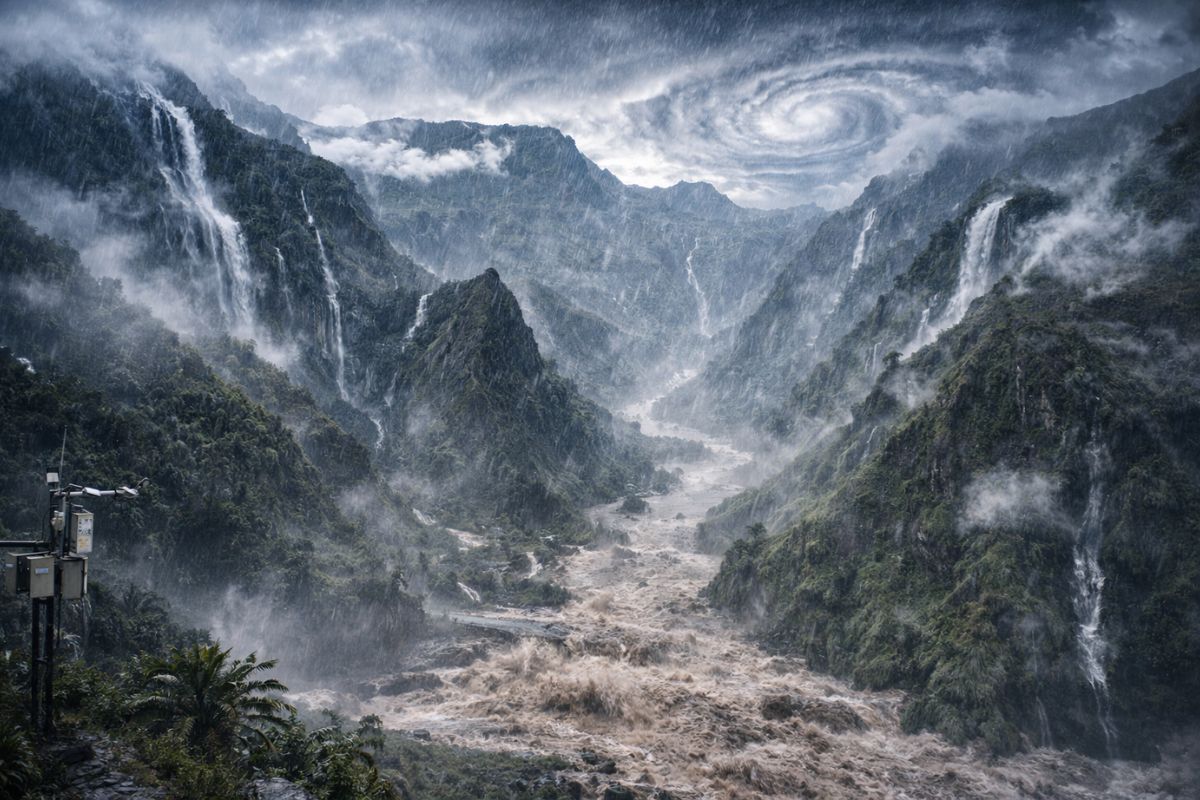
The WMO recognizes that the heaviest rain in 24 hours was 1.825 mm in Foc-Foc, during the tropical cyclone Denise in 1966, with relief of up to 3,300 m amplifying precipitation.
The heaviest rain ever recorded in 24 hours on the planet has a well-defined address and context: Reunion Island, in the Indian Ocean, during the passage of a tropical cyclone. The value recognized by the World Meteorological Organization is 1,825 mm of rain in a single day, a volume that helps to understand why extreme events do not depend only on heavy clouds but also on geography.
This record of rain occurred in Foc-Foc when the tropical cyclone Denise crossed the southern Indian Ocean in 1966. Reunion Island, about 670 km east of Madagascar, has mountains up to 3,300 meters and steep valleys, a relief that can multiply precipitation by forcing moist air to rise rapidly.
What the WMO recognizes as a world record for rain in 24 hours
The World Meteorological Organization maintains a record of extreme climate and weather events and recognizes that the maximum rain in 24 hours is 1,825 mm.
-
In northern Guatemala, a colossal scan revealed 964 Maya settlements and condensed this map into 417 cities, towns, and villages connected by 177 km of elevated walkways, suggesting a regional power much greater than previously thought for the Pre-Classical period.
-
Much more than a conventional boss: meet the story of the CEO of BYD who spends the day teaching his own engineers so they never stop creating.

-
Understand how the factory that is the second largest in the world manages to produce at a surreal pace and dominate the streets with technology and sustainability.

-
Natural phenomenon expected to cause a ‘thermal disaster’ in Brazil, with extreme heat, drought, and financial impact, now has a date set to occur.
This value was measured in Foc-Foc, on Reunion Island, during the tropical cyclone Denise in 1966. It is an official record, consolidated as a global reference for accumulated precipitation in one day.
Where is Reunion Island and why does relief matter so much
Reunion Island is located in the Indian Ocean, approximately 670 kilometers east of Madagascar. The decisive factor is the so-called extreme orography, with mountains reaching 3,300 meters and very steep valleys.
This relief forces moist air to be pushed upwards, intensifying cloud formation and precipitation. When air rises quickly, rain can explode in volume, especially under the influence of a tropical cyclone.
How tropical cyclones and mountains can “boost” rain
Tropical cyclones carry enormous amounts of moisture and energy. When this system encounters mountainous terrain, the so-called orographic lifting occurs, which amplifies rain because the moist air is forced to rise, cools, and condenses faster.
On Reunion Island, this mechanism is enhanced by the combination of cliffs, deep valleys, and high altitude. The result is an ideal scenario for extreme accumulations in a few hours, as in the case of 1966.
The “old record” of 1,870 mm that Reunion considers an error
A higher number sometimes appears in historical citations: 1,870 mm in 24 hours, attributed to Cilaos between March 15 and 16, 1952. The WMO itself explains that meteorologists from Reunion consider this value an old error.
They confirm that this data is invalid and that the correct extreme of rain in 24 hours is 1,825 mm, measured in Foc-Foc during the tropical cyclone Denise in 1966. In other words, the official world record is not the highest number ever repeated, but rather the validated value.
What 1,825 mm of rain means in simple terms
1,825 mm is equivalent to 1.825 meters of rain accumulated in 24 hours. In practical terms, it is as if a volume of water with a height close to that of a small child fell from the sky in a single day.
That is why the record draws attention: it reveals that, in very specific scenarios, rain can reach levels beyond what most people imagine possible.
Why this record helps to understand current extreme events
The case of Reunion Island shows an important pattern: extreme events are the result of a combination, not of an isolated factor. A tropical cyclone provides moisture and energy, and extreme relief provides the physical “trigger” that intensifies precipitation.
Understanding this logic helps to interpret why certain places are more susceptible to absurd volumes of rain, especially when tropical storms pass exactly on the right route.
Did you already have an idea that mountains can amplify rain to the point of creating a world record in just 24 hours?







Seja o primeiro a reagir!