





 Portuguese
  English
  Spanish
  8 min of reading
  0 comments



End of the 6×1 schedule: President said on April 8, 2026, that he will send a proposal ‘in the coming days’; government defends 40-hour workweeks, two days off, and maintenance of salaries.
The Lula government decided to place one of the most advocated issues by workers in recent months at the center of the labor agenda: the end of the 6×1 schedule and the reduction of the weekly work hours to 40. The strongest signal came on April 8, 2026, when President Luiz Inácio Lula da Silva publicly stated that he would send a bill to Congress, “in the coming days,” to change the working hours in the country, without salary reduction. According to Lula, the proposal will not be rigid enough to ignore sectoral realities, but the central line has already been established by the Planalto: fewer hours of work per week and more rest for the worker.
Lula’s statement gave the topic a new political weight because, until then, the government had been supporting the debate from a distance, leaving the greater protagonism with the Chamber of Deputies. This changed throughout March and became clearer at the beginning of April.
In practice, the Planalto began to openly defend that the country is ready to review the 44-hour workweek and weaken the model in which the worker works six days to rest only one. (Gov Agency)
-
In Spain, a law has created paid menstrual leave funded by the state, turning debilitating cramps into legal leave and placing the country among the most advanced in Europe in terms of women’s health rights.

-
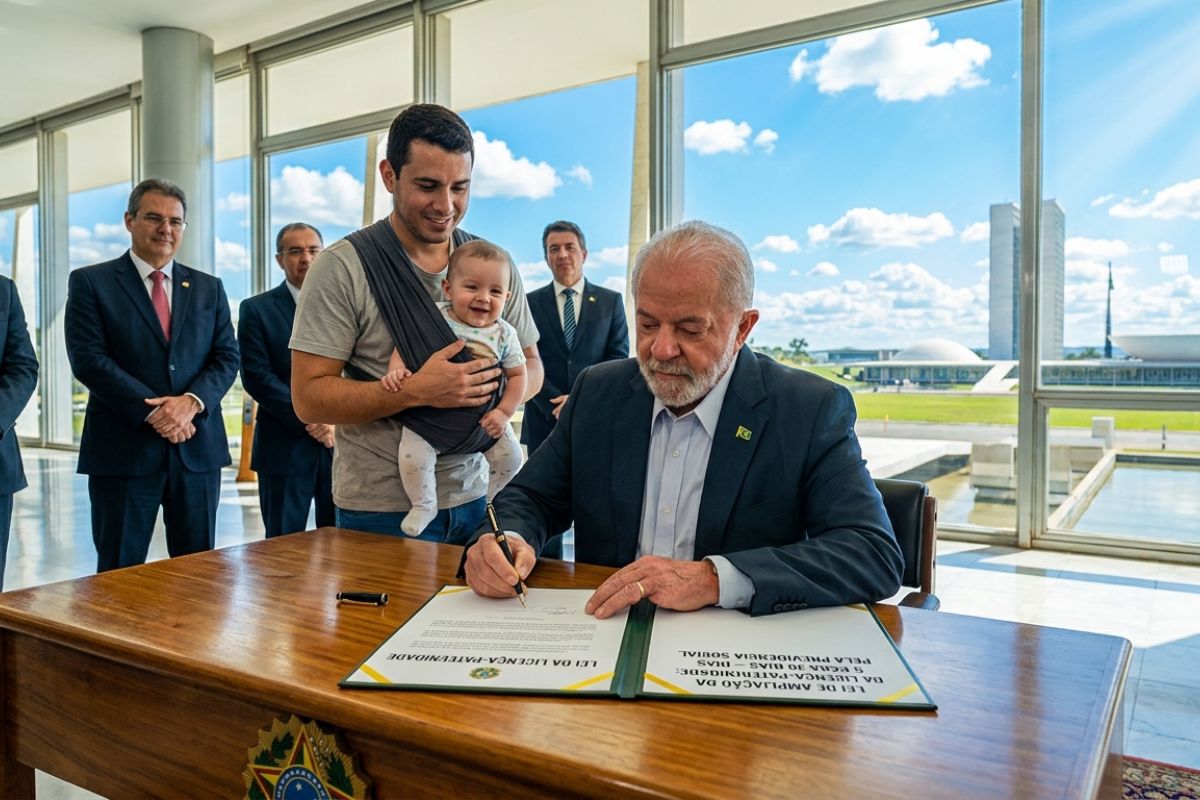
Government enacts new law: paternity leave increases from 5 to 20 days with gradual increases until 2029, and Social Security pays the paternity salary; companies no longer bear the absence cost, estimated at R$ 5.4 billion.
-
End of the 1-hour lunch break in the CLT? Current labor law maintains the break, allows for negotiated reductions, and defines rules for working hours and home office in Brazil.

-
Employee Fired After Accumulating 114 Days of Medical Leave in One Year, Labor Court Upholds Company’s Decision

The issue became an official priority on February 2, 2026
The first concrete milestone of this shift occurred on February 2, 2026. At the opening of the legislative year, the government officially included the end of the 6×1 schedule without salary reduction among the priorities sent to Congress.
This means that, since the beginning of the work in Brasília, the Executive has already treated the subject as a strategic agenda for 2026, alongside other sensitive issues in the social and economic areas.
This detail is important because it shows that Lula’s speech in April was not improvised. The subject had been politically prepared for more than two months, with space on the government’s institutional agenda and with the construction of a discourse to support the change before Congress and the productive sector.
On March 10, Luiz Marinho defended 40 hours and two days off
The next step came on March 10, 2026, when the Minister of Labor, Luiz Marinho, defended in the Chamber the reduction of the workweek from 44 to 40 hours, with two days off per week and without salary cuts.
It was on this date that the government made it clearer what model it wants to see advance: a shorter workweek, closer to the 5×2 model, and not just a generic discussion about revising the work schedule.
Marinho’s statement also served to consolidate the official discourse that the measure does not need to mean a loss of productivity.
According to the minister, the Brazilian economy would already have the conditions to absorb the change, especially since part of the impacts has already been accommodated over time through collective agreements and by reorganizing sectors.
The government hardened its discourse throughout March
After the statement on March 10, the government raised its tone. On March 18, 2026, Luiz Marinho reiterated that the end of the 6×1 schedule was one of the Executive’s priorities in Congress. By the end of March, the minister reinforced the defense of the 40-hour workweek without salary reduction, arguing that the rejection of working six days a week, especially among younger people, began to have real political weight.
In the midst of this process, the CCJ of the Chamber held a public hearing on March 24, 2026 to discuss proposals related to the end of the 6×1 schedule and the reduction of working hours.
The debate showed that the topic was moving in the Legislative, but it also made it clear that the processing was not progressing at the speed desired by government sectors. It was this environment that opened space for the idea of a project from the Planalto.
End of the 6×1 schedule: April became a hot topic in Brasília
The perception that the matter was moving slowly gained strength on April 1, 2026, when behind-the-scenes reports began to inform that the government had decided to send a own bill to Congress, possibly with constitutional urgency, to address the end of the 6×1 schedule and the reduction of the workweek to 40 hours. The political reading was simple: the Executive wanted to take command of the agenda and stop relying solely on the processing of parliamentary proposals.
The environment became even hotter on April 7, 2026, when the President of the Chamber, Hugo Motta, stated that the government had given up on sending its own project and that the debate would continue through the PEC already in progress in the House.
Hours later, interlocutors from the Planalto contested this version. The next day, April 8, Lula himself ended the political doubt by stating that the project would be sent “in the coming days.” It was this presidential statement that transformed the topic into one of the hottest agendas in Brasília this week.
End of the 6×1 schedule: What the government wants to change in practice
Currently, the general rule provided in the Constitution allows for a workday of up to 8 hours per day and 44 hours per week, which opens space for schedules like the 6×1, as long as legal limits for rest and remuneration are respected.
The project defended by the government aims to change precisely this center of legislation, reducing the weekly work hours to 40 hours and weakening the logic of six consecutive days of work.
In practice, what the worker would feel the most would be the reduction of the weekly workload and the increase in rest time. The formulation presented by Luiz Marinho speaks of two days off per week, which brings the change closer to an organization more similar to the 5×2.
The official discourse of the government also insists on an essential point for the popular acceptance of the proposal: the work hours would decrease, but the salary would be maintained.
Why the Planalto wants its own project with urgency
The discussion about constitutional urgency has become a key piece because it changes the pace of processing. This mechanism can be requested by the President of the Republic in projects of his initiative and imposes a deadline of 45 days for the Chamber and 45 days for the Senate to deliberate.
If this does not happen, the House’s agenda may become stuck until the proposal is analyzed. In other words, the government gains power to pressure Congress to vote.
That is precisely why the hypothesis of an Executive bill has come to be seen as a more efficient route than continuing to rely solely on a PEC. While the PEC requires a heavier and more time-consuming process, a government bill with urgency can shorten the political path and transform the discussion into concrete voting in less time.
The government’s proposal to end the 6×1 schedule is not the same as Erika Hilton’s PEC
Although the public debate treats everything as the “end of the 6×1 schedule,” there are different proposals at play. The best-known of them is the PEC 8/2025, presented by Erika Hilton, which proposes a deeper change: a reduced workweek of 36 hours, with a structure of four days of work for three days of rest. This proposal was filed on February 25, 2025, and became the main political reference on the topic within the Chamber.
On the other hand, the Lula government’s line, according to official statements made between March and April 2026, is more moderate: 40 hours per week, salary maintenance, and two days off. In other words, the Planalto is working with a significant reduction, but less radical than that of Erika Hilton’s PEC.
This difference is central to understanding the debate and avoids confusing proposals that share the same political banner but have quite distinct designs.
The PL 67/2025 already points to the model that the government wants
In addition to the PEC, there is already a text in the Chamber that is much closer to the design defended by the government. This is the PL 67/2025, presented on February 3, 2025, which amends the legislation to establish a maximum workweek of 40 hours and guarantee at least two days of paid rest per week. The proposal has already received a request for urgency and, therefore, has become an important reference within the current discussion.
This point helps explain the movement of the Planalto. The government is not opening a debate from scratch, but trying to take the lead on an agenda that already exists in Congress and that, in the view of the Executive, can advance more quickly if it comes with the direct signature of the President of the Republic.
What is at stake for workers and companies
For the government, the reduction of working hours is presented as a change with the potential to improve quality of life, mental health, family coexistence, and productivity. The thesis defended by Lula and Luiz Marinho is that less exhausting work hours can lead to more rested, less ill, and even more productive workers. This discourse has been repeated at different times in March and April and serves as the main political pillar of the proposal.
On the other side, resistance remains strong. In debates in the Chamber, opposition lawmakers and representatives of productive sectors argued that the change could increase costs for companies, especially in areas that operate with more intense schedules.
This shows that the topic has strong popular appeal, but it still faces a heavy dispute in Congress, both in the political and economic arenas.
What needs to happen after Lula’s speech
As of April 10, 2026, the scenario is as follows: the government placed the topic as a priority on February 2, publicly defended the 40-hour workweek with two days off on March 10, saw the pressure for its own text grow throughout the end of March, faced a clash of versions with Hugo Motta on April 7, and had Lula himself, on April 8, confirming the sending of the project “in the coming days.”
What remains now is the formal step: the protocol of the project and the confirmation of the processing regime. When this happens, the discussion will cease to be merely political and will have defined text, deadlines, and procedures. Until then, one thing is already clear: the end of the 6×1 schedule and the reduction of the workweek to 40 hours have ceased to be merely a street banner and have become an official bet of the Lula government for 2026.
And you, do you support the end of the 6×1 schedule and the reduction of the workweek to 40 hours without salary cuts? Do you believe that the change can improve the life of the worker or do you see a risk of impact on companies and employment? Leave your opinion in the comments and participate in the debate.









Seja o primeiro a reagir!