






 Portuguese
  Spanish
  3 min of reading
  0 comments


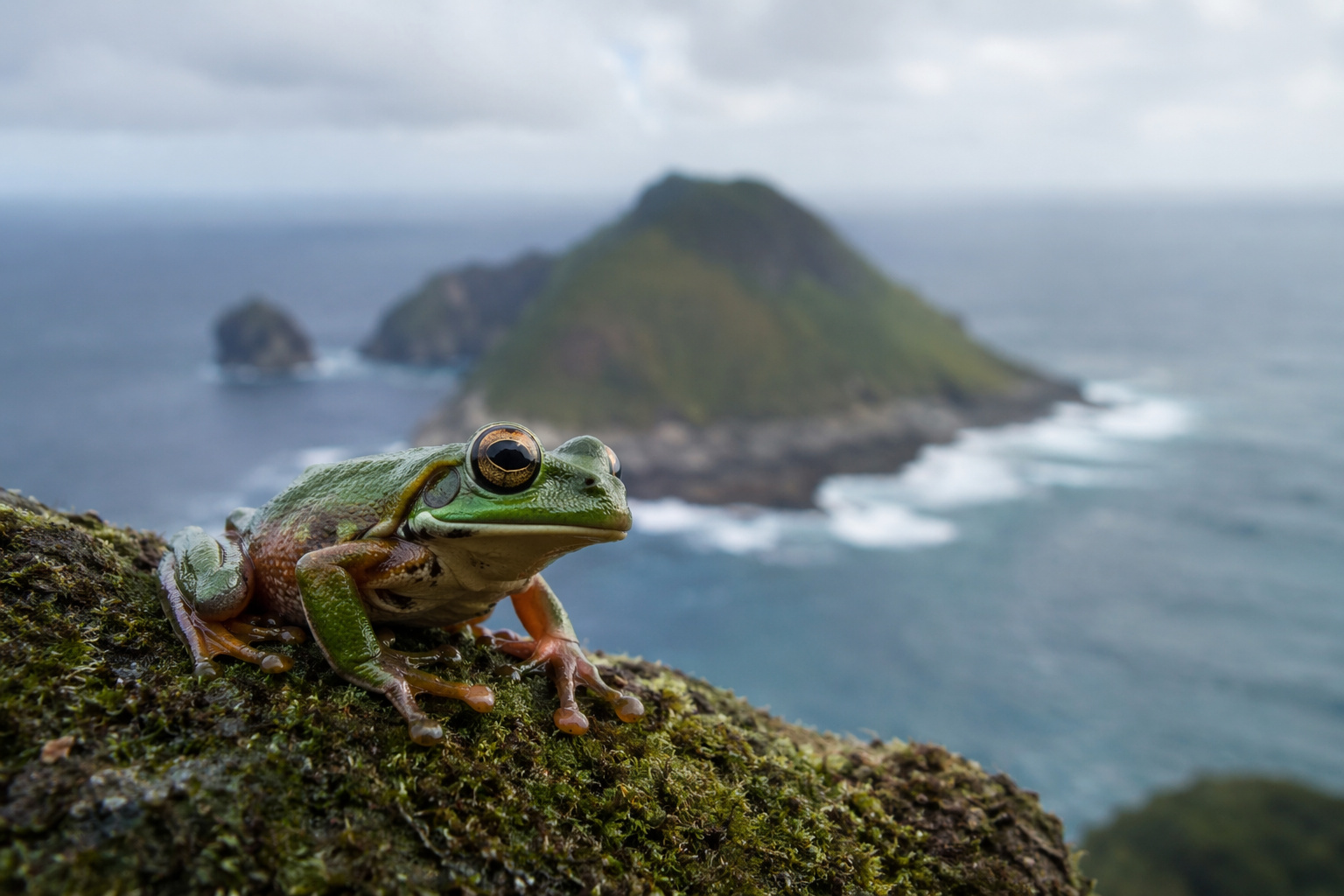
Research supported by FAPESP explains why distance from the continent and climatic stability shape the presence of amphibians on marine islands
A scientific investigation of great ecological relevance was recently published, attracting international attention to island biodiversity.
Moreover, the study analyzed 3,812 marine islands and revealed unprecedented patterns regarding the presence of toads, frogs, and tree frogs.
According to Brazilian researchers, with support from FAPESP in 2026, the distance from the continent and climatic stability are determinants.
Thus, these factors explain why some islands concentrate high diversity, while others have few species.
Despite this, amphibians have always challenged traditional scientific logic.
This is because they have permeable skin and depend on freshwater, which makes it difficult for them to cross salty oceans.
-
Hairdresser opens a simple salon at her doorstep in Sete Lagoas, cuts the ribbon with her daughter, and draws attention on social media; emotional video goes viral, attracts over 22,000 followers, and turns a humble beginning into an inspiration for thousands of people.

-
Japanese fans transform NFL stadium into a global example of education at the 2026 World Cup; after a dramatic draw against the Netherlands, blue bags used in the celebration become a cleaning tool and the stands end up trash-free in the United States.
-
United Kingdom announces social media ban for under 16s

-
Human beings are ‘dumber’ and Generation Z’s IQ raises a global alert: for the first time in 100 years, studies indicate a decline in scores, but 70% of large companies already prioritize skills that tests created in 1905 cannot measure.





Still, these species have been recorded on thousands of islands around the world.
Therefore, the study sought to understand the mechanisms that make this possible.

Distance from the Continent limits species colonization
Traditionally, the Island Biogeography Theory, established by Robert MacArthur and Edward O. Wilson, guides this type of analysis.
In this sense, the study confirmed that the greater the distance from the continent, the lower the colonization of amphibians.
Consequently, these events are rare and occur accidentally.
For example, animals may be transported by “natural rafts”, such as logs and vegetation carried by storms.
Thus, arrival at new islands depends on unpredictable events.
Therefore, the distribution of these species is limited by significant natural barriers.
Climatic stability favors diversity over time
Furthermore, researchers identified that climatic history plays an essential role.
Especially, islands that maintained a humid and warm climate during the Pleistocene functioned as natural refuges.
In this way, the species that arrived were able to survive.
As a result, they also diversified over millions of years.
Thus, these islands today present greater species richness of amphibians.
Consequently, they become priority areas for conservation.

Climate and humidity act as decisive biological filters
At the same time, the study demonstrated that temperature and precipitation function as rigorous environmental filters.
In this context, amphibians are ectothermic, depending on the environment to regulate their temperature.
Therefore, small and dry islands rarely support viable populations.
On the other hand, larger islands with abundant freshwater exhibit greater diversity.
Additionally, varied topography creates different microclimates.
Thus, these environments favor the survival and expansion of species.
Difference between Continental and Oceanic islands explains patterns
Another relevant aspect involves the origin of the analyzed islands.
In this sense, scientists differentiated continental and oceanic islands.
While continental islands were once connected to the continent, inheriting its fauna,
oceanic islands depend exclusively on rare colonization events.
In this way, biodiversity on oceanic islands is more limited.
Thus, each species present represents a unique evolutionary process.
Insular species are among the most vulnerable on the planet
Currently, in 2026, researchers warn about the fragility of these ecosystems.
Mainly, insular amphibians are highly vulnerable to climate change.
Moreover, many of these species are endemic, existing only on a single island.
Consequently, habitat loss can quickly lead to extinction.
According to the authors, identifying islands with ideal conditions is essential.
Thus, conservation efforts can be better directed.
Therefore, islands that act as natural climate refuges should be prioritized.
In this way, it is possible to preserve unique evolutionary lineages.
Finally, the study supported by FAPESP in 2026 positions Brazil at the scientific forefront.
Thus, it contributes to predicting environmental impacts in the 21st century.
In light of this scenario, will the protection of these islands be sufficient to ensure the survival of these unique species?





-

-

-

-

5 people reacted to this.