





 Portuguese
  English
  Spanish
  3 min of reading
  1 comment





The Construction Of The Longest Bridge In The United States, The Iconic Lake Pontchartrain Bridge, Revolutionized Mobility In Louisiana And Overcame Historical Challenges.
The construction of the longest bridge in the United States, the Lake Pontchartrain Bridge, was a true engineering feat that seems like something out of a movie! Imagine crossing 38 kilometers of water in a straight line, without seeing dry land for almost an hour. That’s exactly what happened when, in 1956, the state of Louisiana achieved the impossible: connecting two regions separated by a huge lake, which had been an insurmountable obstacle for years. If you think it’s hard to cross a busy street today, imagine building a bridge over a massive lake!
The Lake Pontchartrain Bridge, also known as the Lake Pontchartrain Causeway, is the fourth longest bridge in the world and the longest in the United States. Inaugurated on August 30, 1956, it radically transformed the lives of communities north of the lake, allowing for a direct connection to New Orleans. Before its construction, anyone wanting to make this trip had to go around the lake, which added about 50 extra minutes to the journey. The Lake Pontchartrain Bridge connects the city of Mandeville, to the north, to Metairie, a suburb of New Orleans, to the south, in the state of Louisiana.
Project For The Construction Of The Longest Bridge In The United States
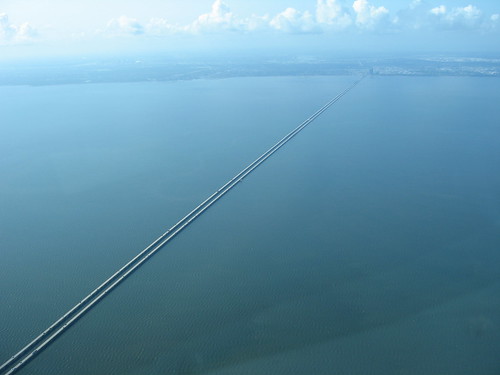
The project for the construction of the longest bridge in the United States began to be conceived in the 1950s, but the idea of crossing the lake had existed long before. In the early 20th century, there was a plan to build small interconnected islands by bridges, which ultimately did not materialize. However, it was the creation of the Causeway Commission that brought the ambitious project of crossing Lake Pontchartrain with a continuous prestressed concrete bridge to life.
-
Created by George Lucas with over $1 billion, a futuristic museum in the shape of a spaceship with 1,500 curved panels is about to open in Los Angeles and will house one of the largest private collections of narrative art in the world.

-
Couple shows how they built a retaining wall on their property using 400 old tires: sloped land turned into plateaus, tires are aligned, filled, and compacted with layers of soil, with grass helping in support and at almost zero cost.

-
Engineer explains drainage during the rainy season: the difference between surface water and deep water, ditches, gutters, and water outlets on the road, as well as drains and drainage mattresses, to prevent erosion, aquaplaning, and flooding at the construction site today.

-
With 55 floors, 177 meters in height, a 15-meter walkway between the twin towers, ventilated facade, and 6,300 m² of leisure space, Ápice Towers already has one tower completed and another nearly at the top.


The construction began in 1955 and, surprisingly, was completed in just one year. However, the increase in traffic quickly highlighted the need for a second lane, inaugurated in 1969. This new bridge, parallel to the original, brought technological innovations and was 65 meters longer, with seven emergency connection points between the two lanes.
Lake Pontchartrain Bridge Is Supported By Over 6,000 Concrete Pillars
The Lake Pontchartrain Bridge is supported by over 6,000 concrete pillars, which are set on the lake bed, whose average depth is only 4 meters. At navigation points, however, the depth reaches up to 45 meters. The height of the bridge varies from 5 meters to 15 meters at specific points, allowing for the passage of vessels of various sizes.
Over the years, the Lake Pontchartrain Bridge has survived various challenges, including the devastating Hurricane Katrina in 2005. After the hurricane, despite minor damages, the structure remained strong, becoming an essential route for relief efforts and the restoration of New Orleans.
Daily Traffic Flow Exceeds 30,000 Vehicles
Today, the bridge continues to charge a toll, but the daily traffic flow, which exceeds 30,000 vehicles, is generating debates about the need for a third lane. This new construction, wider and with emergency lanes, is planned for the near future, ensuring that the longest bridge in the United States continues to fulfill its vital role in connecting the region.
With its rich history and numerous milestones, the Lake Pontchartrain Bridge is not only an engineering record, being the longest bridge in the United States, but also a symbol of resilience and the human capacity to overcome geographic and natural challenges. The future may bring even more innovations, but the legacy of this incredible work remains unwavering.
With all the impact that the construction of the longest bridge in the United States had on the region and the constant increase in traffic, do you think that a third lane will be sufficient to meet future demands, or would it be better to consider more innovative alternatives?









Qual a maior ponte do mundo e não existe outra igual?
Resp: João 14.6