





 Portuguese
  English
  Spanish
  4 min of reading
  0 comments


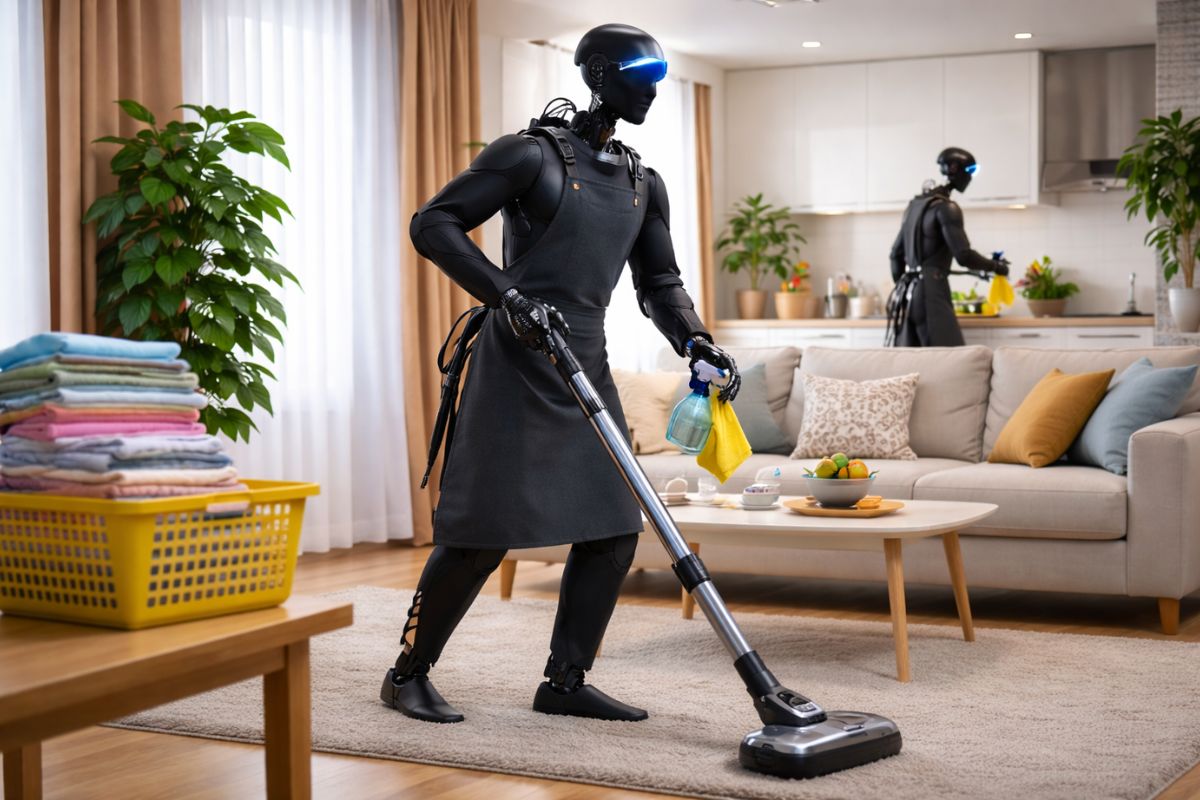
The startup Mind On installed an artificial intelligence system on the G1 humanoid robot from Unitree Robotics that allows the machine to interpret objectives and perform complete tasks autonomously, functioning as a true robotic domestic worker without receiving step-by-step orders
The G1 humanoid robot from Unitree Robotics has ceased to be just an agile machine with good balance and has become something that seems straight out of a science fiction movie. The Shenzhen-based startup Mind On replaced the original control system with a digital brain that uses artificial intelligence to interpret objectives and perform complete household tasks without relying on real-time human commands.
According to pplware, in the videos that went viral on social media, the G1 humanoid robot is seen climbing onto a bed to vacuum the mattress, watering plants, opening curtains, cleaning surfaces, and transporting objects from one room to another. What impresses is not each isolated task, but the fact that it operates as a genuine robotic domestic worker: it understands what needs to be done, observes the environment, and acts on its own.
What Mind On changed in the brain of the G1 humanoid robot

The G1 humanoid robot was already recognized for its mobility, balance, and precision in movements, thanks to the algorithms developed by Unitree Robotics.
-
The Moon has essential rare earth minerals for 99% of the electronics you use in your daily life and a future fuel that is almost nonexistent on Earth: now the race to explore the satellite has turned into a global competition among more than 70 countries.

-
Scientists reveal an impossible artifact for its time made with iron from space, and the discovery reignites a historical debate about the Bronze Age in China.

-
They seemed like common bones, but scientists were surprised to find a relic over 12,000 years old that dates back to before the Bronze Age.

-
With an almost perfect ring of 70 km visible from space, known as the “Eye of Quebec” and over 100 km in length, the Manicouagan Crater in Canada reveals the colossal mark left by a giant asteroid and has become one of the most impressive formations ever identified on the Earth’s surface.

But the original system operated with rigid instructions: the machine executed predefined actions, one at a time, without understanding the context around it.
Mind On replaced this logic with an artificial intelligence system that allows the robot to adapt to the environment in real-time.
Instead of receiving step-by-step commands, the G1 humanoid robot now interprets complete objectives and decides on its own how to accomplish them. In practice, if the goal is to clean a room, it identifies what is dirty, chooses the appropriate tool, and executes the entire task without human intervention.
A robotic domestic worker that vacuums, waters, and organizes on its own
A robotics startup in Shenzhen called Mind On has upgraded the Unitree G1 humanoid with an advanced robot brain.
— Space and Technology (@spaceandtech_) April 1, 2026
With this upgrade, the robot can perform everyday tasks on its own without human control.
It was shown watering plants, opening curtains, cleaning, and moving items… pic.twitter.com/IZPceiR6qm
In demonstrations released by Mind On, the G1 humanoid robot performs a sequence of household tasks that showcase the leap in capability.
The machine climbs onto a bed to vacuum the mattress, waters plants, opens curtains, cleans spaces, and moves objects independently, all without anyone needing to control it remotely.
The most relevant detail is the autonomy. Each of these actions is performed by the robotic domestic worker without direct human control in real-time, which represents a significant difference compared to previous solutions where the operator had to guide the robot through each movement.
According to Onur Sezgin, founder of CTO ROBOTICS Media, a global platform dedicated to robotics, this change reflects a fundamental transition in the field: from remotely controlled robots to autonomy at the level of complete tasks.
Artificial intelligence allows the robot to learn by observing
The artificial intelligence system installed by Mind On does not just function as a more efficient controller.
It allows the G1 humanoid robot to learn by observing the environment, identifying patterns, objects, and conditions that directly influence how each task should be performed.
This continuous learning is what differentiates the modified G1 from other domestic robots available on the market. The artificial intelligence analyzes the space, recognizes surfaces, calculates the necessary forces to manipulate objects, and adapts movements as the situation changes.
The G1 humanoid robot from Unitree Robotics stands 1.3 meters tall, has dozens of joints, sensors, 3D cameras, and hands with force control that allow it to interact with objects accurately, and all this hardware is now enhanced by the new digital brain.
What is still missing for the robotic domestic worker to reach homes
Despite the impressive advancement, there are still significant limitations.
The demonstrations of the G1 humanoid robot took place in controlled environments, far from the complexity and unpredictability of a real home with children, pets, and scattered objects.
Reliability in unexpected situations, safe interaction with people, and the ability to respond to unforeseen events are challenges that Unitree Robotics and Mind On still need to address before the robotic domestic worker reaches widespread use.
But the path is becoming clearer: artificial intelligence is transforming humanoid robots from machines that obey into machines that understand, and the G1 is the latest proof that this transition has already begun.
Would you have a robot like this working in your home?
The G1 humanoid robot modified by Mind On shows that the boundary between science fiction and domestic reality is thinner than ever.
With artificial intelligence capable of interpreting objectives and a body built by Unitree Robotics with enough precision to vacuum a mattress or water a plant, the robotic domestic worker has ceased to be a promise and has become a concrete demonstration.
Would you buy a robot like this to help with household chores? Do you think we are close to seeing machines like this in everyday life, or is there still a long way to go? Leave your opinion in the comments.





Seja o primeiro a reagir!