





 Portuguese
  English
  Spanish
  4 min of reading
  0 comments


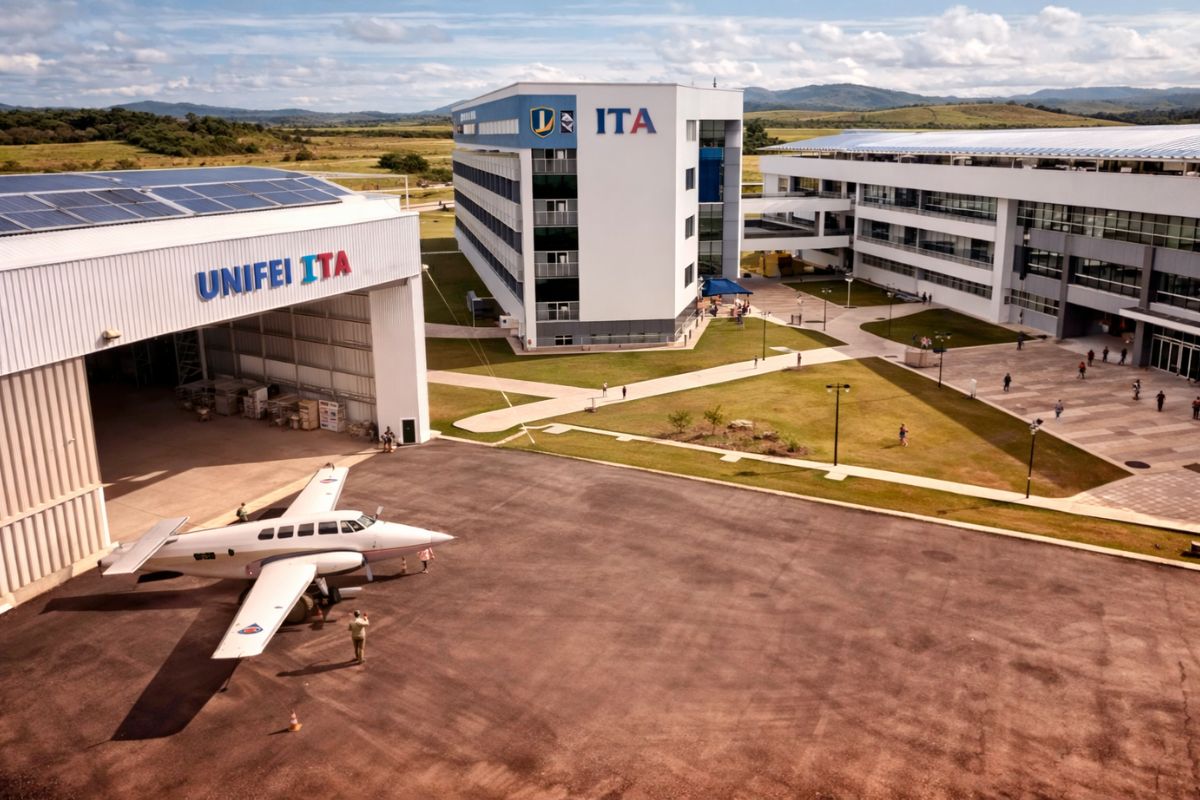
ITA Ceará inaugurates this Wednesday (1st) the first facilities of the advanced campus at the Air Force Base of Fortaleza, with a total investment of R$ 445.4 million from the Federal Government, two engineering courses that have never existed in the history of the institute, and a structure with 14 laboratories and accommodation for 80 students.
For 75 years, the Aeronautics Institute of Technology operated exclusively in São José dos Campos, in the interior of São Paulo. No other campus, no extension, no branch. All the training of engineers who helped build Embraer, the Brazilian space program, and the country’s aviation industry came from a single address. This officially changed this Wednesday when President Lula inaugurated the engineering block and student accommodation of ITA Ceará, located at the Air Force Base of Fortaleza, in the Aeroporto neighborhood.
According to g1, the institute that for decades was synonymous with excellence restricted to a single point on the Brazilian map is now preparing to welcome students in the Northeast. And this is not a replica of what already exists in São Paulo. The Ceará campus will offer two completely new courses that are not part of ITA’s traditional catalog: Energy Engineering and Systems Engineering.
What ITA Ceará will have in concrete when it is operational
The block designated for engineering courses occupies three entire floors.
-
Luciano Hang, owner of Havan, goes to Juiz de Fora after the tragedy in February, brings R$ 1 million, hands out R$ 2,000 cards, and donates up to R$ 15,000 to victims in the region.

-
The Brazilian passport allows legal residence in dozens of countries without the need for a prior visa, and most Brazilians are unaware that they can apply for residency directly upon arriving in nations in South America, Africa, and even Europe.

-
Petrobras sends a message to Brazilian truck drivers after fuel collapse and reveals plan to have 100% domestic diesel.

-
Mothers and daughters come together, create an ‘express’ beauty salon and turn the idea into a network with 21 units, revenue of R$ 16.7 million and 12,000 subscribers.


There are 14 teaching laboratories, 4 technical support rooms, 8 classrooms, 2 auditoriums, 6 meeting rooms, 6 study rooms, and 2 common rooms, in addition to reserved spaces for teachers, libraries, and academic events.
The student accommodation has been designed to ensure that students can live on campus, following the institute’s tradition in São José dos Campos.
There are 40 rooms equipped with a living room and kitchen, with a total capacity for 80 students. The residential block also includes 2 rooms adapted for accessibility, 2 activity rooms, and 1 additional classroom.
Why the institute chose Ceará and not another state
The decision to install the advanced ITA campus in Fortaleza was not random. The project was officially announced by President Lula in January 2024 and received a total investment of R$ 445.4 million from the Federal Government.
The location within the Air Force Base of Fortaleza offers existing military infrastructure and proximity to the technological hub that Ceará has been developing in recent years.
The Minister of Education, Camilo Santana, and Governor Elmano de Freitas, both from the PT party, attended the inauguration ceremony.
The choice of Ceará also carries strategic symbolism: to bring one of the most prestigious training centers in the country to the Northeast, historically concentrated in the South and Southeast axis.
Two courses that ITA has never offered in 75 years of existence
Until the creation of the Ceará campus, ITA offered six traditional engineering courses: Aeronautics, Electronics, Aeronautical Mechanics, Civil Aeronautics, Computing, and Aerospace. None of them will be replicated in Ceará. Instead, the institute chose to create two completely new degrees.
The first is Systems Engineering, aimed at training professionals capable of designing and integrating complex systems, a growing demand in sectors such as defense, telecommunications, and information technology.
The second is Renewable Energy Engineering, aligned with the global energy transition agenda and especially relevant for Ceará, which is one of the largest producers of wind and solar energy in Brazil.
In addition to these two degrees, there is already the prospect of creating postgraduate courses and a third undergraduate offering in Bioengineering, further expanding the institute’s training scope.
When will students start studying in Fortaleza
The first selection process for ITA Ceará took place in 2024. The approved students have already been welcomed by the institute but are still attending the initial stages of training at the campus in São José dos Campos, in São Paulo. The classes of 2025 and 2026 will follow this same provisional model.
The official forecast for the start of academic activities at the Fortaleza campus is 2027.
When the construction is fully completed, students will be transferred from the interior of São Paulo to the capital of Ceará, where they will continue their training in the new courses.
To ensure the operation of the institute in Ceará, 99 staff members were approved in a specific public competition, including teachers, researchers, technicians, and technologists. Of these, 33 have already taken office and are working on the implementation of the activities that will be carried out on campus.
What today’s inauguration means for the future of the institute
The rector of ITA, Antônio Guilherme de Arruda Lorenzi, summarized the moment during the ceremony: more than a physical expansion, the Ceará campus represents the willingness to preserve the excellence that built ITA’s reputation while renewing it in the face of the challenges of the 21st century.
The institute that for decades trained the professionals responsible for Brazilian aviation is now betting on renewable energy and complex systems as strategic areas for the country.
It is a deliberate change of direction, recognizing both the aeronautical legacy and the need to prepare engineers for problems that are still being formulated.
With R$ 445.4 million invested, two unprecedented courses, 14 laboratories, and accommodation that allows students to live on campus, ITA Ceará is not just a geographical extension. It is a bet that excellence can be built outside the traditional axis.
And what do you think of ITA’s decision to open its first campus outside São Paulo precisely in Ceará? Do you believe this can transform the engineering landscape in the Northeast? Leave your opinion in the comments.






Seja o primeiro a reagir!