





 English
  Francês
  Alemão
  Italiano
  Japonês
  Norueguês
  Portuguese
  Spanish
  6 min of reading
  0 comments


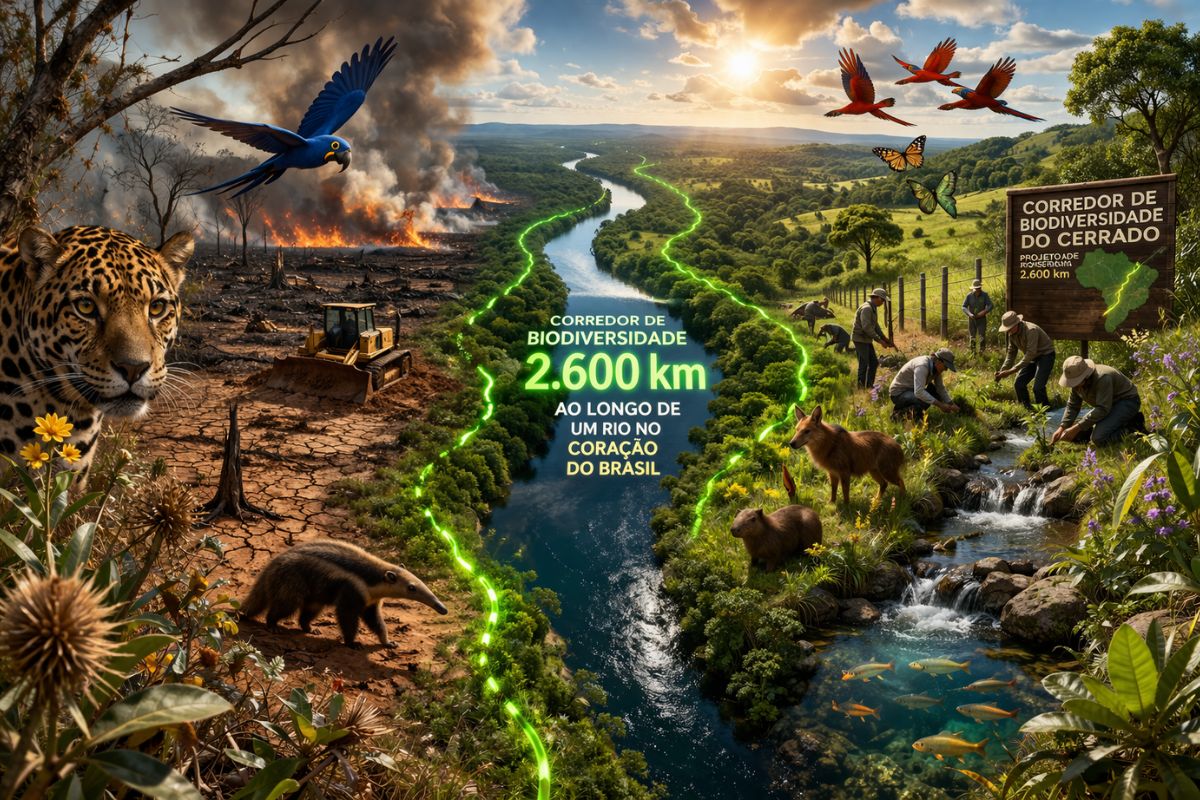
The Cerrado, an ecosystem that houses 5% of all species on the planet, has lost more than half of its vegetation cover. An ambitious project aims to build a 2,600-kilometer biodiversity corridor along the Araguaia River to reconnect habitats and save the Amazon.
The most underestimated ecosystem in the world lies just below the Amazon, housing 5% of all plant and animal species on the planet and disappearing at an alarming rate. In the last 50 years, more than half of the Cerrado has been deforested, an area equivalent to twice the size of Germany. While the world focused its efforts on protecting the Amazon, this ecosystem, crucial for the water balance of South America, was consumed by agricultural expansion.
Now, an ambitious plan aims to reverse part of this destruction.The Black Jaguar Foundation is building a biodiversity corridor of 2,600 kilometers along the Araguaia River, reconnecting fragments of native vegetation in a continuous chain of 1 million hectares that links the Cerrado to the Amazon. If successful, it will be one of the largest ecological restoration projects the world has ever seen.
Why the Cerrado is a vital ecosystem for South America

The Cerrado is the savanna with the highest biodiversity on the planet, even surpassing African savannas. In this ecosystem live giant anteaters, maned wolves, jaguars, macaws, and thousands of species of insects and plants, many of which are found exclusively in this region. It is a biome that sustains a biological wealth that few places on Earth can match.
-
With 19,000 tons, 199 meters in length, and the capacity to carry 720 marines, the ROKS Marado has become a floating amphibious base that extends South Korea’s naval reach in one of the most tense regions on the planet.

-
The United States has unveiled the MQ-25 Stingray, the world’s first carrier-based tanker drone designed to operate on aircraft carriers and extend the range of naval fighters.

-
A cheap Brazilian invention promises to change the fate of patients in ICUs by accelerating muscle recovery even in critical condition.

-
Kawasaki surprises by revealing a 140-ton aircraft capable of winning wars without a single shot and bets on ultra-secret technology to protect Japan by 2027.



But the role of the Cerrado goes far beyond visible biodiversity. The native plants of this ecosystem have roots that reach up to 18 meters deep, fragmenting the soil and transforming the savanna into a giant sponge that absorbs, stores, and slowly releases water.
This mechanism feeds springs, rivers, and underground reservoirs that sustain the entire water cycle of South America, including the so-called flying rivers that connect the Amazon to the rest of the continent.
How deforestation destroyed half of the Cerrado in 50 years

The rapid expansion of soybean production has exerted devastating pressure on the Cerrado. In the last five decades, more than half of the ecosystem has been converted into crops and pastures. The deforested area is equivalent to twice the territory of Germany, and the pace of destruction surpasses that of the Amazon.
The problem has worsened because, while international attention and protection policies focused on the Amazon rainforest, deforestation shifted south to the Cerrado, where legal protections are weaker. The fragmentation of the ecosystem has turned continuous forests into isolated islands surrounded by farms, compromising the ability of animals to move, plants to reproduce, and soil to absorb and distribute water. Soybean now occupies vast stretches of the biome, and 80% of global production is destined for animal feed.
The risk to the Amazon if the Cerrado continues to disappear
The connection between the Cerrado and the Amazon is much deeper than geographic proximity.In the Amazon, trees act as giant water pumps, absorbing water from the soil and releasing about 20 trillion liters into the atmosphere each day.
This moisture forms the flying rivers, masses of air loaded with vapor that cross the continent until they reach the Cerrado, where the rain is absorbed by the deep roots of native vegetation.
When rain falls on the preserved Cerrado, the ecosystem functions like a sponge: it absorbs the water, stores it in underground reservoirs, and slowly releases it into springs and rivers that flow back to the Amazon, closing the cycle.
But when the Cerrado is replaced by soybeans, whose roots reach a maximum of one and a half meters, this mechanism collapses. Without the original ecosystem, both the Cerrado and the Amazon may eventually dry up, with catastrophic consequences for the water supply across the continent.
The 2,600-kilometer biodiversity corridor along the Araguaia River

In light of this scenario, the Black Jaguar Foundation has developed a plan to create a continuous biodiversity corridor along the Araguaia River, in the heart of the Cerrado. The idea is to connect fragments of native vegetation that survived deforestation, forming a chain of 1 million hectares that extends for 2,600 kilometers and links the Cerrado to the Amazon.
The choice of the Araguaia River as the axis of the biodiversity corridor is strategic. Concentrating restoration along a river helps groundwater and wildlife recover much more quickly than in isolated areas.

The river acts as a natural corridor that reconnects fragmented ecosystems, allowing animals to move, plants to reproduce, and the water cycle to function again. The Foundation works in partnership with local farmers, using degraded pasture areas for planting, without taking productive land.
How the ecosystem restoration process works
The restoration begins with a network of 120 seed collectors that gather hundreds of thousands of seeds from over 80 different species of native trees from the Cerrado.
These seeds are taken to the Black Jaguar Foundation’s nursery, which has the capacity to produce at least 500,000 seedlings per year. The seedlings are then planted in degraded pastures in partnership with rural landowners who need to comply with the Brazilian Forest Code.
In Brazil, the law requires every rural landowner to protect and restore native vegetation on a percentage of their land: 35% in the Cerrado and 80% in the Amazon. In practice, many farmers do not comply with the requirement due to a lack of technical knowledge or resources.
The Foundation fills exactly this gap, helping producers restore their degraded areas while contributing to the formation of the biodiversity corridor. So far, at least 2 million trees have already been planted along the ecosystem.
The results that can already be seen in the Cerrado
Monitoring cameras installed in restoration sites show that the plan is working. Wildlife that had disappeared from these areas is already returning, and the planted seedlings are developing into new forests. In just two months, the roots of the native seedlings have already surpassed the length of the local grass, signaling that the ecosystem is beginning to regenerate.
In addition to environmental benefits, the project is generating significant jobs for local communities. Seed collectors, nursery workers, and tree planters find in the biodiversity corridor a stable source of income. For many, it is their first formal job, showing that the restoration of the Cerrado ecosystem can walk hand in hand with social development. Just like the forest, the community is also regenerating.
The Cerrado is the ecosystem that sustains the water cycle of South America, houses unique biodiversity, and is disappearing at an alarming speed.
The biodiversity corridor along the Araguaia River represents one of the most ambitious attempts ever made to reverse this destruction and reconnect a fragmented ecosystem on a continental scale.
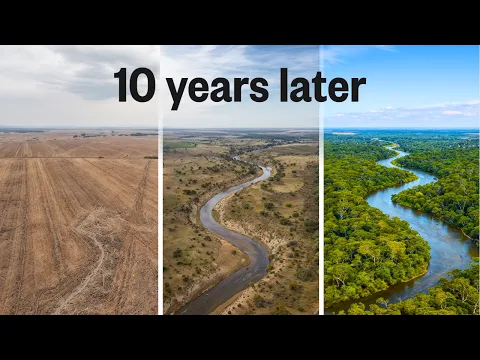

With information from the Channel Ecosia.
Did you know the importance of the Cerrado for the environmental balance of the continent? Do you think projects like the Araguaia River biodiversity corridor can make a difference in the face of advancing deforestation? Leave your opinion in the comments and share with those who care about the future of the environment.





Seja o primeiro a reagir!