





AgroVANT will be able to transport 25 times more inputs than a common agricultural drone and will gradually advance from remote operation to fully autonomous flights.
The pilotless agricultural plane developed in Paraná is attracting attention for its ability to transport up to one thousand liters of inputs or agricultural pesticides.
Called AgroVANT, the model will weigh over a ton, have 10-meter wings, a combustion engine, and a maximum speed of 150 km/h.
Additionally, the aircraft will be able to carry 25 times more products than a common agricultural drone, whose capacity is close to 40 liters.
-
The new giant of the fields does not need a pilot, reaches 150 km/h, and carries an amount of inputs that would require 25 common agricultural drones; with 10-meter wings and a capacity for 1,000 liters, the aircraft will be able to perform programmed routes and advance to fully autonomous flights in Paraná.
-
100-year-old woman surprises by maintaining an active routine, riding a jet ski, gathering 12 children, 37 grandchildren, 51 great-grandchildren, and still preserving traditions that unite four generations of the same family.
-
Four babies, one single egg, and an almost unprecedented pregnancy: identical quadruplets are born in Australia in a case estimated at one in every 15 million pregnancies.
-
NASA offers $3 million to anyone who can solve a problem that seems simple on Earth but becomes a nightmare on the Moon: recycling packaging, discarded clothing, and waste from space missions without relying on return to the planet.
Technology will allow agricultural spraying without a pilot inside the aircraft
The project initially foresees a remotely controlled operation. In this stage, the pilot will remain on the ground while monitoring the plane along a programmed route.
Subsequently, the system will advance from supervised flights to fully autonomous operations.
The absence of a cabin, in turn, will provide more space to transport agricultural products.
At the same time, the structure aims to enhance the safety of spraying operations.
The full-scale model is under construction. Additionally, researchers will have up to 36 months to complete the tests and ensure full autonomy.
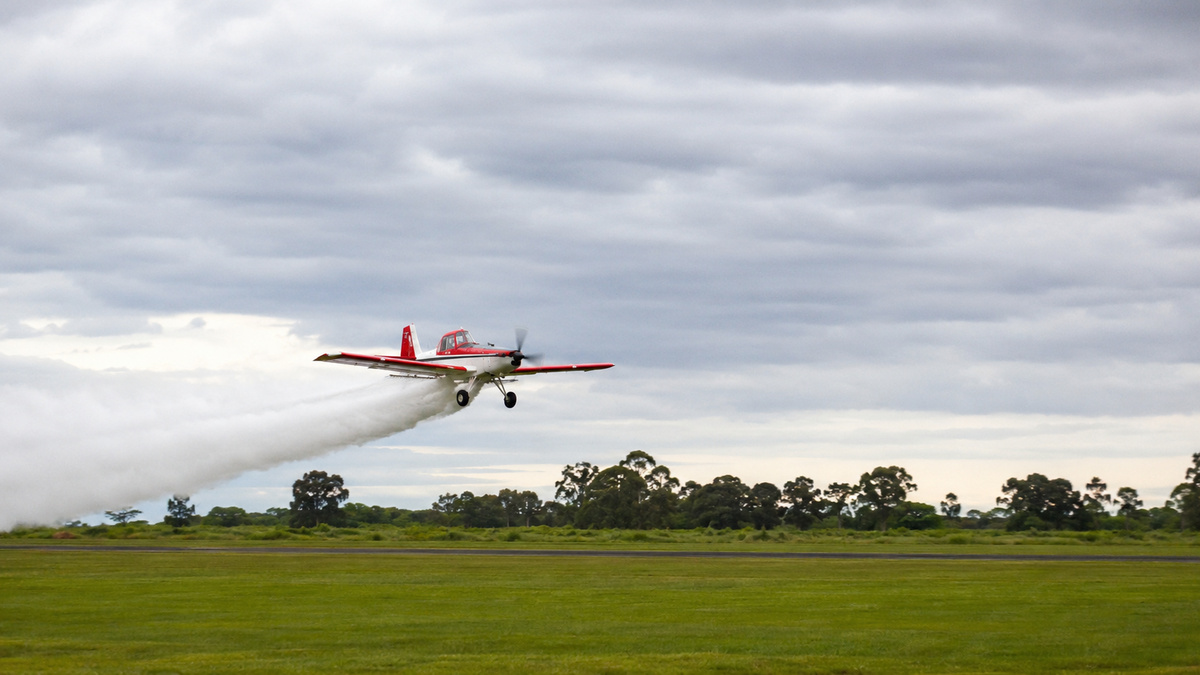
Project received an investment of R$ 2.7 million
The Government of Paraná launched the New Research and Innovation Arrangement for Small Aircraft on April 25, 2025.
Since then, the project has received R$ 2.7 million through the Araucária Foundation.
In May 2026, the first test with a two-meter prototype was successfully completed.
Now, therefore, researchers are working on building the plane in its definitive dimensions.
The initiative includes the Federal Technological University of Paraná, the Federal Institute of Paraná, and the State University of Ponta Grossa.
The project also involves the Pontifical Catholic University of Paraná and IPE Aeronaves.
Unmanned agricultural aircraft will have a capacity of one thousand liters and can reach 150 km/h during spraying operations.

Agricultural aircraft serve different activities in Paraná
Paraná has 141 manned agricultural planes, according to the National Union of Agricultural Aviation Companies.
Consequently, the state ranks seventh nationally and accounts for 4.8% of the Brazilian fleet, according to data from the National Civil Aviation Agency.
The Ministry of Agriculture and Livestock, on the other hand, counts 503 registered agricultural aircraft in Paraná.
Of this total, 122 are conventional aircraft and 381 are agricultural drones.
According to Ágide Eduardo Meneguette, president of the Federation of Agriculture of the State of Paraná, these equipment perform different activities.
Besides spraying, the aircraft distribute seeds and fertilizers. Similarly, they assist in reforestation and fighting forest fires.
The planes, above all, can cover large areas quickly. Thus, they avoid machine traffic, plant trampling, and soil compaction.
Drones, however, can better serve smaller regions.
Still, planes present higher costs than traditional methods and depend on weather conditions.
Moreover, areas that are fragmented or close to residences, water sources, and sensitive crops may limit these operations.
Agricultural aircraft fleet grows in Brazil
In May 2026, Brazil registered 2.16 thousand operational agricultural aircraft, according to the Brazilian General Aviation Association.
Compared to the previous 12 months, the fleet for spraying grew by 4.2%.
Simultaneously, the turboprops used for transporting people and cargo increased by 7.1%.
In 2025, in turn, the Brazilian agricultural fleet grew by 2.5% and reached 2.87 thousand planes, according to Sindag.
Of this number, approximately 62.9% belonged to specialized aerial services. However, the survey did not consider the aircraft of entrepreneurs.
The expansion consolidates agricultural aviation as a strategic productive infrastructure for Brazilian agribusiness, according to the union.
Do you believe that pilotless agricultural planes, capable of carrying a thousand liters of inputs, could transform spraying in large Brazilian farms?


