





 Portuguese
  English
  Spanish
  5 min of reading
  0 comments


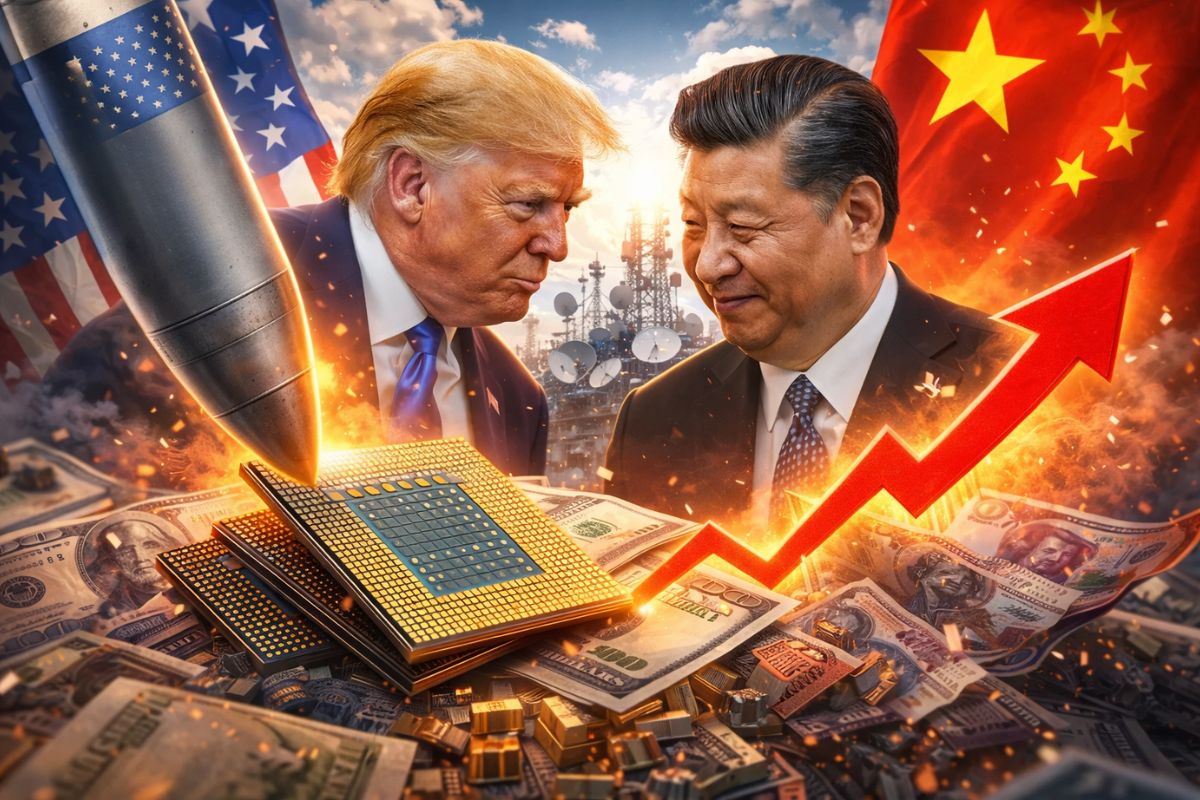
US sanctions against China’s semiconductor sector had the opposite effect intended: Chinese chip manufacturers reported record revenues in 2025, with growth of up to 247%, boosted by demand for artificial intelligence and government policy requiring local companies to buy national technology.
China not only survived American sanctions in the semiconductor sector but is profiting from them. The numbers released by major Chinese chip manufacturers show a scenario that directly contradicts Washington’s strategy: SMIC, China’s largest chip manufacturer, reached a revenue of 9 billion dollars in 2025, with analysts projecting over 11 billion for 2026. Huaon reported record revenue. And More Threads, considered the main competitor to Nvidia within China, reported revenue growth between 231% and 247% in a single year, according to data presented by CNBC.
What happened is, in essence, a classic case of unintended consequences. The restrictions imposed by the United States in recent years isolated China’s chip sector from access to essential technologies, such as the extreme ultraviolet lithography machines from Dutch company ASML. But instead of suffocating the industry, the sanctions pushed the Chinese government to adopt an aggressive import substitution policy, guiding local companies to acquire domestic chips, even if they are less powerful than those from Nvidia and AMD. The result is record revenues for domestic manufacturers that have gained a huge captive market, previously dominated by American suppliers.
Why US sanctions benefited China instead of harming it
The logic behind the sanctions seemed solid: cut China’s access to advanced semiconductor technologies to prevent the country from advancing in areas like artificial intelligence and defense. In practice, technological isolation forced a massive migration of Chinese demand to domestic suppliers. Companies that previously purchased chips from Nvidia, AMD, and other Western manufacturers were directed by the Beijing government to prioritize national alternatives, creating a customer base that did not exist before the restrictions.
-
With a dependency of up to 80% on gas imported from the United States, Mexico responds with a robust energy strategy, betting on shale gas, creating a scientific committee, and preparing to expand natural gas production to reduce vulnerability and strengthen its energy security in the coming years.

-
Goodbye to the classic stamp in the passport and welcome to total digital control: the new border system of the European Union is already in operation with mandatory biometrics, and those who download the Travel to Europe app before their trip can save time.

-
How much does a minimum wage employee really cost in 2026? The amount can reach close to R$ 3,000 and surprises business owners.

-
Man sets fire to giant warehouse of 111 thousand square meters, causing million-dollar losses due to alleged dissatisfaction with payment.

This dynamic works on two simultaneous fronts. On one hand, the demand for artificial intelligence chips remains high globally, and China is not left out of this race. On the other hand, Chinese industrial sectors such as electric vehicles, telecommunications, and consumer electronics absorb huge volumes of chips that local manufacturers can produce, even without access to the most advanced technologies. For these specific uses, Chinese chips are sufficient, and local companies are capitalizing on this opportunity with increasing profit margins.
The numbers that show the size of the boom in China’s chip industry
According to the channel TIMES BRASIL – EXCLUSIVE LICENSED CNBC, the financial results of Chinese semiconductor manufacturers leave no room for optimistic interpretation from Washington. SMIC, which operates China’s most advanced chip factories, closed 2025 with a revenue of 9 billion dollars, a significant jump from previous years. Industry analysts project that this number will exceed 11 billion in 2026, consolidating the company as one of the largest semiconductor foundries in the world by revenue.
The growth of More Threads is even more impressive. With revenue growth between 231% and 247%, the company positions itself as China’s answer to Nvidia in the artificial intelligence chip market. CXMT, a memory manufacturer preparing for an IPO, reported revenue growth of about 130% in 2025, benefiting from the global memory shortage and rising prices. Samsung also profited from this trend, but the fact that domestic alternatives from China are capturing a significant share of the domestic market is what truly worries American strategists.
The role of artificial intelligence and electric vehicles in China’s growth
The demand for artificial intelligence chips is the main driver behind the record revenues of China’s semiconductor industry. Technology companies in China are heavily investing in AI models that, although they do not use the most advanced chips in the world, operate with domestically manufactured processors.
This pragmatic approach allows China to advance in the artificial intelligence race even without access to Nvidia’s next-generation GPUs, whose sale to the country has been restricted by American sanctions.
Electric vehicles represent another fundamental pillar. China is the largest market for electric cars on the planet, and each vehicle uses hundreds of chips for control, navigation, battery, and entertainment systems.
For these components, the manufacturing technology of 28 or 14 nanometers that China dominates is more than sufficient, and demand grows every quarter as electric vehicle sales expand. American sanctions, focused on blocking access to technologies of 7 nanometers or below, ended up having little effect on this massive segment of the market.
What challenges still remain for China’s chip industry
Despite the impressive numbers, China’s semiconductor industry has not solved all its problems. The biggest bottleneck remains access to extreme ultraviolet (EUV) lithography equipment from ASML, the Dutch company whose machines are essential for manufacturing the most advanced chips in the world, those with transistors of 5 nanometers or less.
The export of these machines to China is prohibited, and without them, companies like SMIC and Hua Hong cannot compete in the most advanced segment of the market.
This means that, although China is generating record revenues with chips from previous generations, there is a technological ceiling that the sanctions effectively impose. To surpass it, China would need to develop its own alternative to ASML’s machines, an engineering challenge that experts consider possible, but which could take years or even decades to realize.
In the meantime, Chinese manufacturers maximize what they can produce with the available technology, and the financial results show that this intermediate market is large enough to generate billions in revenue.
What the chip boom in China means for US strategy


The irony of the situation does not escape analysts. The sanctions that were supposed to weaken China’s semiconductor industry are, in practice, accelerating the construction of a domestic supply chain that could become self-sufficient in the medium term.
The United States has managed to block China’s access to the most advanced chips, but has created a powerful incentive for the country to develop its own industrial base, now funded by record revenues that make investment in research and development more viable than ever.
For Washington, the dilemma is real. Easing sanctions would allow American companies like Nvidia and AMD to sell to the Chinese market, recovering lost revenue, but would also give China access to technologies that could be used for military purposes.
Maintaining the sanctions, on the other hand, continues to fuel the domestic boom and pushes China toward self-sufficiency, exactly the scenario that the United States wanted to avoid. The shot has backfired, and now both sides are measuring the consequences of a technological war that neither controls completely.
American sanctions were supposed to slow down China, but Chinese chip manufacturers have never made so much revenue. Do you think Washington’s strategy has failed or that the long-term effects still justify the restrictions? Leave your opinion in the comments.










Seja o primeiro a reagir!