





 Portuguese
  English
  Spanish
  2 min of reading
  0 comments


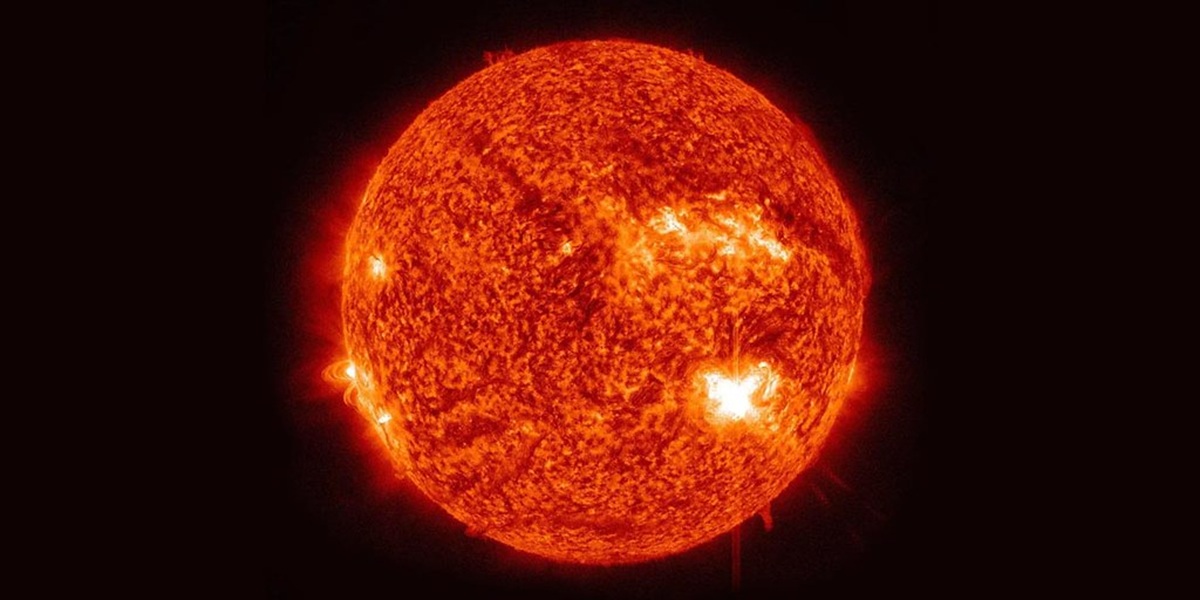
The Sun has drawn attention again after radio signals emitted by a sunspot the size of Earth were converted into sound, in a record that exposed a rare phenomenon observed in March 2024 and associated with bursts that lasted more than a week
The Sun can be observed beyond visible light and also emits radio signals, generated by its electromagnetic radiation, which become especially intense during solar eruptions. These signals reach the Earth’s ionosphere and can affect communications, revealing another way to perceive the activity of the star.
In addition to the visible spectrum, the Sun can also be perceived in the infrared and ultraviolet spectra. As with other celestial bodies, the star emits radio signals that are part of its electromagnetic behavior.
Radio signals from the Sun and sunspots
Sunspots also produce this type of emission, increasing scientific interest in the activity of the Sun. In March 2024, a scientific study identified a phenomenon similar to a terrestrial aurora above a large sunspot.
-
This is the weaponry that the smallest army in the world uses on a daily basis.

-
World’s largest floating library: at 132.5 meters long, Logos Hope is the largest floating book fair in the world, welcoming thousands of visitors each day and bringing over 5,000 titles to ports across various continents.

-
China has designed its first tourist submarine to take 3 passengers to a depth of 1,000 meters.

-
With up to 130 km in length, the Etosha Pan in Namibia remains almost the entire year as a white, cracked basin in the desert, but when the rare rains arrive, it transforms into a lake visible from space that reappears in the midst of one of the driest regions on the planet.

This event generated radio bursts for more than a week, something unusual compared to the pattern normally observed on the Sun. Generally, these bursts last only minutes or hours, making the episode an uncommon case.
Higher frequencies than Earth’s auroras
The difference compared to terrestrial auroras appears in the frequency range of these emissions. NASA pointed out that, unlike Earth’s auroras, radio bursts from sunspots occur at much higher frequencies, ranging from hundreds of thousands of kilohertz to about 1 million kilohertz.
These emissions show that the Sun can be perceived in ways that go beyond the traditional image observed in the sky. The recorded activity reinforces how the star manifests its phenomena in different ranges of the spectrum.
Video transforms signals from the Sun into sound
The channel DudeLovesSpace published a video in which it recorded close-up images of the Sun with a solar telescope while simultaneously capturing its radio signals with an antenna. The images show an active region with a sunspot the size of Earth, identified as AR4381, with plasma flowing in and out along the lines of the magnetic field.
The radio signals were converted into sound by the video’s creator. The result was a “voice” described as strange and fascinating, giving the Sun a rare auditory form of observation.









Seja o primeiro a reagir!