





 Portuguese
  English
  Spanish
  2 min of reading
  0 comments


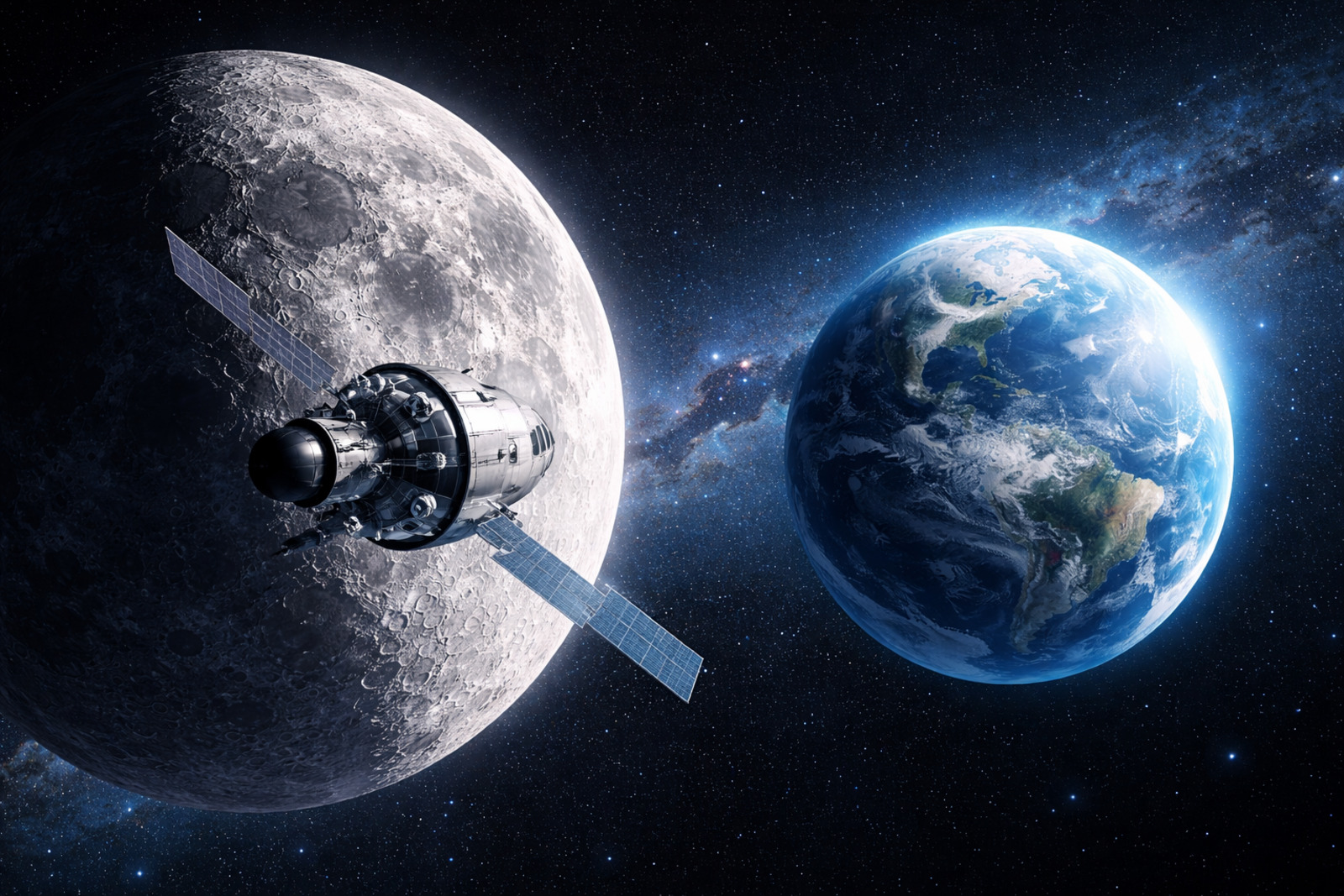
During maneuver around the Moon, the Artemis II mission took Orion to 406,771 kilometers from Earth and surpassed the Apollo 13 record by 6,600 kilometers
The Artemis II mission reached on April 6, 2026, the farthest point ever occupied by living humans in space. The Orion spacecraft reached 406,771 kilometers from Earth during a maneuver around the Moon, extending the reach of space exploration.
Historical record
With the mark of 406,771 kilometers from the Earth’s surface, Orion surpassed the record set by Apollo 13 in 1970 by 6,600 kilometers.
This result placed Artemis II at a new level for crewed missions and solidified the greatest advancement ever achieved by humanity in space.
-
The rare emergence of triple cyclones in the Pacific can unleash extreme rainfall on islands, form twin storms, and even strengthen a stronger El Niño on the planet.

-
The Moon holds billions of years of frozen water in dark craters that could provide fuel, oxygen, and drinking water for astronauts, and a new study finally explains how that ice got there.

-
Pirita, the “fool’s gold,” deceived prospectors for centuries and today helps science uncover the origin of Earth’s magma.

-
The largest volcanic event in Earth’s history may have changed everything beneath the Pacific: a study shows that eruptions 110 to 120 million years ago reshaped the oceanic plate of the Ontong Java Plateau, the largest oceanic plateau on the planet.

Operation around the Moon
The record was achieved during an orbital maneuver conducted near the Moon. The operation was a central part of the Artemis II mission.
The activity was conducted from the Kennedy Space Center in Florida, as part of NASA’s plan to validate technical resources in more complex operations beyond low Earth orbit.
Mission objectives
In addition to the record, Artemis II focuses on testing innovative technologies and advanced safety systems designed to ensure the success of the journey.
The objectives include protecting the crew and the spacecraft during delicate stages of the mission, generating essential learnings for crewed flights beyond Earth’s orbit.
Experts believe that the results of Artemis II may help answer central questions about the challenges of long missions in deep space.
Next steps of Artemis II exploration
The data gathered by Artemis II is considered crucial for future expeditions. NASA intends to use these experiences in the development of new lunar missions.
These advancements are also expected to support the design of a sustainable lunar base, enhancing preparation for scientific and logistical operations on the Moon.
The insights gained from the mission may also be applied to optimize future shipments and potential crewed missions to Mars.
With this milestone, Artemis II reinforces NASA’s commitment to lunar exploration and expands the boundaries of human presence in space.
With information from TNH1.







Seja o primeiro a reagir!