





 Portuguese
  English
  Spanish
  6 min of reading
  0 comments


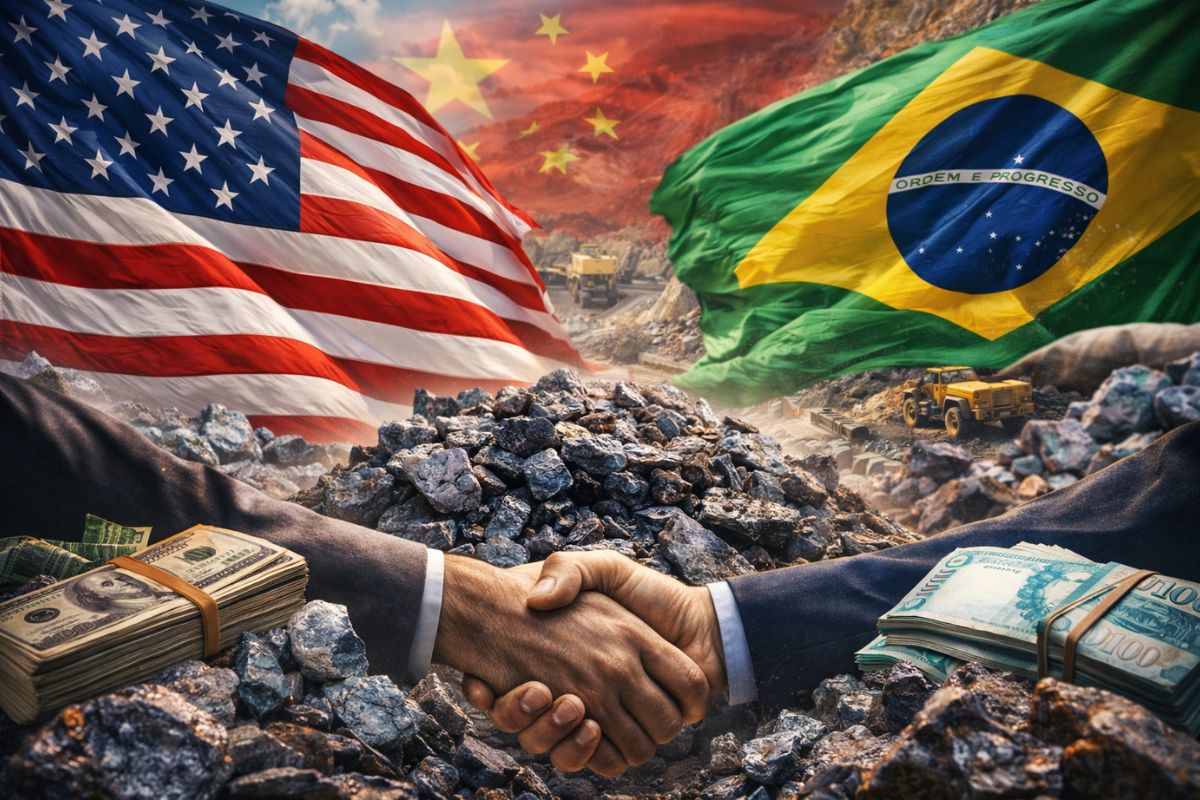
The American proposal for an agreement on critical minerals involves financing, technology transfer, and minimum price mechanisms against Chinese dumping, but the Lula government keeps the document stalled in the Planalto due to geopolitical fears and electoral calculation in an election year.
The critical minerals of Brazil have become a central piece in a silent dispute between Washington and Beijing, and the federal government is caught in the middle of this tug-of-war, unable to decide which way to lean. In February, the United States presented a formal proposal for a cooperation agreement in the critical minerals sector to the Planalto, which includes, among other points, minimum price mechanisms to protect the market against dumping, investments in refining capacity, and technology transfer on national territory. Excerpts of the document were obtained by CNN.
The proposal is considered similar to the agreement already signed between the United States and Australia, now regarded as a reference in the sector, with differences also inspired by a memorandum signed later between Americans and Thais. The problem is that, despite the offer being formally on the table, the Brazilian government has not signed it. The reasons range from the fear of displeasing China, Brazil’s main trading partner, to a political calculation that takes into account Donald Trump’s low popularity in the country and the electoral calendar.
What the American proposal offers Brazil in critical minerals
The document presented by the United States to the Brazilian government is not vague. It directly addresses the American strategy to reorganize the supply chains of critical minerals, which are currently heavily concentrated in China.
-
With a dependence of up to 80% on gas imported from the United States, Mexico is responding with a robust energy strategy, betting on shale gas, creating a scientific committee, and preparing to expand natural gas production to reduce vulnerability and strengthen its energy security in the coming years.
-
How the world’s largest market sidestepped Trump’s tariff hike, diverted part of the cargo to new destinations, and still set a record in exports.

-
Petrobras buys back fields for billions — what no one is talking about regarding this decision and how it could impact jobs and oil in Brazil.

-
Grande SP gains unprecedented technology to control water flow with installation in just 8 hours and a promise to reduce leaks without the need for human intervention.
According to the text, Brazil and the United States would commit to intensifying cooperation efforts to accelerate the secure supply of these inputs, considered strategic for defense, energy transition, and advanced technologies.
The second axis of the proposal involves financing. Both countries would mobilize government and private sector support, including capital and operational expenses, through guarantees, loans, equity participation, insurance, and regulatory facilitation.
In practice, this would open up space for direct financial support for mining and processing projects of critical minerals in Brazil, especially in the stages of highest value addition, such as refining and separation, exactly the link in the chain where the country loses the most revenue by exporting raw ore.
Minimum price against Chinese dumping is the most sensitive point of the agreement
One of the most important excerpts of the proposal deals with the so-called price mechanisms. According to the text, Brazil and the United States would work to protect their domestic markets of critical minerals against practices considered unfair, including the creation of systems with minimum prices or equivalent mechanisms. This point is seen as central by mining companies and industry analysts.
The reason is simple: China dominates the processing chains of critical minerals and often practices prices that make international competition unfeasible. Without a minimum price floor, investors hesitate to put capital into mining and refining projects that take years to mature and require predictability of return.
Mining companies point to the constant risk of dumping as the main obstacle to the development of the sector outside the Chinese orbit. The mechanism proposed by the Americans seeks exactly to create this predictability, and Brazil, with its reserves of niobium, lithium, rare earths, and graphite, would be one of the biggest beneficiaries.
The investment priority clause that divided the government
Another point that generated internal friction in the Planalto comes from a passage inspired by the agreement between the United States and Thailand.
In it, the countries would agree that “they expect to have the first opportunity to invest” in critical minerals projects considered a priority. CNN obtained access to this excerpt of the document, which establishes that priority would occur within the domestic laws of each country.
Part of the Brazilian government interprets the wording as potentially restrictive, raising doubts about any mandatory preference for American investors.
Representatives of the United States deny that the provision represents any kind of exclusivity, arguing that the text only establishes investment priority within national legislations, without preventing partnerships with other countries.
The divergence of interpretation among the factions of the government is one of the factors keeping the agreement stalled, fueling an impasse that has lasted for months.
What the United States agreement with Australia has and Brazil’s does not
The comparison with the Australian agreement reveals differences that weaken the proposal made to Brazil. In the case of Australia, the two countries committed to facilitating at least $1 billion in financing for selected critical minerals projects. In the Brazilian proposal, this amount simply does not appear, which, according to sources involved in the negotiations, reduces the degree of direct financial commitment from the Americans.
Another relevant absence is that of periodic ministerial meetings dedicated exclusively to investments in mining, a mechanism present in the agreement with Australia. A formal rapid response group for supply security was also not included, a structure that in the Australian case was created to identify vulnerabilities and accelerate priority projects.
In summary, the proposal offered to Brazil is less robust in concrete commitments than the Australian reference, although American representatives argue that agreements in the mineral sector tend to follow similar patterns and that they are negotiating simultaneously with dozens of countries.
Why the Planalto does not sign the agreement on critical minerals
The memorandum is still under analysis at the Palácio do Planalto, and the reasons for the paralysis are both geopolitical and electoral. One faction of the government assesses that it would not be strategic for Brazil to position itself in an agreement with a bias considered anti-China, since the entire American strategy for critical minerals seeks, by definition, to reduce global dependence on Chinese processing.
China is currently Brazil’s main trading partner, and any movement interpreted as alignment with Washington—especially an agreement that explicitly mentions dumping and minimum price—could generate trade or diplomatic retaliation.
There is also the factor of domestic politics. The agreement, according to sources, would only be signed in a potential meeting between President Luiz Inácio Lula da Silva and President Donald Trump, a scenario considered increasingly distant.
Trump faces low popularity in Brazil, and members of the government recall that moments of confrontation between the two leaders coincided with peaks of approval for Lula. In an election year, the approach to the American government in this context is seen as politically risky. The calculation is straightforward: signing a critical minerals agreement with the United States may yield long-term economic gains, but the short-term political cost is considered too high by those who need to win an election.
What is at stake for Brazil while the agreement does not come through
While the Planalto calculates political costs, the critical minerals sector continues to undergo rapid transformation in the global scenario. The United States, Australia, Canada, and European Union countries are closing bilateral agreements to ensure supply chains outside of China.
Brazil, with some of the largest global reserves of strategic minerals, risks falling behind in this reorganization if it does not define its position in time.
The American document, despite its limitations compared to the Australian agreement, provides for cooperation in geological mapping, support for recycling technologies, and, above all, the construction of refining capacities on national territory. For a country that exports raw ore and reimports processed products at much higher prices, the promise of a minimum price against dumping and investments in refining is not trivial.
The decision to sign or reject the agreement on critical minerals is not just a diplomatic issue—it is a choice about what role Brazil wants to occupy in the global economy in the coming decades. And this choice, for now, is suspended between the fear of China, the electoral calendar, and a proposal that ages in the drawer of the Planalto.
Should Brazil sign this critical minerals agreement with the United States or is it right to wait? Does the risk of upsetting China justify missing the opportunity to attract investments in refining and processing?









Seja o primeiro a reagir!