





 Portuguese
  English
  Spanish
  6 min of reading
  0 comments


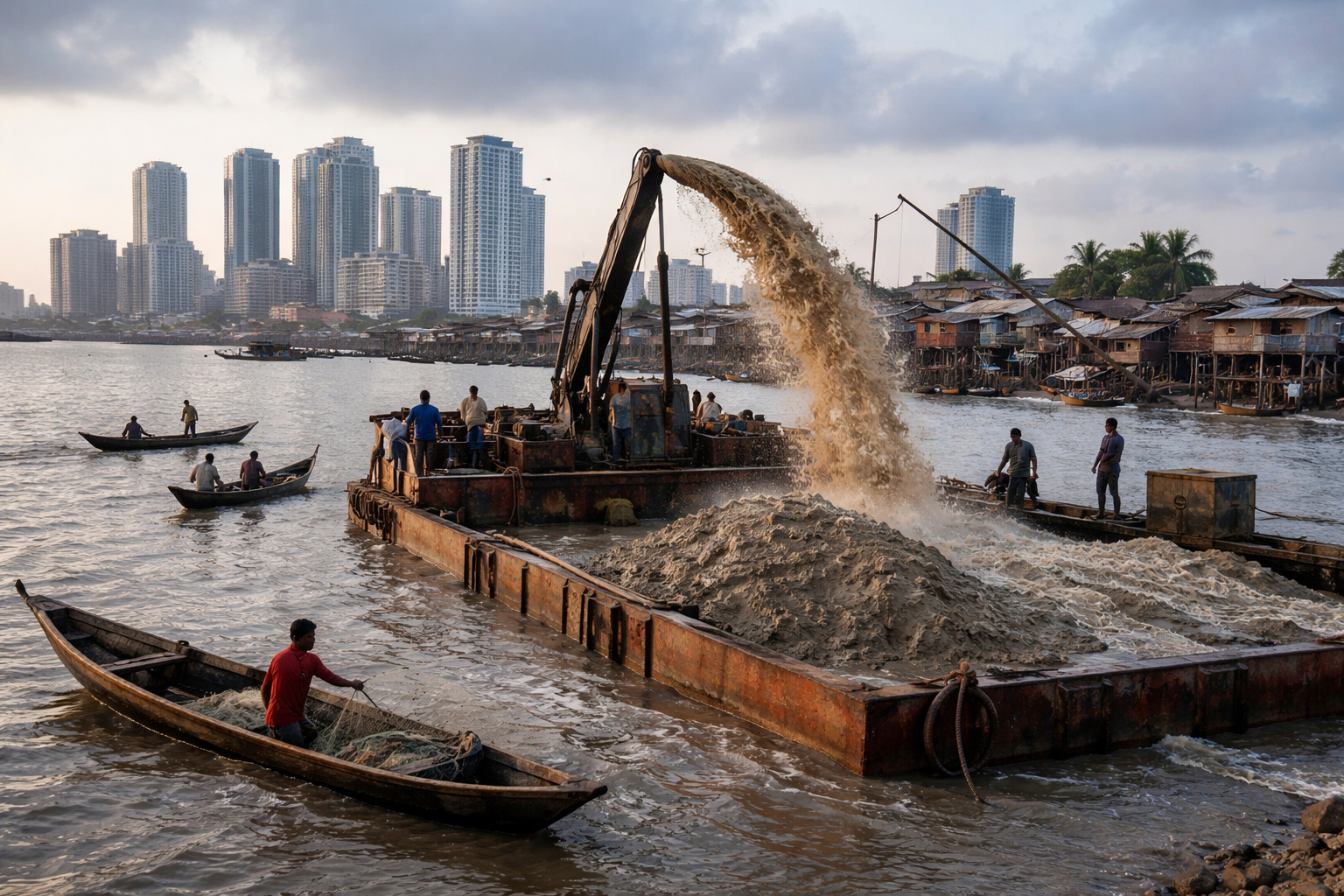
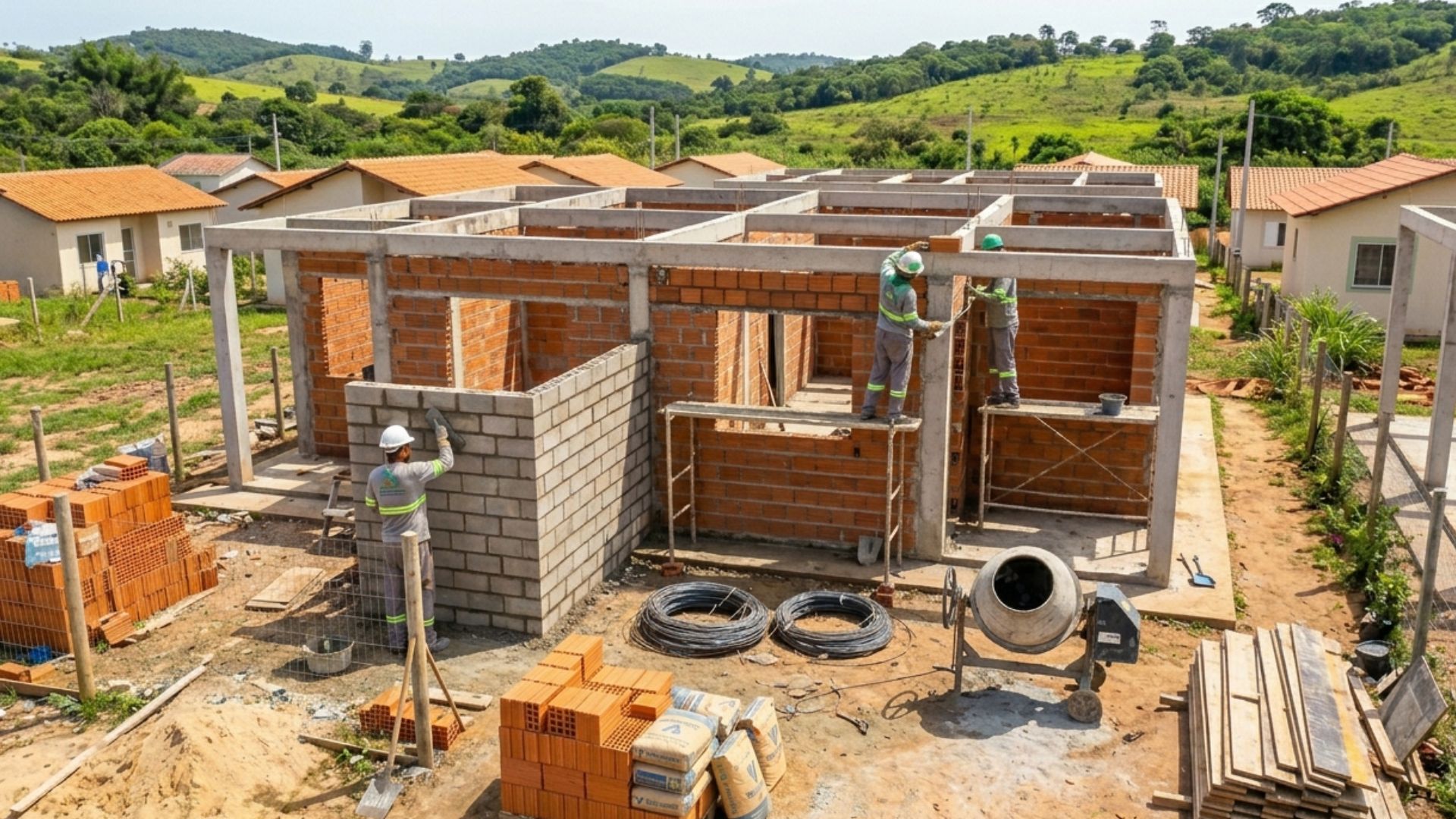
Dredging machines remove sand from rivers and the lagoon to supply the construction of skyscraper blocks, residential areas, and viaducts. The advancement of the city accelerates erosion, destroys fishing, and threatens entire communities.
Before dawn, the dredging machines already cut through the silence and pull sand from the bottom of the water to feed the expansion of a city that never stops growing. Rivers, canals, and the lagoon have become a source of raw material for the construction of skyscraper blocks, residential areas, and viaducts. However, behind the new constructions, a scenario of mining, erosion, murky water, disappearing fish, and entire communities losing what has always guaranteed food and income is advancing.
In Lagos, sand dredging is regulated by the state government and the waterways authority. In practice, however, oversight does not keep up with demand. In a metropolis with over 20 million inhabitants and a constant thirst for construction material, not all extraction occurs within the rules.
Dredging machines, mining, sand, and rivers under pressure to meet construction projects
One of the most serious signs appears in the stretch between Banana Island and the area near the Third Mainland Bridge. According to a study by the Nigerian Institute of Oceanography and Marine Research, uncontrolled dredging and mining have eroded nearly 6 meters of the riverbed over a stretch of about 5 kilometers. When the bottom gives way on this scale, it changes the circulation of water, the stability of the banks, and the balance of species.
-
A man renovated a caravan spending less than R$15,000, transforming the vehicle into a small and functional trailer using wood, wheels, metal plates, and wall installation, and surprises with the perfect result.

-
Children from emotionally cold homes reveal a shocking secret: early independence may hide deep traumas and silently and durably impact adult life.

-
The United States damages a millennia-old archaeological site with explosives to build the wall at the border.
-
Giant silos with a capacity of 300,000 tons have been erected outside the Strait of Hormuz to safeguard the supply of the Gulf; this megainfrastructure transforms Fujairah into one of the most strategic food vaults on the planet in times of crisis.
Environmentalist Nnimmo Bassey warns that removing sand without proper assessment destroys species, weakens fishing, and directly affects those who depend on it. In areas like Epe, Oto-Awori, Era Town, and Makoko, this has ceased to be a distant risk.
The city driven by the construction of skyscrapers, residential areas, and viaducts while the bank disappears
In Era Town, anger grows at the same speed as erosion. Ogbemi Okuku, 20 years old, summarizes the feeling of abandonment: “While Lagos rises, our land is washed away with the water. They build condos with sand taken from our waters. But who builds for us?”
The statement exposes the harshest contrast of this story. On one side, the city erects developments, viaducts, and new neighborhoods. On the other, residents see the land giving way with each rainy season.
Urban expansion may be presented as a sign of progress, but the landscape shows another face. In several points of the lagoon, what disappears is not just the mud from the bank. The sense of security also vanishes. Houses become more exposed. Fear grows with the rains. And the community begins to realize that the very water, once seen as sustenance, has turned into a threat.
Fishing has entered a silent collapse
Fasasi Adekunle, a 55-year-old fisherman, has known the lagoon for over 30 years. Previously, he would cast his nets at seven in the evening and return before noon with enough tilapia to earn at least 30,000 naira. Today, he needs to navigate farther, spend more on fuel, and even then, often returns with almost nothing.
His statement summarizes the turning point: “Water is no longer our friend.” Then comes the cruelest portrait of the problem: “Fish are disappearing, and our children still need to eat.”
The impact does not stop at the boat. It also reaches the market. Ajoke Orebiyi, 42 years old, says that ten years ago she needed three full boats to meet demand. Now, supply has dropped so much that her income has been reduced by almost half in five years. The little that comes in must pay for food, rent, and school.
When catch decreases, prices rise. The customer complains. But those who sell are also suffocated. In the end, the loss spreads from the lagoon to the table, from the fisherman to the fishmonger, from the water to the entire community.
Murky water and signs of collapse
The decline of fish in coastal areas is often associated with the climate crisis, which alters water temperature, rainfall, and species distribution. However, fishermen in Lagos point to another visible change: the bottom of the lagoon is no longer the same.
They report deeper channels, muddy water, altered currents, and nets caught in an irregular bed. Jeremiah, a 77-year-old fisherman in Oto-Awori, describes what he sees: “When the dredges operate, the water becomes murky. The fish leave, and sometimes we find some dead floating on the surface.”
This type of report helps to understand why the crisis has ceased to be merely environmental. When the water changes, the entire routine changes along with it. The fisherman loses his reference. Work yields less. The risk increases. And the community begins to live in uncertainty.
Joseph Onoja, the director-general of the Nigerian Conservation Foundation, states that the impact goes beyond fishing. According to him, uncontrolled dredging threatens turtle nesting areas, habitats of migratory birds, and other already pressured species. The warning is direct: there are already early signs of ecological collapse.
Mark Ofua, a representative of Wild Africa for West Africa, reinforces that over 230 species of fish from Nigeria’s inland waters are already showing population declines, partly due to these activities.
Weak oversight and quick money maintain the cycle
Although there is a regulatory framework, residents and fishermen claim that many mechanized operations occur at night. According to them, operators also change locations to escape oversight. There are also reports of support from local leaders to dredging companies, making any reaction from those living there more difficult.
Money helps to maintain this cycle. Sand mining yields high returns in a city driven by real estate expansion and the reclamation of flooded areas for new developments. For some groups, this means profit. For poor workers, it means survival.
This is the case of Wasiu Olaniyi, 36 years old. A former bricklayer, he now dives to the bottom of the lagoon in Oto-Awori to extract sand. Each full boat yields 10,000 naira for those who sell the material to intermediaries, and filling a single boat takes about three hours.
This is the harshest point of the story. The same activity that destroys part of the ecosystem has also become a source of income for those who can no longer find a way out in a fragile economy. In other words, the problem is not sustained solely by the ambition of large projects. It also grows on the desperation of those who need to put food on the table.
When sand becomes a threat to the city itself
Environmental organizations advocate for strict monitoring, habitat restoration, and a moratorium on dredging in sensitive areas. The argument is simple: development is necessary, but it cannot destroy the ecosystems that sustain life and the local economy.
Without real control, the same sand that raises the construction of skyscraper blocks, residential areas, and viaducts can push the lagoon and communities toward a collapse that is difficult to reverse. What today seems like urban advancement may tomorrow turn into a much greater environmental, social, and economic loss.
At the time public agencies were sought for comment on the situation, there was no response. And this silence weighs heavily. Because, while the city grows, the water loses strength, the bank disappears, and fishing goes along with it.
And you, do you think a city can call this progress when the water stops sustaining those who have always lived from it? Leave your comment and share this publication.






Seja o primeiro a reagir!