





Trump Administration launches campaign to attract veterans to the trucking sector after new rules affect commercial licenses of immigrant drivers in the USA.
The White House has begun promoting the entry of military veterans into the United States trucking sector amid a federal crackdown on commercial licenses for immigrant and non-resident foreign drivers. The initiative occurs during the Trump administration and was reported by the Associated Press, which informed that the administration wants military personnel to consider working as truck drivers upon leaving the Armed Forces. The measure comes in the same context where tens of thousands of immigrant drivers lost licenses or were removed from the roads due to new federal rules.
The program was presented as a way to connect veterans to jobs in road transportation, an essential sector for supplying the American economy. The campaign was named Freedom Haulers and involves agencies such as the Department of Transportation, the Department of Defense, the Department of Veterans Affairs, and the Department of Labor.
The Freedom Haulers campaign targets military personnel transitioning to civilian life
The Freedom Haulers campaign was created to promote opportunities in the road transportation sector to veterans and military personnel leaving the Armed Forces.
-
Few people noticed, but Yamaha has initiated a change that could redefine its urban logistics: the electric truck has already started operating in São Paulo, and the initial results explain why this plan should advance quickly.

-
New 508 km high-speed train promises 12 stations, a 21 km underwater tunnel, and a new railway industry in India, paving the way for factories, jobs, local technology, and long-term economic corridors.
-
New 508 km high-speed train promises 12 stations, a 21 km underwater tunnel, and a new railway industry in India, paving the way for factories, jobs, local technology, and long-term economic corridors.
-
Port of Itajaí permanently changes traffic starting July 22, closes a section of Blumenau Street at Gate 2 and redirects trucks, buses, cars, and cyclists through the new Via do Porto, while Max Street gets reversed direction, parking prohibition, and a bike lane in Santa Catarina.


According to the Associated Press, the proposal seeks to leverage the experience of military personnel who have already operated heavy vehicles during service.
The government argues that this experience can facilitate the transition to civilian commercial driving, especially at a time of labor pressure in the sector.
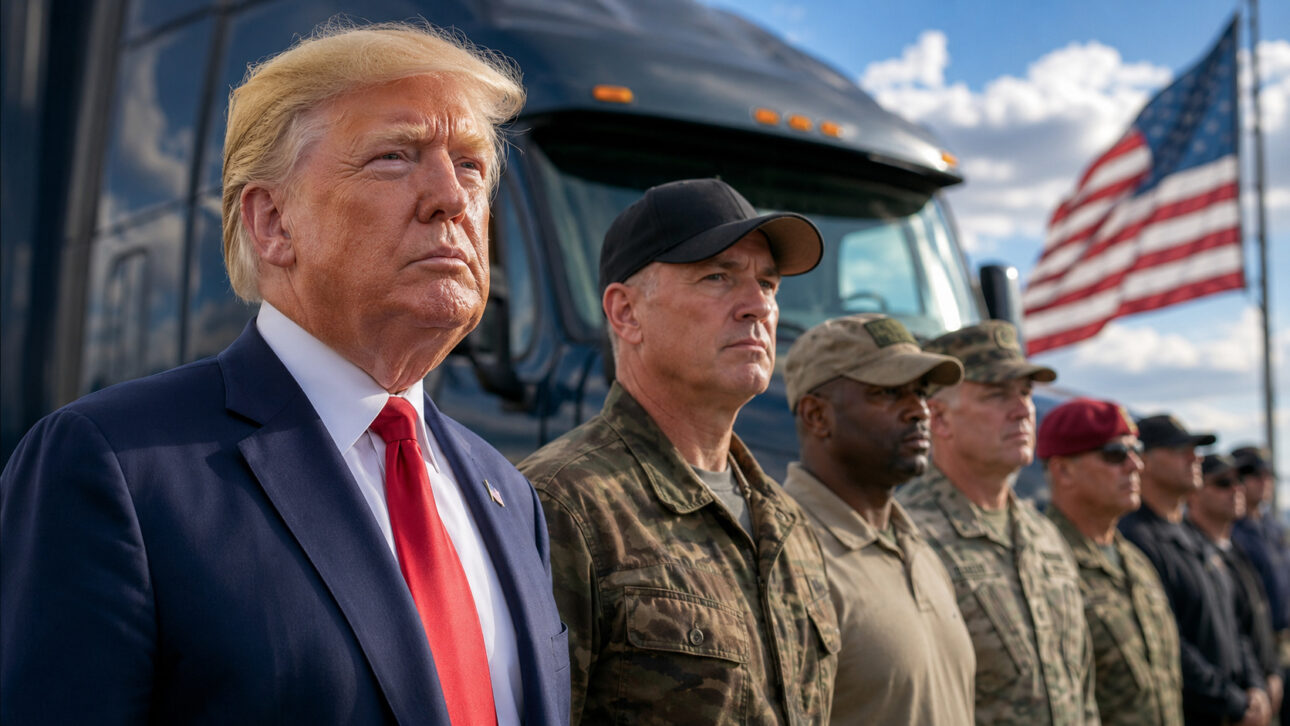
The campaign also promotes pathways to obtaining the Commercial Driver’s License, known by the acronym CDL, a mandatory license for commercial drivers in the United States. Among the mechanisms disclosed are programs that allow military personnel with recent experience in heavy vehicles to waive the CDL practical test.
Veterans can skip part of the process to obtain a commercial license
According to the rules cited by the Associated Press, military personnel who have driven heavy vehicles of more than 2.5 tons recently may be exempt from the practical test to obtain the commercial license.
Even with this waiver, candidates still need to meet other requirements. They must study commercial traffic regulations, know federal and state rules, and pass the written test necessary to obtain the CDL.


The campaign also highlights the possibility of using GI Bill benefits to cover professional training in the field. This point transforms the policy into a bridge between veteran qualification and workforce replenishment in road transportation.
The federal offensive targeted immigrant driver licenses
The other part of the measure is linked to the actions of the Federal Motor Carrier Safety Administration, known by the acronym FMCSA, an agency linked to the United States Department of Transportation.
In February 2026, the FMCSA announced a final rule to restrict the issuance of commercial licenses to non-domiciled foreign drivers. The rule limited eligibility to specific visa categories, such as H-2A, H-2B, and E-2, and tightened verification criteria for granting the CDL.
The agency stated that the change seeks to prevent foreign drivers without a verifiable driving history or without accepted documentation from receiving commercial licenses to operate large trucks on American roads.
Work authorization documents are no longer sufficient
The FMCSA rule also eliminated the use of work authorization documents as sufficient proof for obtaining a commercial license by non-domiciled foreign drivers.
According to the Department of Transportation, the change was adopted to correct flaws in the commercial licensing system. The agency states that some states were issuing licenses without proper verification of driving history and without sufficient proof of migratory eligibility.
The new policy also established procedures for reviewing licenses already issued before the rules came into effect. This paved the way for cancellations and disputes involving drivers who were already working in the sector.
Tens of thousands of drivers were affected
The Associated Press reported that about 26,000 drivers were removed from the roads for failing to demonstrate proficiency in English.
The same report cited a statement from the Department of Transportation according to which 30,000 commercial licenses were canceled for having been issued illegally. These numbers show the extent of the federal offensive, although they refer to different categories and should not be automatically treated as a single count of people.
The impact is enough to create pressure on carriers, logistics chains, and supply routes. The trucking sector relies on a large volume of qualified drivers to maintain the flow of goods between ports, distribution centers, factories, farms, and supermarkets.
English proficiency has become a central point of inspection
The requirement for English proficiency has taken a central role in the federal policy of inspecting commercial drivers.
The FMCSA states that drivers need to be able to understand traffic signs, communicate with authorities, respond to official instructions, and fill out required documents during commercial trips.
According to the Associated Press, thousands of drivers have been removed from the roads for failing to demonstrate this proficiency during inspections. The measure has particularly affected immigrant or foreign drivers already working in the sector.
California clashed with the federal government
California has become one of the main focal points of the dispute between the federal government and the states.
Reuters reported that the United States Department of Transportation withheld federal funds intended for California due to commercial licenses granted to foreign drivers. The federal government stated that the state did not cancel licenses deemed irregular within the required timeframe.
According to Reuters, the Trump administration threatened to withhold nearly $160 million in federal funds if California did not comply with requirements related to the cancellation of commercial licenses. The state contested the accusations and claimed to follow applicable rules.
Road transport became an economic pressure point
Road transport is one of the foundations of the American economy. Trucks move food, fuel, industrial parts, port cargo, agricultural products, and goods destined for retail.

When a federal policy removes thousands of drivers from the system, the effect can reach freight costs, delivery times, and the availability of labor in certain regions.
The campaign aimed at veterans arises in this context. While tightening the rules against foreign drivers deemed ineligible, the government tries to present an alternative to fill part of the demand for commercial drivers.
Replacement does not occur immediately
The entry of veterans into the sector does not mean the automatic replacement of drivers affected by the new rules.
Driving commercial trucks requires adaptation to civil regulations, interstate routes, cargo documentation, weight limits, inspections, rest control, and operation in a private logistics environment.
Even military personnel with experience in heavy vehicles need to go through licensing, training, and adaptation to the market. The routine of road transport also involves long hours, deadline pressure, and prolonged periods away from home.
Therefore, the campaign may increase veterans’ interest in the profession, but its ability to quickly replace all affected drivers depends on the actual adherence of ex-military personnel and the response from transport companies.
Government associates the measure with road safety
The official justification from the Department of Transportation is road safety. The FMCSA states that stricter rules are necessary to prevent the improper issuance of commercial licenses to people without accepted documentation or without a verifiable driving history.
The government also associates the enforcement of English proficiency with the ability of drivers to understand orders, signs, instructions, and emergency situations.
This line of argument places the policy within a road safety agenda. The Trump administration claims that large trucks require strict licensing standards, especially on interstate trips.
Critics point to risk for workforce and logistics
The policy also sparked criticism for affecting immigrant workers who were already active in road transport.
The trucking sector has historically depended on foreign and immigrant workers in different routes and operations. The removal of drivers may affect smaller companies, regional carriers, and distribution chains that were already struggling to hire qualified drivers.
The Associated Press reported that the new rules and requirements are being legally challenged. This keeps part of the policy in dispute and may influence its implementation in the coming months.
The measure unites immigration, military employment, and supply
The Freedom Haulers campaign brings together three sensitive political fronts in the United States: immigration, employment for veterans, and cargo transport safety.
For the White House, the initiative allows for the promotion of veterans, strengthening control over commercial licenses, and responding to the need for drivers in the sector.
For companies and workers, the change creates a scenario of reorganization. Foreign drivers face stricter rules, while veterans are encouraged to occupy space in a strategic profession for the economy.
The impact will depend on veterans’ adherence
The success of the campaign will depend on how many veterans actually seek training, obtain the CDL, and remain in the profession.
The truck sector has a constant demand for drivers, but it also faces turnover, high operational costs, and working conditions considered difficult by professionals.
Military experience with heavy vehicles can help in the transition, but it does not eliminate all the challenges of civilian commercial transportation. The career requires endurance, operational discipline, and adaptation to specific norms of the private market.
Policy occurs amid dispute over commercial licenses
The campaign to attract veterans did not arise in isolation. It accompanies a broad regulatory change regarding who can or cannot receive a commercial license in the United States.
The FMCSA restricted the eligibility of non-domiciled foreign drivers, reduced the acceptance of certain documents, and paved the way for the review of previously issued licenses.
This change directly affected immigrant and foreign drivers who relied on the CDL to work. At the same time, the White House began promoting veterans as an alternative for the sector.
White House tries to turn labor crisis into military appreciation agenda
The Freedom Haulers campaign presents road transport as a career opportunity for military personnel leaving the Armed Forces.
The official message associates military experience with discipline, mastery of heavy vehicles, and the ability to operate in an area essential for the country’s functioning.
This strategy also allows the government to turn a regulatory offensive against foreign driver licenses into an agenda of veteran appreciation. The truck sector is presented as a professional destination for people who have already served the country and seek reintegration into the civilian market.
A change that could redefine part of transportation in the US
The combination of license cancellations, new requirements for foreigners, and veteran recruitment campaigns could alter part of the composition of the workforce in American road transport.
The immediate effect is the removal or threat of removal of thousands of drivers from the roads. The intended effect by the government is to replace part of this workforce with veterans and drivers considered fully eligible under the new rules.
The execution, however, will depend on enforcement, judicial decisions, state responses, company adherence, and the real interest of veterans in entering the profession.
An offensive that puts truck drivers at the center of American politics
The White House policy places truck drivers at the center of a national dispute over work, immigration, and security.
On one side, the Trump administration claims it is correcting flaws in the licensing system and protecting the roads. On the other, the offensive affects immigrant workers who were already part of the sector and may pressure logistics chains dependent on licensed drivers.
In this scenario, the campaign to attract veterans functions as a labor response to the reduction of drivers caused by the new rules.
The result is a major impact change in American road transport: thousands of commercial licenses were contested or canceled, immigrant drivers lost ground, and the White House began targeting military veterans as part of the solution to rebuild the workforce on the roads.


