





 Portuguese
  English
  Spanish
  5 min of reading
  0 comments


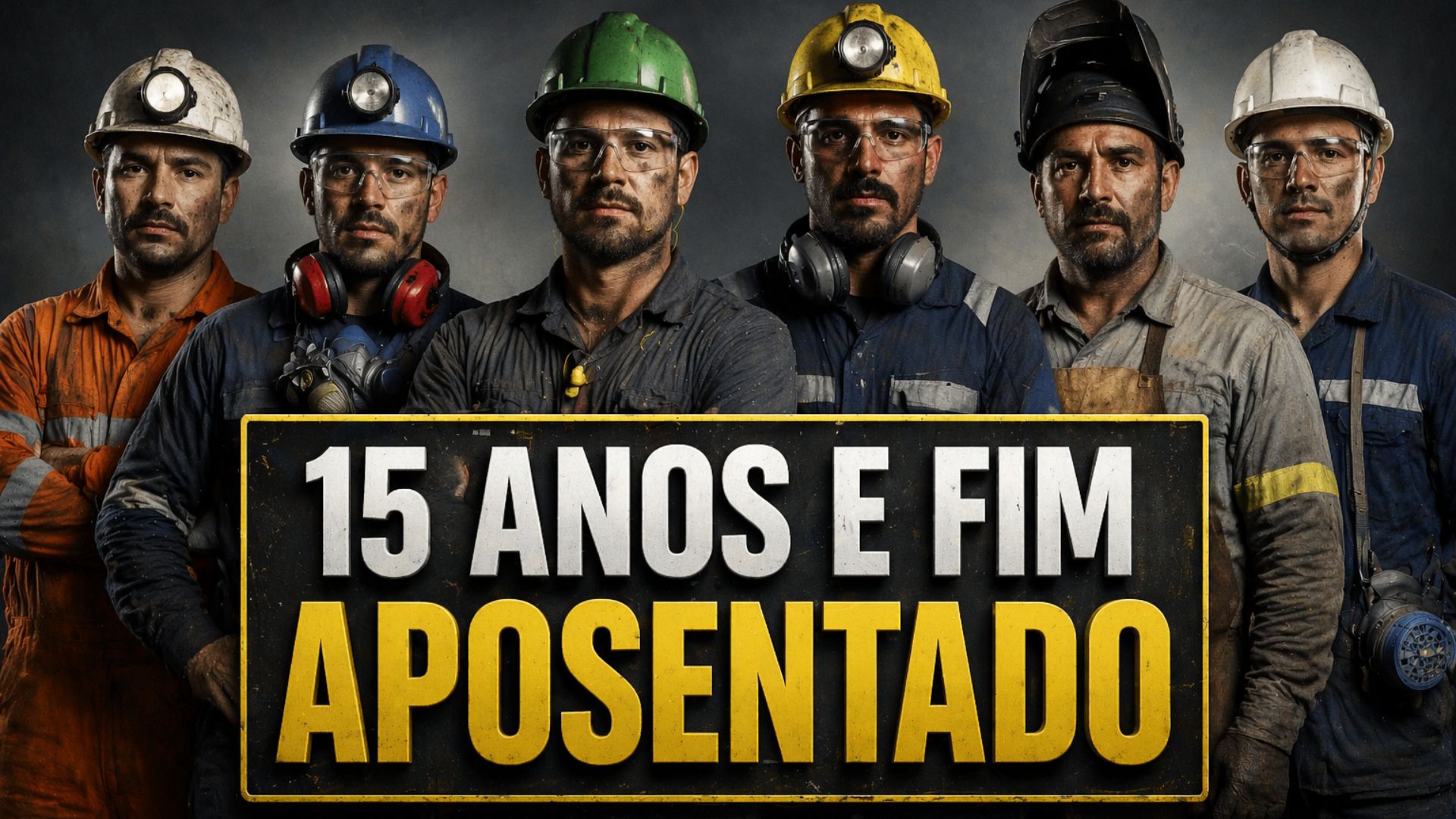
Continuous exposure to extreme risks in the subsurface guarantees differentiated retirement rules, but requires rigorous technical evidence and compliance with specific criteria defined by current social security legislation.
Special retirement is still provided for workers in the general regime who engage in activities with permanent exposure to harmful agents, but access to the benefit depends on more specific criteria than the simple function recorded in the employment card.
In the case of underground mining in production fronts, the permanent rule requires 55 years of age, 15 years of effective exposure, and compliance with the minimum contribution period of 180 contributions.
For those who were already in the system before the Social Security Reform, there is still a transition rule with points.
-
The plan of R$ 526.3 billion that could reindustrialize Rio de Janeiro by 2028 includes nearly 2,000 projects mapped by Firjan and creates one of the largest waves of investments ever concentrated in a single Brazilian state.

-
The shot backfired: the United States sanctions intended to curb China ended up creating a record revenue boom for Chinese chip manufacturers, with growth of up to 247% in a single year.

-
With a dependency of up to 80% on gas imported from the United States, Mexico responds with a robust energy strategy, betting on shale gas, creating a scientific committee, and preparing to expand natural gas production to reduce vulnerability and strengthen its energy security in the coming years.

-
Goodbye to the classic stamp in the passport and welcome to total digital control: the new border system of the European Union is already in operation with mandatory biometrics, and those who download the Travel to Europe app before their trip can save time.

Rules for special retirement after the reform
The differentiated protection arises from the very design of social security legislation.
Law 8,213 provides for special retirement for those who worked under conditions harmful to health or physical integrity, while Constitutional Amendment 103 began to require a minimum age under the new rules.
The Social Security Regulation maintains permanent activity in the subsurface of underground mining in production fronts among the most severe classification hypotheses, requiring only 15 years of special work.
Work in underground mining and its risks
In practice, this encompasses occupations directly related to the advancement of mining, rock fragmentation, internal transportation of material, and support of galleries.
Among the examples traditionally associated with this group are the crusher, rock loader, driller, mine shot firer, underground miner, and operator of underground rock crusher, as well as other similar functions historically described in the old classifications of special activity.
The central point, however, is that Social Security does not grant the benefit automatically just because the worker has performed one of these occupations.
Since 1995, proving special activity has required effective demonstration of habitual and permanent exposure to harmful agents, making technical documentation from the company indispensable.
Therefore, two people with the same position may have different results in their requests, depending on the actual work environment and the records presented to the INSS.
Professions most associated with the minimum time of 15 years
In the case of the crusher and the rock crusher operator, the routine often involves some of the most recurring risks of heavy mining.
These activities involve rock fragmentation, intense vibration, mineral dust, and high noise levels, factors often examined in social security reports and in court decisions regarding the recognition of special time.
Prolonged exposure can compromise hearing, the osteomuscular system, and respiratory capacity, especially when work occurs in an underground environment with limited air circulation.
The rock loader and driller are linked to the heavier stages of the production front.
The former works in the removal and displacement of extracted material within the mine, while the latter works directly in the opening or widening of passages and mining fronts.
In both cases, physical effort is combined with the presence of mineral particles, constant humidity, and typical operational risks of the galleries, such as falling blocks, low visibility, and insufficient ventilation.
The mine shot firer occupies a strategic position in the stability of the subsurface because their function is associated with reinforcing ceilings and walls to reduce the possibility of structural collapse.
Even when the activity has a preventive character, the worker remains in a high-risk environment, subject to collapses, vibrations, heat, and dust.
It is precisely this combination of permanent exposure with threats to physical integrity that supports the more favorable social security treatment for work in production fronts.
Among all the occupations mentioned, the underground miner often symbolizes more broadly the wear and tear of underground activity.
They work in direct contact with mineral extraction, in confined areas and without natural light, under high humidity, and in many cases, with exposure to various chemical and physical agents.
Still, the right does not arise from a generic presumption about the hardness of the profession, but from the legal classification of special activity and the concrete proof of continuous exposure to the risks provided for in the regulation.
Mandatory documents to prove special activity
To transform this work time into recognized social security rights, the most important document is the Social Security Professional Profile (PPP).
It gathers data on working conditions and exposure to harmful agents, serving as the main basis for the request.
Since January 1, 2023, the issuance of the PPP in electronic format has become mandatory for periods worked from that date.
The LTCAT remains relevant as a technical report that supports the information in the PPP.
The official guidance indicates that the PPP is, in principle, the document presented to the INSS, but the report can be requested when there is a need for additional clarifications or doubts about the characterization of special time.
In other words, it is not enough to claim contact with silica, extreme noise, or toxic gases; it is necessary for the company to have technically recorded this exposure throughout the workday.
Difference between old and current rules
It is also important to separate the current rule from the situations prior to the reform.
Until November 13, 2019, special retirement could be granted without a minimum age, as long as the insured proved the required time of special activity.
After the constitutional change, a minimum age began to apply in the permanent rule and points in the transition for those who had already contributed before the reform.
This detail decisively alters the planning of mining workers, as simply reaching 15 years of exposure no longer concludes the analysis in all cases.
Therefore, although these six occupations are among the most remembered when talking about special retirement of 15 years, the classification depends on a set of factors: period worked, location of the activity, permanence in the production front, and valid social security documentation.
The rule exists and remains valid for the most severe underground mining, but the recognition of the right continues to be conditioned to the technical proof presented to the INSS at the time of the request.







Seja o primeiro a reagir!