





 Portuguese
  English
  Spanish
  4 min of reading
  0 comments


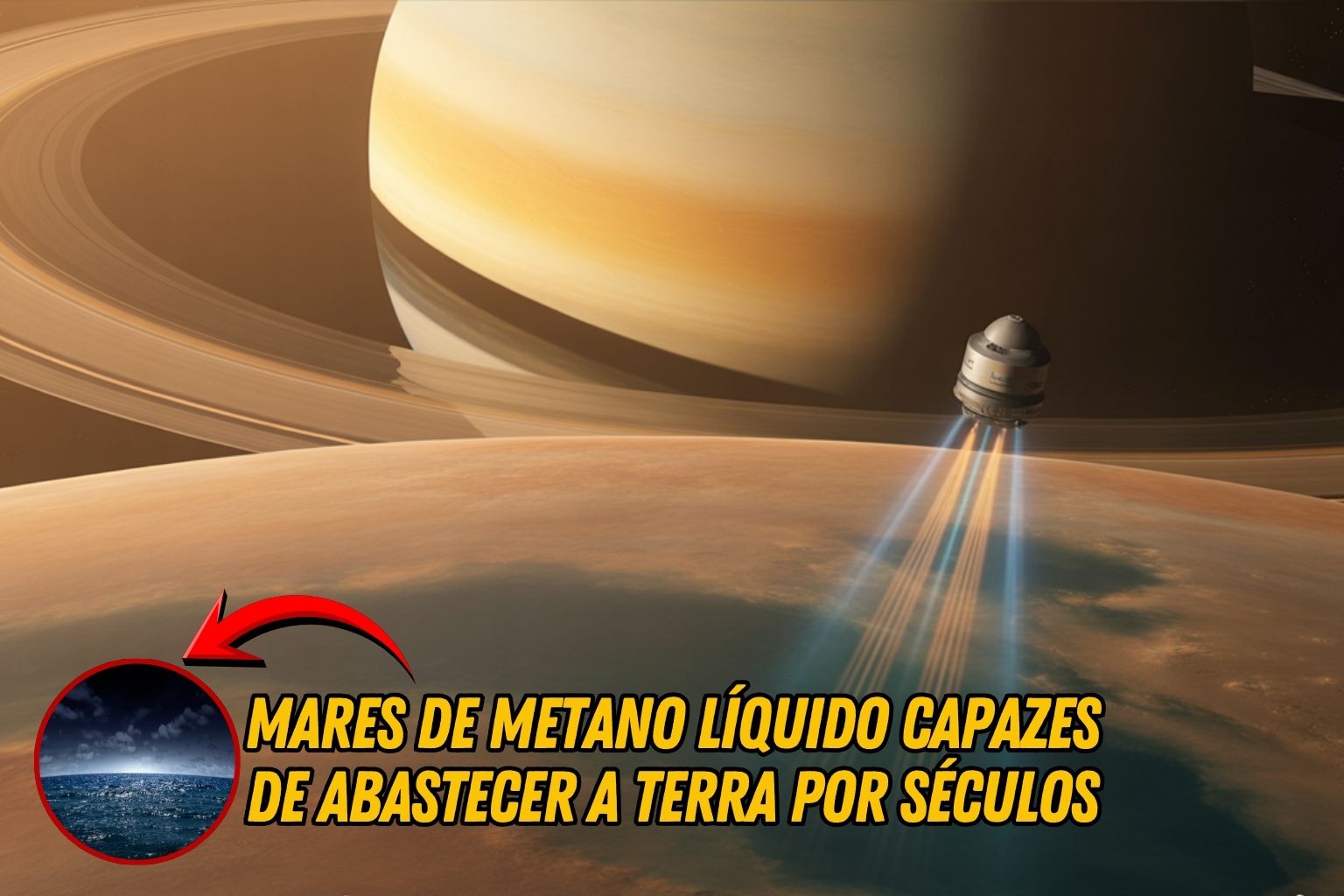
NASA And ESA Research Confirm That Titan, Saturn’s Moon, Hosts Vast Liquid Methane Seas That Could Supply Earth For Centuries And Revolutionize Fossil Fuel Energy.
While the eyes of the world are turned to Mars, a distant moon of Saturn has been intriguing scientists with its unique combination of mystery, chemistry, and energy potential. Titan, the largest moon of the ringed planet, has entire seas of liquid methane and ethane on its surface — something never before observed on another celestial body. Simply put, this icy moon literally has oceans of natural fossil fuel. According to studies by NASA and ESA, the total volume of these hydrocarbons would be enough to supply Earth for hundreds of years.
Discovered in 1655 by Christiaan Huygens, Titan was merely an orange dot among Saturn’s rings for centuries. But everything changed in 2005, when the Huygens probe from the European Space Agency landed on its surface and revealed lakes, channels, and dunes made of organic compounds. Since then, Titan has ceased to be just a moon and has come to be seen as one of the most fascinating and enigmatic worlds in the Solar System.
Liquid Methane Seas: An Ocean of Extraterrestrial Energy
According to measurements from the Cassini-Huygens mission, temperatures on Titan hover around -179 °C, which causes gases like methane and ethane to remain in a liquid state. These hydrocarbons form large lakes and seas in polar regions, notably the Kraken Mare, which has an estimated area of 400,000 square kilometers — almost the size of the Caspian Sea, the largest lake on Earth.
-
With a cost per shot close to zero, the DragonFire laser could change naval warfare in 2027 and provide British ships with nearly unlimited defense against drones.

-
A British startup creates tires that generate electricity in electric vehicles when passing over potholes, speed bumps, and cracks.

-
Scientists have created robots made with living cells that have their own nervous system, swim on their own, explore the environment, and self-organize without any genetic engineering, and now they want to do the same with human cells.

-
Students create a solar-powered ambulance that operates without a plug, without fuel, and still keeps medical equipment running in remote areas.




NASA studies indicate that the total volume of these oceans could reach 300 times the amount of oil and natural gas present on Earth. This comparison illustrates Titan’s energy potential, even if practical exploration is beyond any current possibility. Still, the mere existence of such vast reserves of natural methane outside of Earth ignites a debate about the future of energy and the astroindustry.
Methane, the main component of natural gas, is one of the most efficient and clean sources of fossil energy, producing fewer carbon emissions than coal and oil. On Titan, it performs the role that water plays on Earth — forming lakes, rivers, and even rain. It is, therefore, the only known world with an active hydrological cycle, but completely composed of hydrocarbons.
A Methane Cycle That Mirrors Earth — But In Another World
Titan is, in many ways, a dark mirror of Earth. There, methane clouds condense in the dense, yellowish atmosphere, causing rains that flow through channels and accumulate in lakes and seas. The cycle is completed when methane evaporates again, feeding the clouds — just like Earth’s water cycle.
The difference is that the “fuel” sustaining this cycle is flammable and highly energetic. If it were possible to extract and convert all of Titan’s methane into usable fuel on Earth, it could supply global consumption for hundreds or even thousands of years, depending on the efficiency of the process.
But there’s a fascinating detail: this methane does not appear to be produced by volcanic processes like those on Earth. Researchers suggest it may have biogenic origins — that is, formed by chemical processes similar to those that led to the emergence of life. Therefore, every drop of this icy liquid is also a clue about the primordial past of organic chemistry.
Future Missions And The Plan To Explore Titan
NASA already has concrete plans to return to Titan. In 2028, the Dragonfly mission is scheduled, a nuclear-powered drone that will fly over the surface for hundreds of kilometers to analyze the chemical composition of the soil and seas. Unlike Mars, which is arid and rocky, Titan offers an environment rich in organic compounds, similar to what may have existed on Earth before life emerged.
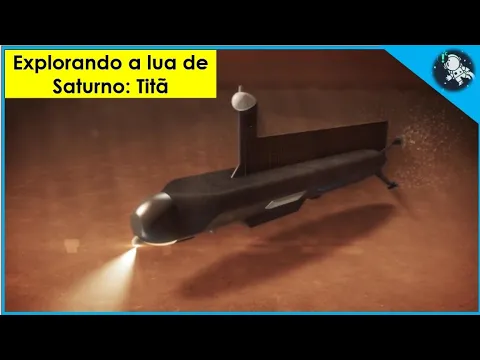
Dragonfly will attempt to answer two fundamental questions: where does all this methane and ethane come from, and could they support primitive forms of life? The mission will also precisely measure the volume and depth of the hydrocarbon seas, especially Kraken Mare, whose depth may exceed 300 meters.
The goal is not to extract energy, but to understand if worlds like Titan could serve as models for the future industrial exploration of the Solar System.
Titan And The New Energy Imaginary Of Humanity
Although exploring or extracting resources from Titan is unfeasible in the coming decades, the mere existence of liquid methane seas outside Earth already changes the way humanity perceives energy scarcity. Titan proves that the basic elements of life and energy are not exclusive to our planet.
With advances in space technologies, especially in electric propulsion and automated mining, it is possible that, in a distant future, humans will see Titan not just as an icy moon, but as a symbol of a new frontier — where science, energy, and exploration mix on a planetary scale.
Just as gold and oil have shaped centuries of history on Earth, Titan’s methane represents the symbolic promise of a new era: that of cosmic energy.








-

-

2 pessoas reagiram a isso.