





 Portuguese
  English
  Spanish
  5 min of reading
  0 comments


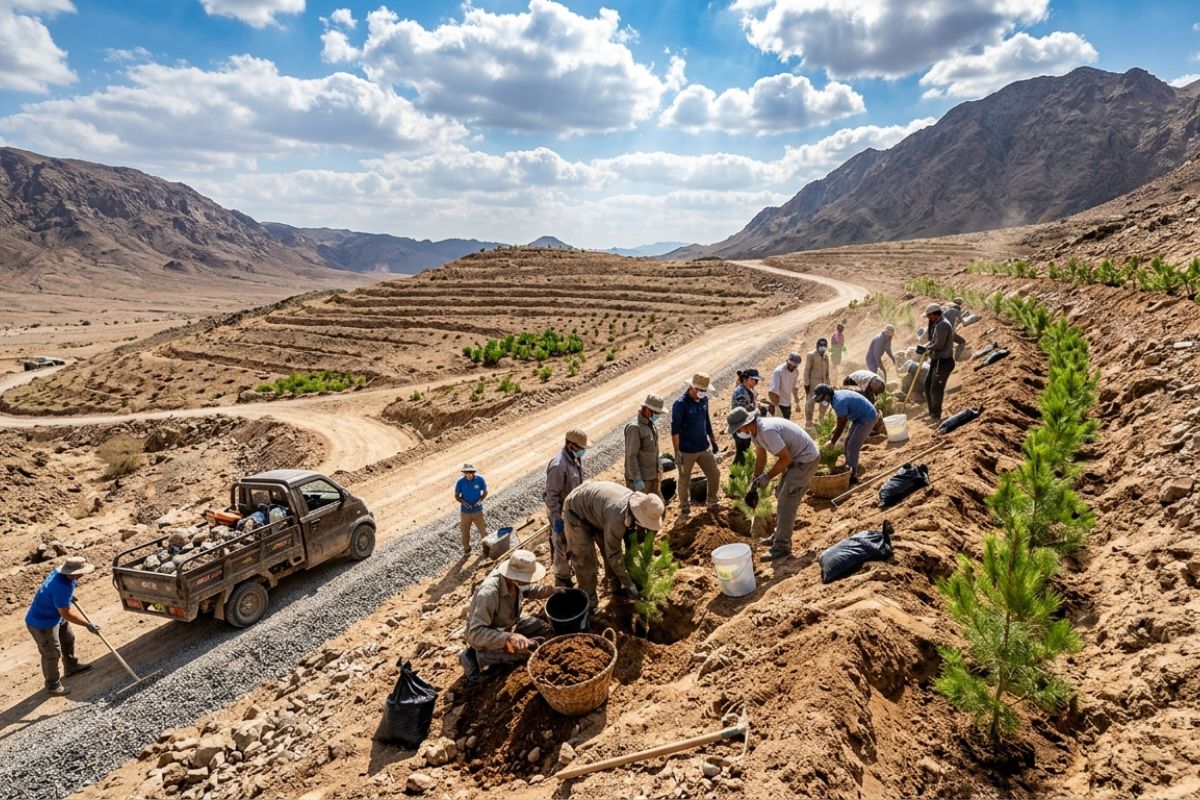
forest becomes a practical goal in the desert with 36 containment dams, 50 Afghan pines, and 12 volunteers, with manure, biochar, and cactus glue to face wind and drought
The mission to create a forest in the desert began with a simple self-criticism: last year, Rich built 36 small dams on the ranch in just one week of manual labor, with visible results, but walking half a kilometer in the sun and wasting precious time searching for stones. Now he returns in two weeks with 11 more people, and the owner decides that it is not feasible to accommodate 12 volunteers with the same improvised logistics.
To accelerate the impact of this planned forest, the focus shifts to preparation. Gravel leveled roads, ramps redone after floods, safe return for trucks, and a mini Chinese truck capable of carrying a lot of weight come in as the pieces that save human energy. Meanwhile, 50 Afghan pines receive manure, biochar, and cactus glue to gain an advantage before the rain and wind that dominate the area.
The forest begins before planting, in access to the work

The recurring theme is access. Instead of making volunteers spend the morning walking in the sun to the site, the priority becomes allowing them to arrive by vehicle, with more comfort and less wear and tear.
-
Airbus and Mercedes take the G-Class to the skies: the ACH145 helicopter priced at R$ 78 million debuts in São Paulo, unit goes to Brazilian, AMG cabin, 5-blade rotor, and a 2-year wait.

-
New material could change everything: it is the thickness of an atom, 200 times stronger than steel, and 100,000 times thinner than a human hair.

-
A new study published in Nature reveals that the SLIT3 protein can increase calorie burning by activating brown fat in the body, functioning as a kind of “biological switch.”

-
New signals detected by NASA suggest that the Moon may hide accessible underground cavities, after data from Mini-RF indicated a conduit over 60 meters beneath a lunar pit.


To achieve this, the owner uses a leveling blade to improve internal roads, making the path smoother than the dirt trails made with a tractor.
He also tries to protect the rented truck with air conditioning, considering scratches from vegetation and the risk of flat tires. The idea is simple: if the team arrives in better shape, they build more forest in the same time.
Gravel and crossings: preparing the path is also planting the future
Part of the preparation involves the dam and the crossing, where the plan is to lay gravel to improve the passage and, at the same time, address what is lacking in lower areas. The reasoning is efficiency: one move, two problems solved, without requiring extra human strength.
The need for stones appears as a constant because the containment dams depend on this material.
Instead of spending the week searching for stone by stone, the owner wants the volunteer to arrive, unload, organize, and move on to the next dam, maintaining a pace that truly pushes the forest forward.
The mini Chinese truck that changes the logistics of the forest

The equipment that becomes the protagonist is a mini Chinese truck left at the ranch, described as essential to accelerate the work. It can carry up to 900 kg of load and runs on tracks, allowing it to reach remote places even when access is difficult.
In practice, it allows picking up stones at one point and taking them exactly where they are needed, bringing volunteers closer to the work site and transforming their main task into unloading and organizing.
The gain is direct: less time walking, less time carrying stones by hand, more time building structures that support the forest.
Floods destroy ramps and force reconstruction of access
The biggest obstacle between the camp and the containment barriers is the central bed of the creek. The floods have dug a hole of almost 1 meter over a gabion, messing up the access ramps.
To pass trucks over the bed, it is necessary to rebuild the ramps, and the excavator is pointed out as the equipment capable of doing this.
Besides the ascent and descent, there is a detail that seems small but weighs on the end-of-day fatigue: when volunteers return, they have already driven almost 1 km, are sweaty, and thirsty.
The owner does not want them to have to descend the ramp and drive in reverse for about 100 m. Therefore, he plans a comfortable return for trucks, trying to balance safety with the least possible damage to the desert.
Strong wind becomes a daily enemy, and the forest needs a barrier

The wind appears as a real and recurring problem, with reports of tables and chairs being overturned during the night. Even with containers and cabins, the location remains very windy.
The owner concludes that he needs a wind barrier and points to the Afghan pine as the gold standard for this in that region.
He has 50 Afghan pines to plant on the windward side and wants to have as much ready as possible before the volunteers arrive.
Earth mounds about 1.20 m high have already been made, which helped but did not solve everything. The forest, here, depends on reducing the wind as much as it depends on planting trees.
Manure, biochar, and cactus glue: preparing the soil before planting
The soil plan is aggressive because, according to his own account, when planting there is a main chance to correct the soil.
The owner spreads horse manure along the line of trees, aiming to increase moisture retention and improve soil life. The goal is for the Afghan pines to establish themselves as quickly as possible.
Biochar comes in as another critical step, with the detail that it takes about 30 days to cure. Since the volunteers arrive in six weeks, he needs to produce this now to avoid running out on planting day.
He also mentions an ingredient he wants to use for the first results: cactus glue, associated with soil biology and activity and the strength of the first germinations observed.
To accelerate the group’s work, he intends to pre-dig holes for the trees in advance. Thus, when the volunteers arrive, the sequence becomes more objective: they mix additives into the soil, plant the tree, water it, and move on. The declared goal is to maximize human impact, not occupy the team watching a machine dig.
Why the forest is organized in lines and not in blocks
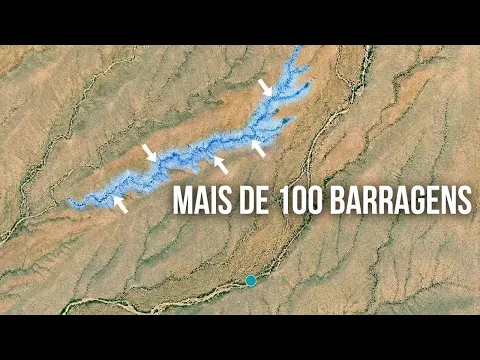

A recurring comment he responds to is about planting in straight lines. The reason is access. If he planted in circles or made a large block of vegetation, it would be difficult to bring in supporting materials like tons of stones, soil amendments, and even people to work.
The final proposal is to build a forest in the desert with a system logic, described as agroforestry, and not as trees scattered randomly.
And there is an important counterpoint: he acknowledges that building water catchment systems on the ranch may be more impactful than planting trees individually, because “planting water” allows the rest to sustain itself with more autonomy.
In the end, the forest is less a one-time act and more a sequence of practical decisions: access, water, wind, soil, and only then planting. What seems like “roadwork” becomes part of the birth of a forest.
If you had 12 volunteers for a week, would you prioritize building containment dams or planting the trees of the forest first?







Seja o primeiro a reagir!