





 Portuguese
  English
  Spanish
  4 min of reading
  0 comments


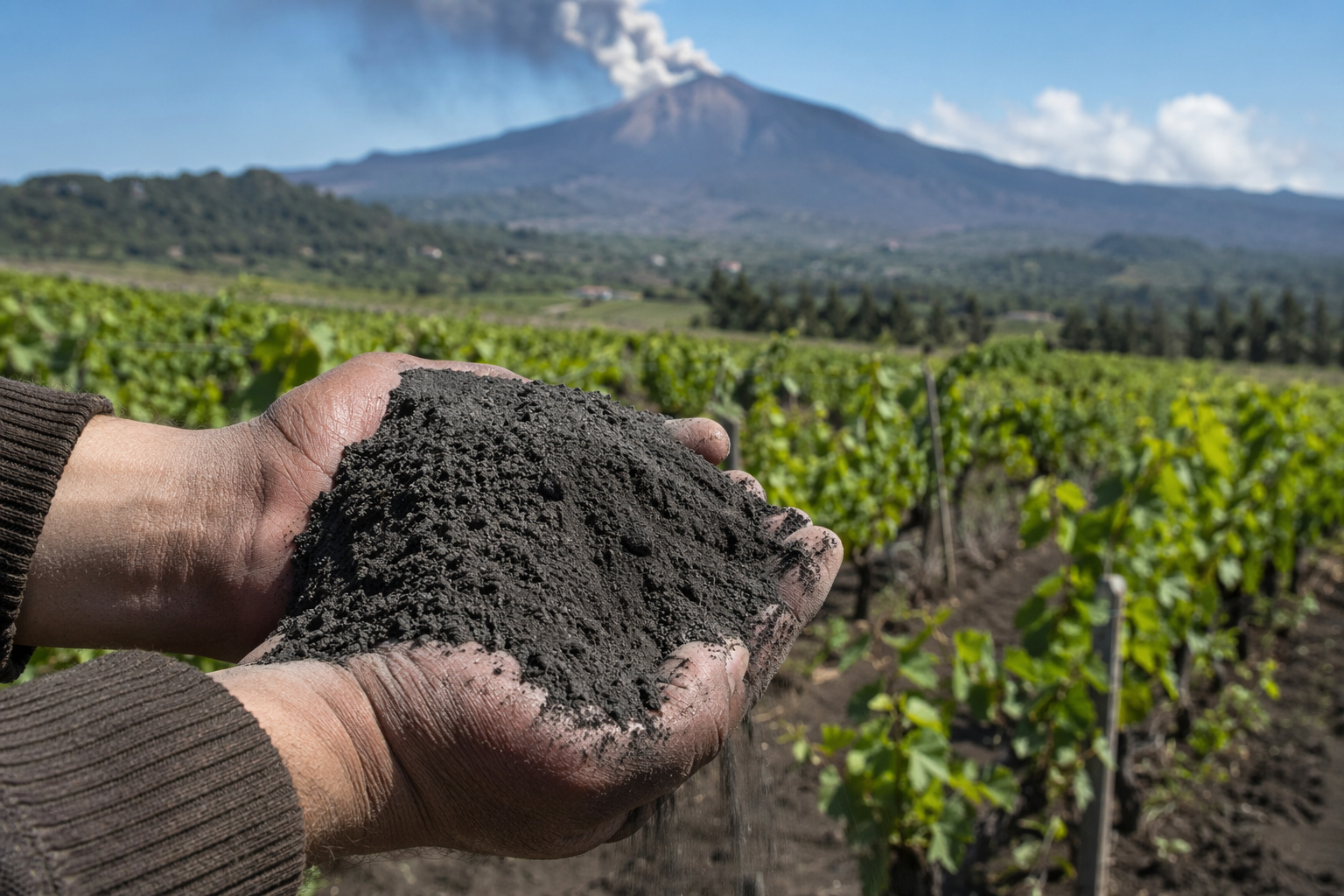
How tons of ashes from the tallest and most active volcano in Europe are being reused in agriculture, reducing costs and increasing soil productivity sustainably
A silent transformation is taking place in Sicily. Tons of volcanic ash from Mount Etna have begun to be used as agricultural input.
The material, once seen as an environmental problem, is now treated as a strategic resource for the field. Farmers in the region have been utilizing this resource for generations.
The practice gained momentum between 2020 and 2024, a period marked by increased volcanic activity. This scenario expanded the volume of ash accumulated over the crops.
-
NASA launched a $1.2 billion probe to travel through space to an asteroid that may be worth more than all the wealth ever produced by humanity and reveal the lost core of a destroyed planet.

-
Scientists discover in Alaska a 350,000-year-old ice block that has survived multiple periods of global warming and is now melting so quickly that it may disappear before revealing all its secrets.

-
While Starlink supports SpaceX’s trillion-dollar scale, Elon Musk encounters issues in Namibia due to local control regulations, digital sovereignty, and denied licenses, and the orbital internet race faces political limits outside the United States.

-
The USA accelerates tests on the A-10 with an adapter that allows refueling from multiple tanks, installed in a few hours, increasing compatibility with up to 5 aircraft, reducing dependence on the KC-135, and creating strategic space for Embraer’s KC-390.

Growing challenge drives farmers to seek solutions
Farmers have been living with the constant accumulation of ash for decades. The increase in eruptions has significantly raised this volume in recent years.
Data from The Guardian indicates that Giarre receives about 12,000 tons of ash daily. In Catania, the volume reached 17,000 tons per day in 2024.
This excess has made the development of viable alternatives essential. Researchers and producers have begun to analyze practical ways of reuse.

Ashes cease to be a threat and reveal agricultural potential
The idea that ashes harm the soil was widely spread in the past. Recent studies show that this perception does not correspond to reality.
The lands near the volcano rank among the most fertile in Europe. The cultivation of citrus fruits, herbs, and DOC Etna wines proves this productivity.
Scientific project reinforces sustainable use of ashes
The University of Catania initiated the Reucet Project to study the reuse of the material. The goal is to expand its use in different productive sectors.
Chemical analyses identified relevant applications. Among them are:
- Road construction
- Water purification
- Wall insulation
- Production of ink for 3D printing
Agricultural use stands out among applications
The agricultural sector concentrates the greatest interest.
AITNE points out that the ashes act as a efficient natural fertilizer.
The material improves water drainage in the soil.
This characteristic reduces excess moisture and favors the development of crops.
Mineral composition strengthens the soil
The ashes are composed of particles rich in iron, aluminum, and silica. They also provide essential nutrients such as potassium, phosphorus, and magnesium.
According to AITNE, the main effects include:
- Improvement of soil structure
- Reduction of acidity
- Increase in pH
- Gradual release of nutrients
These characteristics make the soil more balanced and productive over time.
Tests confirm gains in agricultural productivity
Tests conducted in the region of the volcano confirmed positive results. The soil was enriched without the need for chemical fertilizers.
The experiments indicated:
- Greater water retention
- More resilient plants
- Lower incidence of diseases
These factors consolidate the use as a sustainable alternative.
Field application follows different strategies
Experts indicate three main forms of utilization:
- Direct application to the soil
- Mixing in organic composting
- Correction of acidic soils
Each method can be adapted according to the type of crop.
Lack of regulation limits commercial advancement
European legislation still does not regulate the commercial use of ashes.
The material continues to be classified as urban waste.
Researcher Paolo Roccaro highlights that producers need to collect it on their own.
The disposal cost reaches 300 euros per ton.
Studies indicate that reuse could reduce this value to 30 euros.
Experience in Iceland reinforces agricultural potential
In Iceland, the use of ashes also showed positive results after 2010.
The eruptions of Eyjafjallajökull impacted agricultural areas.
Producers reported improvements in crop performance.
Wheat plantations showed vigor similar to the first year of cultivation.
Volcanic ashes emerge as a solution for sustainable agriculture
The examples from Sicily and Iceland indicate a clear change in perception.
The ashes cease to be a problem and become a strategic resource for the field.
The reuse reduces costs and increases agricultural productivity.
This scenario raises an important question: can this natural resource redefine the future of global agriculture?







Seja o primeiro a reagir!