





 Portuguese
  English
  Spanish
  4 min of reading
  14 comments


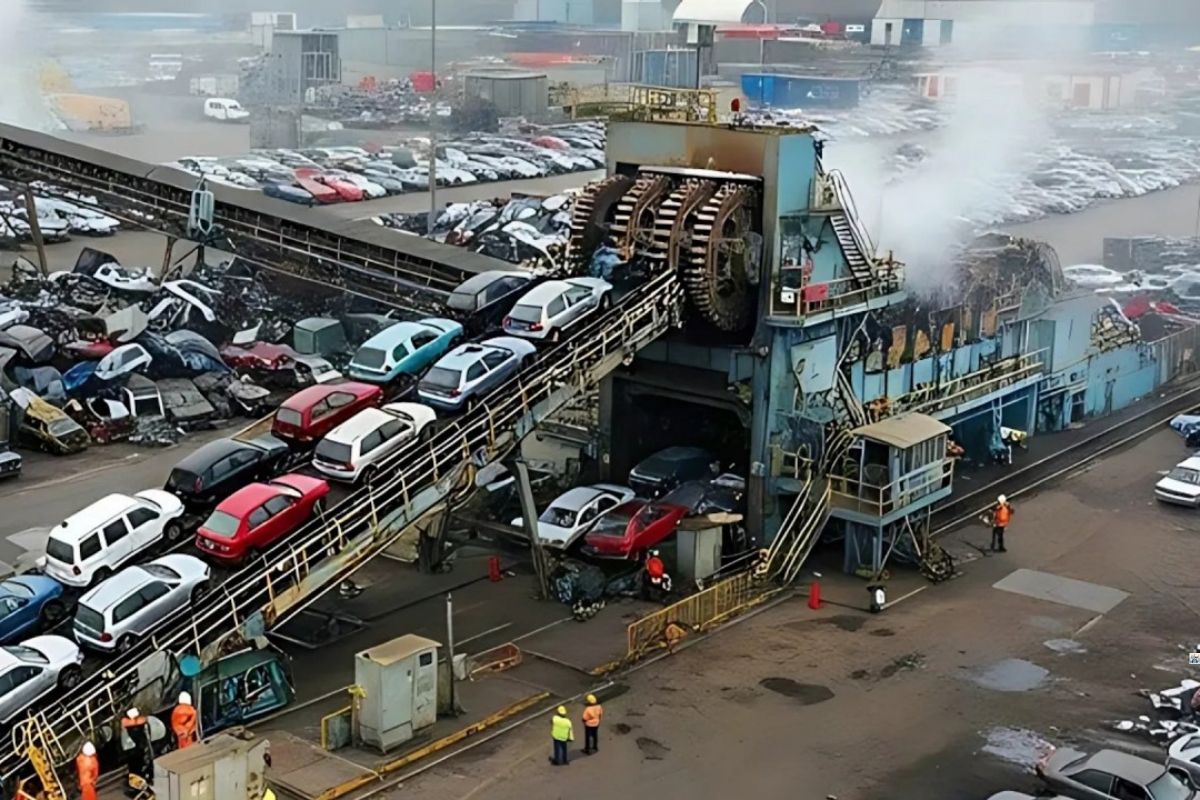


How Crushers That Devour Cars And Hydraulic Presses Transform The End Of A Vehicle Into Valuable Raw Material, Shorten Logistics With Dense Bales, And Feed Foundries That Return Steel To The Market With Energy Efficiency And Predictable Margins
The crushers that devour cars are the first link in an industrial chain that prevents mountains of end-of-life vehicles from ending up in landfills. In seconds, sets of steel blades reduce car bodies to fragments, enabling transport, sorting, and immediate sale to foundries. The operation connects with a stable market: recycled steel has continuous demand and scrap metal priced per ton creates a basis for recurring revenue.
The technical sequence includes presses that compact the material into bales of half to two tons, a step that cuts logistical costs and standardizes the product. In a scenario cited in the database, a yard processing 3,000 tons per month at $200 per ton registers $600,000 in gross revenue, a typical result for a plant that masters supply, operation, and buyer.
From Junkyard To Industrial Input
Every year, millions of vehicles reach the end of their useful life. Without processing, this liability would occupy areas and generate environmental risk.
-
Meta’s new smart glasses are not just for seeing; they use artificial intelligence, analyze your food, summarize messages, and can even change the way you work in professions like engineering.

-
According to an analysis by NASA, only one human-made structure is visible from space, and it is not the Great Wall of China or the Pyramids of Egypt.

-
After 377 years of history, the Brazilian Army will have its first female general: Colonel Claudia Cacho has been promoted to brigadier general by Lula and will receive the sword and command baton this Wednesday in Brasília.

-
A Mercado Livre customer opened their package and found 32 resumes of people looking for jobs crumpled as protective paper inside the box, exposing names, addresses, documents, and phone numbers of dozens of candidates.


Recycling changes the destination: the end of a car becomes the beginning of a value chain, where each kilogram returns to the industry in the form of steel, aluminum, or copper.
The principle is simple and technical. Fragment, densify, and direct.
What was once bulky and heterogeneous becomes a uniform load for transport, storage, and sale.
Standardization is the key to entering the foundries’ schedule.
How Do Crushers That Devour Cars Operate
The crushers that devour cars use shafts and hammers or discs to process up to about 20 tons per hour, reducing bodies and beams to metal chips.
The brutality is calculation, not spectacle: feed-in mesh, vibration control, and wear monitoring maintain productivity and safety.
After cutting, magnets and separators direct metal fractions into the value stream.
The product goes directly to baling or to bulk loads when the destination accepts loose fragments.
Hydraulic Presses And The Logic Of Density
If the crusher reduces, the press standardizes. Cubic bales and compact briquettes take up less space, accelerate loading, and prevent loss during transit.
The denser the bale, the lower the cost per ton-kilometer and the higher the occupancy rate of containers or flatbeds.
The commercial result is immediate.
Uniform bales are a “modern ingot”: they enter contracts with specifications for dimensions, purity, and density, shortening negotiation time and avoiding issues upon receipt.
Revenue, Prices, And Margin Capture
The baseline cites scrap steel traded between $150 and $300 per ton.
In the example of 3,000 tons per month at $200, the estimated gross revenue is $600,000.
Margin capture depends on constant supply, energy cost, maintenance of knives and hammers, and freight.
The potential grows in the chain.
Steel products after smelting can reach $700 to $1,000 per ton in the industrial market, and non-ferrous metals, like copper, achieve much higher values per ton.
Diversifying by alloys and metals dilutes risk and increases returns.
Energy, Climate, And Technical Credibility
Recycling steel saves more than 60% of energy compared to the primary cycle of ore and coke.
In addition to cutting emissions, this savings becomes a competitive advantage where energy weighs on cost.
Energy efficiency is margin and is an ESG argument that opens doors for large buyers.
Credibility comes from process and traceability.
Weighing, composition reports, impurity control, and batch registration prevent discounts at the foundry and protect the yard’s reputation.
The Role Of Foundries In The Cycle
In the foundry, electric furnaces reach over 1,600ºC, remove impurities, and add alloying elements.
Sheets, coils, rebar, rails, and beams are born from scrap batches that were once cars, beams, and engines.
Recovered aluminum and copper become wiring and electrical components, multiplying markets and sales routes.
The coordination between the yard and the steel mill reduces wait times, avoids excessive moisture in bales, and minimizes losses upon receipt.
Well-designed logistics is part of the profit, not an invisible cost.
Supply, Operation, And Buyer Market
The secret lies in closing the entire cycle. Partnerships with dismantlers and regional yards ensure input flow.
Machine availability and predictive maintenance sustain daily throughput.
Supply contracts with steel mills and refiners anchor sales and soften price volatility.
For local markets, entrepreneurs with a regional focus have space.
The waste of an industrial hub is the stock of the recycler.
Those who organize collection, sorting, and standardization turn junkyard waste into monthly revenue.
Safety And Operational Standardization
The power that crushes also requires discipline. Barriers, acoustic enclosures, PPE, and contingency plans prevent accidents.
Checklists for knife replacement, structural weld inspection, and vibration monitoring enhance availability and protect people and assets.
Standardizing procedures reduces quality variation of bales and prevents returns that erode margins.
From the yard to the steel mill, crushers that devour cars and presses convert urban liabilities into cash flow and new steel.
In your practical evaluation, which link currently most limits scale and margin in Brazil: regular scrap supply, energy costs, freight, or bale standardization?









Qual custo para montar um negasse hoje de triturador de sucatas de veículos
Os motores dos veículo também são moídos.
Para um país lotado de carros velhos jogados pra todos os lados essa realmente é a opção certa : reciclagem.