





 Portuguese
  English
  Spanish
  5 min of reading
  0 comments


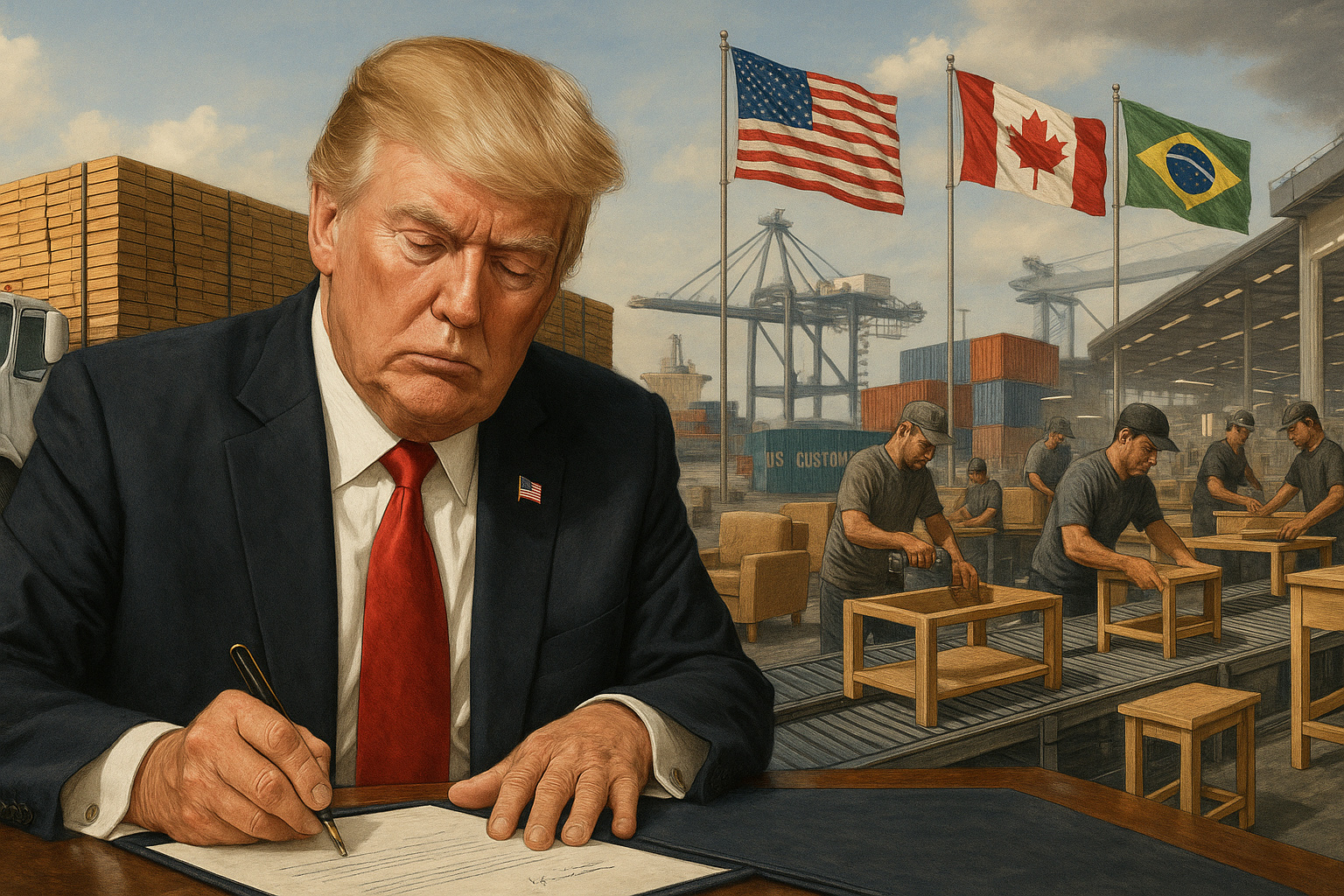
Donald Trump’s Announcement Foresees Rising Tariffs on Logs, Cabinets, and Upholstered Furniture; Impact Already Felt in Brazil and Canada, with Cuts and Billion-Dollar Negotiations Underway
The President of the United States, Donald Trump, confirmed on Monday (29) the imposition of tariffs of 10% on logs and sawn timber and 25% on kitchen cabinets, bathroom vanities, and upholstered furniture. The measure, officially published by the White House, will take effect on October 14, 2025, at 1:01 AM Brasília time.
According to Trump, the decision follows the Section 232 of the Trade Act of 1974, which has been used on other occasions to impose tariffs on steel and aluminum. The central argument is the protection of U.S. national security, as the government claims that reliance on imports is undermining the American woodworking industry.
The presidential document states that the country risks being unable to meet its own demand in strategic areas, such as critical infrastructure, national defense, and missile defense systems. “Wood products are essential even in the construction of nuclear defense systems,” the text highlighted.
-
With a dependence of up to 80% on gas imported from the United States, Mexico is responding with a robust energy strategy, betting on shale gas, creating a scientific committee, and preparing to expand natural gas production to reduce vulnerability and strengthen its energy security in the coming years.

-
The United States proposes to Brazil a critical minerals agreement with a minimum price to combat Chinese dumping and priority for investment, but the Planalto is blocking the signing out of fear of upsetting China and due to electoral calculations in a year of competition.
-
How the world’s largest market sidestepped Trump’s tariff hike, diverted part of the cargo to new destinations, and still set a record in exports.
-
Petrobras buys back fields for billions — what no one is talking about regarding this decision and how it could impact jobs and oil in Brazil.

Canada is the Main Target, but Brazil Also Feels Immediate Impact
Canada, the main supplier of softwood to the United States, is the country most affected by the new measure. Currently, Canadians already face combined antidumping and countervailing duties of about 35%, resulting from a long-standing dispute over timber exploitation on public lands.
To mitigate the impacts, the Canadian government has promised up to US$ 870 million in aid to its softwood producers. Still, trade tensions are expected to rise, as Ottawa seeks to negotiate a review of the U.S.-Mexico-Canada Agreement (USMCA), signed in 2020, with Washington.
In Brazil, the effects are immediate. According to the Abimci (Brazilian Association of Mechanically Processed Wood), between July 9 and September 15, the sector registered 4,000 layoffs, representing about 2% of the 180,000 formal jobs in the sector. This is because 50% of the national wood production had the U.S. as its destination, and the tariff spike resulted in mass cancellations of exports.
According to a report from Folha, already in August, Brazilian exports fell between 35% and 50% compared to July, deepening the crisis in the production chain, particularly in the states of Southern Brazil (Paraná, Santa Catarina, and Rio Grande do Sul).
Tariffs Will Increase Further in January 2026
Although the enforcement is set for October 14, 2025, the decree signed by Donald Trump anticipates a progressive increase in the rates. Starting from January 1, 2026, tariffs will reach 30% for upholstered furniture and 50% for kitchen cabinets and bathroom vanities from countries that do not enter into a trade agreement with the U.S.
This strategy mimics the approach used by Trump in 2018, when tariffs were applied to Chinese furniture. At that time, the rates started at 25% and now already reach 55%, causing a global redistribution of suppliers. Mexico and Vietnam, for instance, have become growing exporters of furniture to the American market.
Who Wins and Who Loses with Trump’s Decision
According to the announcement, countries that have reference agreements with the U.S. will receive tariff relief. Imports from the United Kingdom will only pay 10%, while products from the European Union and Japan will be taxed at 15% — values aligned with the base tariffs already practiced in these blocs.
On the other hand, the official statement did not mention the agreement with Vietnam, concluded in July 2025, which provided for a rate of 20% on timber. As the document has not yet been formalized, uncertainties remain regarding the validity of this concession.
The U.S. Department of Commerce began an investigation into the national security of wood imports in April. However, the American Chamber of Commerce harshly criticized the decision, highlighting that these imports do not pose a real risk to national security. The entity further argued that higher tariffs could increase the cost of construction, reduce paper and pulp exports, and cut the income of thousands of communities that depend on the industry.
Brazilian Furniture Sector on High Alert
The impact in Brazil is already worrying unions and business associations. According to data from Abimci, only in August 2025, after the first round of 50% tariffs on the country, Brazilian exports plummeted by almost half. The trend is likely to worsen with the new rates in January.
Brazil concentrates 90% of wood and furniture production in the Southern region, an area that employs thousands of workers in sawmills and furniture industries. For business owners, the continuation of the tariffs threatens not only sales to the United States but also the balance of domestic production.
In the international arena, Trump has already indicated that this is just the beginning of a new round of protectionist measures. In addition to the wood sector, patented drugs and heavy trucks are also in sight for future taxation.
According to a report published by Folha, Trump’s goal is to bolster the domestic industry in segments considered strategic, even in the face of criticism from trade allies and business entities.
Protectionism with Global Effects
Donald Trump’s decision shows that economic protectionism is gaining strength in the United States again, especially in sensitive sectors. On one hand, the measure seeks to revitalize the local industry, while on the other hand, it creates turmoil in international trade and puts pressure on partners such as Canada, Mexico, Vietnam, Brazil, and the European Union.
The Brazilian wood and furniture sector, already weakened by layoffs and declining exports, is expected to face a period of significant challenges. For Canadian producers, the only option is to negotiate within the USMCA, while Asian countries attempt to expand their share in the competitive American market.
In the short term, consumers and builders in the U.S. may also feel the effect of rising prices for furniture, wood, and related products. The escalating tariffs, therefore, not only reshape global supply chains but also test the resilience of economies strongly linked to the sector.








-

-

-

-

7 pessoas reagiram a isso.