





 Portuguese
  English
  Spanish
  4 min of reading
  1 comment


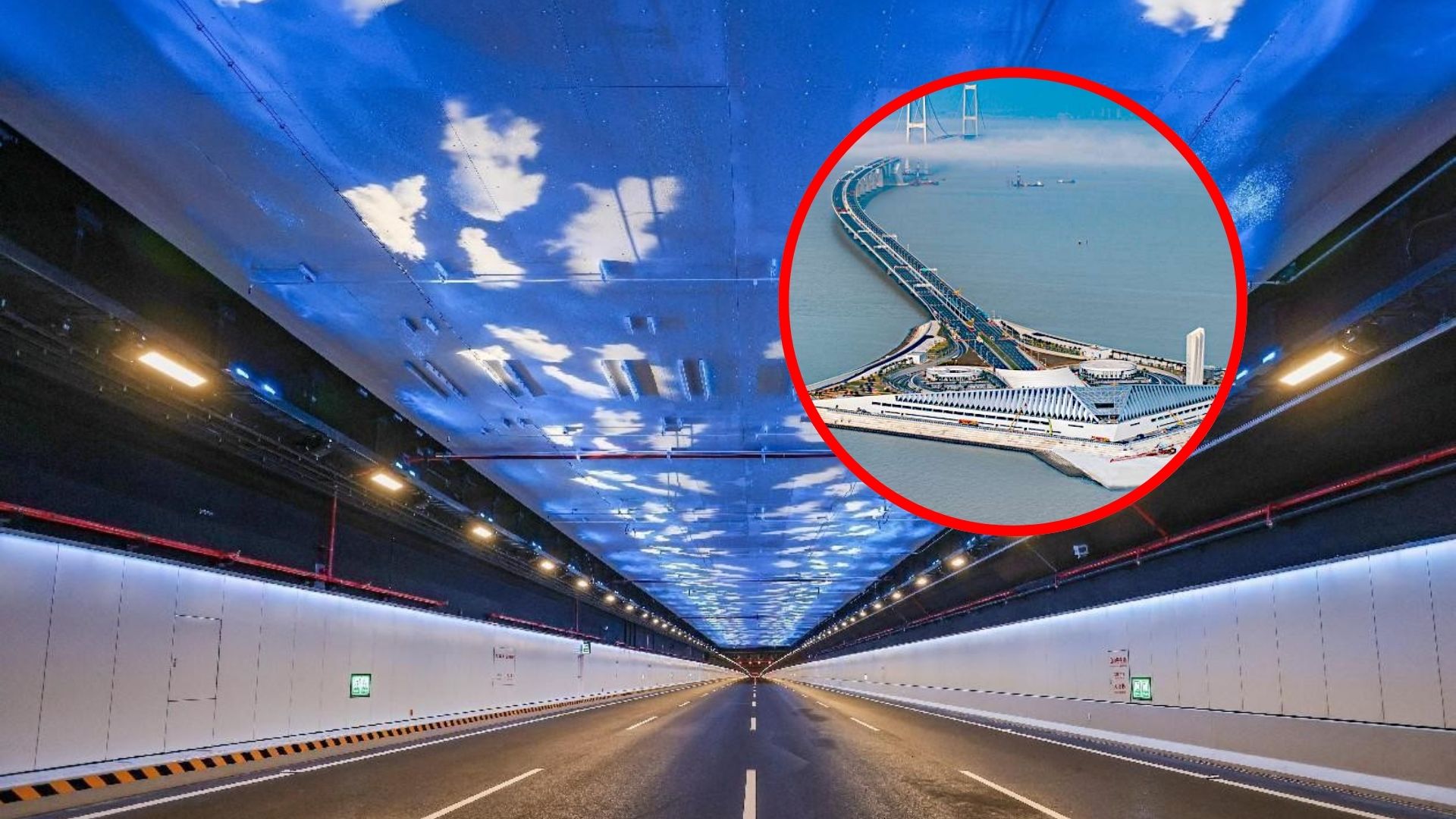


The Chinese Megaproject Establishes New Engineering Parameters When Crossing the Pearl River Estuary with a Large Width Submerged Tunnel and Strategic Integration Between Cities.
China has launched the Shenzhen–Zhongshan road link, a set of bridges, artificial islands, and a submerged tunnel that crosses the Pearl River estuary and includes what Chinese authorities classify as the widest steel and concrete tunnel ever constructed, with 55.6 meters in width and approximately 5 km of submerged stretch.
Official data from the project indicate that the work encompasses ten technical records and enhances integration between cities in the Greater Bay Area.
Structure and Connection Between Shenzhen and Zhongshan
The Shenzhen–Zhongshan Link is approximately 24 kilometers long between its functional ends and establishes a new route between Shenzhen, an important technological hub, and Zhongshan, on the opposite shore of the estuary.
-
He started running at 66 years old, broke records at 82, and is now a subject of study for having a metabolic age comparable to that of a 20-year-old, in a case that is intriguing scientists and inspiring the world.

-
Oldest tree on the planet reappears after 130 years of searches: Wattieza, 385 million years old, was 10 meters tall and had no leaves or seeds; Gilboa fossils in New York solved the mystery in 2007.

-
A 48-square-meter house assembled in hours with 4,000 bricks made of recycled plastic that does not absorb moisture, has natural thermal insulation, and costs less than 90,000 reais in a complete kit.

-
Luciano Hang revealed that Havan’s air fleet has already accumulated more than 20,000 landings, 10,000 flight hours, and 6 million kilometers traveled, and he says that without the planes, the company would never have grown so quickly.

According to construction managers, the link reduces the average travel time from routes that previously relied on longer land routes or congested road connections.

The submerged tunnel utilizes the immersed pipe method, in which steel and concrete modules are produced in dry docks, towed by sea, and positioned over a pre-prepared foundation.
Each module receives finishing, waterproofing, and monitoring systems before being connected to the next segment.
According to engineers involved, the widest point of the tunnel can accommodate eight traffic lanes, distributed in two directions, plus a central gallery for technical circulation, cables, and safety equipment.
The solution was adopted to meet the estimated volume of vehicles and the ventilation and evacuation standards required for large underground structures.
Construction of the Submerged Section
The submerged segment is approximately 5,035 meters long and consists of 32 main modules.
Each piece features a reinforced structure and receives approximately 29,000 cubic meters of self-compacting concrete, volume reported by construction documents.
This type of concrete facilitates the filling of large molds and reduces the risk of internal failures.
The heaviest modules weigh around 80,000 tons.
The positioning and fitting operation requires precise alignment in three axes, monitored by sensors and navigation systems.

Technical authorities claim that the tolerances used in the work are lower than those in previous underwater projects in the region, due to the tunnel’s dimensions and the estuary’s conditions.
The project has faced challenges related to maritime currents, tide variations, and soil characteristics.
To reduce risks, the construction employed continuous monitoring, dedicated vessels, and reinforcement of the seabed, as well as containment systems to stabilize the module installation area.
In daily operation, the tunnel uses high-capacity fans, air quality sensors, cameras, smoke control equipment, and escape routes integrated into the central gallery.
Responsible technicians state that the monitoring system employs automatic anomaly detection algorithms and robots for periodic inspections.
Ten Records Attributed to the Megaproject
According to official documents from Guangdong province, the Shenzhen–Zhongshan Link comprises ten technical records.
The set includes the largest span in a suspension bridge fully built in a marine environment, with about 1,666 meters, and the highest installed deck in a structure of this type, allowing for increased navigability.

The work also boasts one of the largest concrete anchorages ever recorded in marine suspension bridges, with approximately 344,000 cubic meters.
In wind resistance tests, the responsible engineers report testing speeds of up to 83.7 meters per second on the main deck.
The deck’s surface uses hot epoxy asphalt over an area of about 378,800 square meters, considered by Chinese authorities to be the largest of its kind in metal bridges.
In the submerged section, the tunnel is classified by project agencies as the longest bidirectional eight-lane tunnel constructed with immersed pipes, measuring 5,035 meters.
It is also identified as the widest steel and concrete underwater tunnel, reaching up to 55.6 meters.
Each pipe section received the largest volume of self-compacting concrete ever applied in a single mold for such a project, according to the records presented.
The final junction utilizes a sealing joint in the shape of an “M”, about 3 meters, regarded as the largest ever installed in a submerged tubular tunnel.
The system also integrates a submerged roadway interchange connected to the Shenzhen International Airport area, described as the first of its kind in the world.
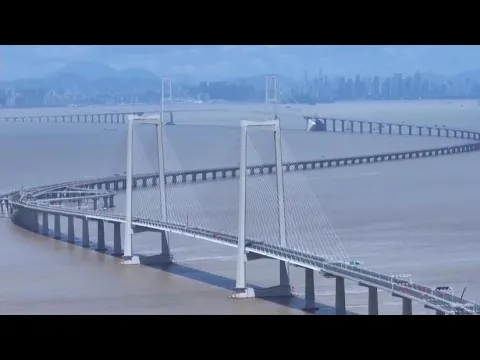

Effects on Mobility and Regional Integration
Local authorities claim that the new link reduces travel time between Shenzhen and Zhongshan to about half an hour.
The direct connection should redistribute vehicle flows and lessen the burden on other crossings of the estuary, in addition to facilitating access to industrial and logistics centers.
The project is part of the strategy for integrating the Guangdong–Hong Kong–Macau Greater Bay Area, which seeks to unify transportation systems and bring together economically complementary urban areas.
The official expectation is that the new link will enhance the movement of workers, supplies, and products between the cities connected by the corridor.
As new projects are planned in coastal regions of Asia and other continents, one question remains open: will submerged structures of this scale become more common in areas facing similar mobility and urban expansion challenges?







O nosso país precisa e muito dessas obras e em várias regiões, principalmente aqui na região sul onde a Br 116 corta os 3 estados, não falo só de túneis,mas também de pontes e viadutos.
A Br 116 a partir da cidade de Vacaria é um trecho bem sinuoso, precisaria de pontes e viadutos para melhorar a mobilidade e ganho de tempo aos veículos.