





 Portuguese
  English
  Spanish
  4 min of reading
  0 comments


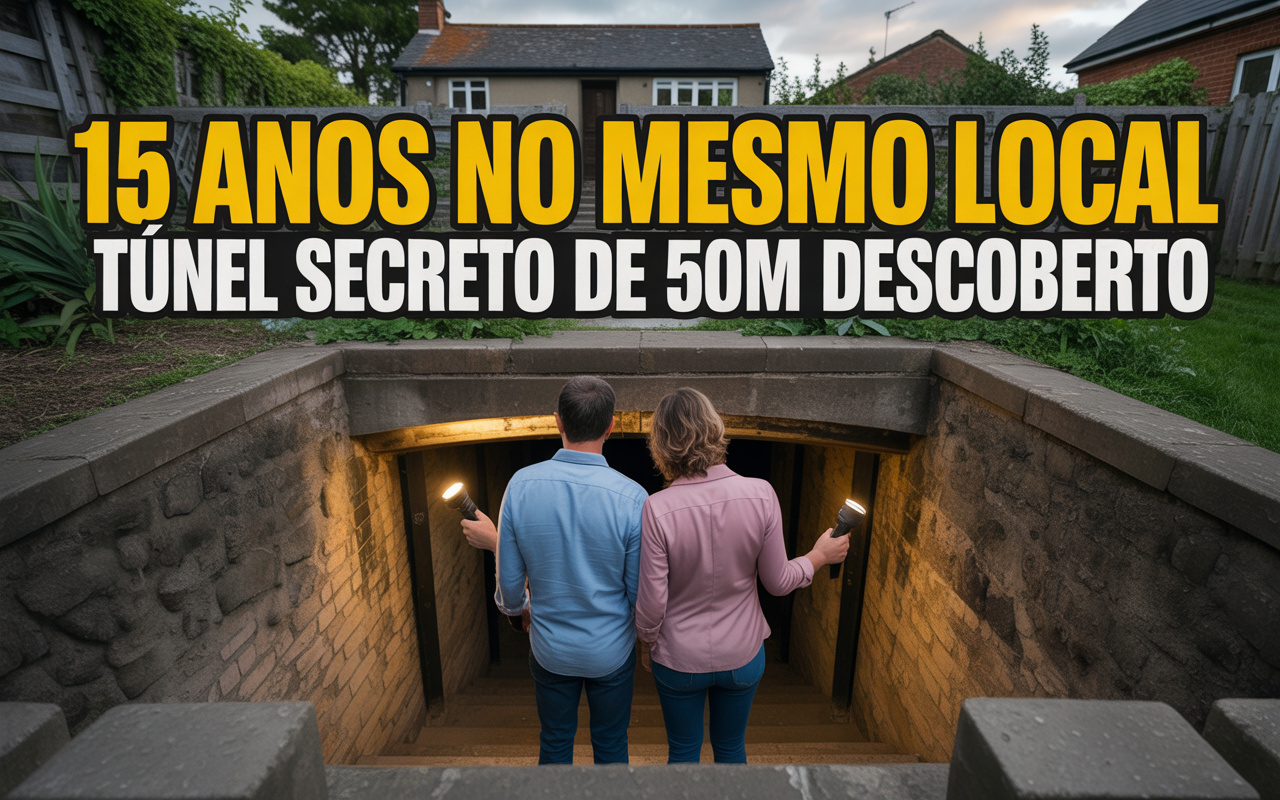
After 15 Years in the Same House, Couple Discovers Air Raid Shelter Tunnel of About 50 Meters in the Backyard, Revealing a Large Structure Used to Protect Civilians During the Blitz in England.
In March 2024, a couple living in a regular house in the coastal town of Folkestone decided to investigate a curious detail in their garden. What seemed like just an irregular area of the land turned into a historical discovery: a World War II air raid shelter tunnel, preserved beneath the yard, extending dozens of meters. The find was documented in a video, published on social media, and quickly went viral, attracting the attention of the British press and local historians.
The most surprising detail is that the couple had lived in the property for over 15 years without knowing that, literally under their feet, there was a structure designed to save lives during one of the most intense periods in European history.
World War II Air Raid Shelter Hidden Beneath Residential Garden
The initial excavation revealed a concrete staircase leading several meters below ground level. Following the access, the couple found a wide underground corridor, with reinforced walls and clear signs of military engineering from the early 1940s. According to historical records from the Kent area, structures like this were part of the British civil defense network during the Blitz, the air bombing campaign conducted by Nazi Germany between 1940 and 1941.
-
Hidden beneath the dense forest of the Sierra Nevada, Betoma emerges in a neighbor of Brazil as the greatest archaeological discovery of the century, revealing a colossal ancestral city covering over 18 km², with 8,334 stone structures and the potential to rewrite the history of South American civilizations.

-
Goodbye iron: new technology from Xiaomi promises to revolutionize the way we iron clothes with 500 kPa steam, continuous flow of 120 g/min, heating in 65 seconds, and six smart modes for different fabrics.

-
Rio Pardo, the most mysterious city in Rio Grande do Sul: untouched Pampas castle, the missing treasure of the Devil Boy, bride’s saint, invisible tunnels, and a 200-year curse today.

-
China retires the J-7 fighter after years of military protection and can now transform military items into drones, following more than 60 years of operation of the J-7, derived from the MiG-21, with thousands of units produced and strategic use in the PLAAF and PLANAF.


Reports published by local media indicate that the tunnel discovered in Folkestone is approximately 50 meters long, possibly having been connected in the past to other accesses now buried. Shelters like this were designed to protect dozens or even hundreds of civilians during air raids, especially in vulnerable coastal towns.
Underground Structure Preserved for Over 80 Years
One of the aspects that caught experts’ attention was the state of preservation of the shelter. Even after more than eight decades, the tunnel still exhibits:
- intact concrete walls,
- basic ventilation preserved,
- side niches used as waiting areas,
- and a relatively stable floor, despite the accumulation of soil and moisture.
These features confirm that it was a collective shelter, rather than a simple improvised hiding place. During World War II, Folkestone was strategically important due to its proximity to the English Channel, making it a frequent target for bombings and evacuations.
Why Folkestone Hid War Tunnels Beneath Ordinary Houses
The town of Folkestone had, during the war, a significantly larger population than today, as well as intense military activity. Many modern residential neighborhoods were built over old defense areas, without the complete records of these underground structures being incorporated into later urban plans.

At the end of the conflict, many shelters were sealed, buried, or simply forgotten, especially those located on private land. Over the decades, houses, gardens, and streets emerged over these structures, visually erasing any sign of their existence.
British historians assert that there are still dozens of unmapped tunnels and shelters beneath cities in southern England, especially in Kent and Sussex.
Viral Discovery Rekindles Interest in Hidden War Structures
The video published by the couple quickly reached millions of views on TikTok and other platforms, boosting public interest in similar stories. After going viral, urban archaeology teams and local authorities showed interest in officially documenting the tunnel, assessing structural risks and historical value.
Such cases are not unheard of in the UK, but rarely display such a high level of preservation in common residential areas. The episode reinforces how the legacy of World War II is still literally buried beneath modern daily life.
What Happens When a Historic Shelter Is Found on Private Property
In the UK, historically significant structures discovered on private land are not automatically expropriated, but may receive heritage protection. This means that:
- the owner remains the owner of the property,
- structural renovations become subject to restrictions,
- and the site may be cataloged as a local historic heritage.
In the case of Folkestone, experts are assessing whether the tunnel can be partially restored or simply documented and sealed again for safety reasons.

Why Finds Like This Continue to Happen
The discovery of the air raid shelter beneath a residential garden shows how the rapid post-war urbanization left gaps in historical records. Many European cities grew over entire layers of military infrastructure without a complete mapping.
Moreover, modern excavation technologies, home renovations, and even simple curiosity from residents have revealed, in recent years:
- forgotten bunkers,
- abandoned railway tunnels,
- sealed ammunition depots,
- and civil shelters intact since the 1940s.
These discoveries help concretely reconstruct how civilian populations faced one of the most violent periods of the 20th century.
For the couple from Folkestone, the backyard of their house will never again be just a domestic space. The discovery transformed the property into a direct window to World War II, reminding that history is not always found in books or museums — sometimes it is buried just a few meters deep, waiting to be rediscovered.









-

-

-

-

-

21 pessoas reagiram a isso.