





 Português
  Inglês
  Espanhol
  5 min de leitura
  0 comentários


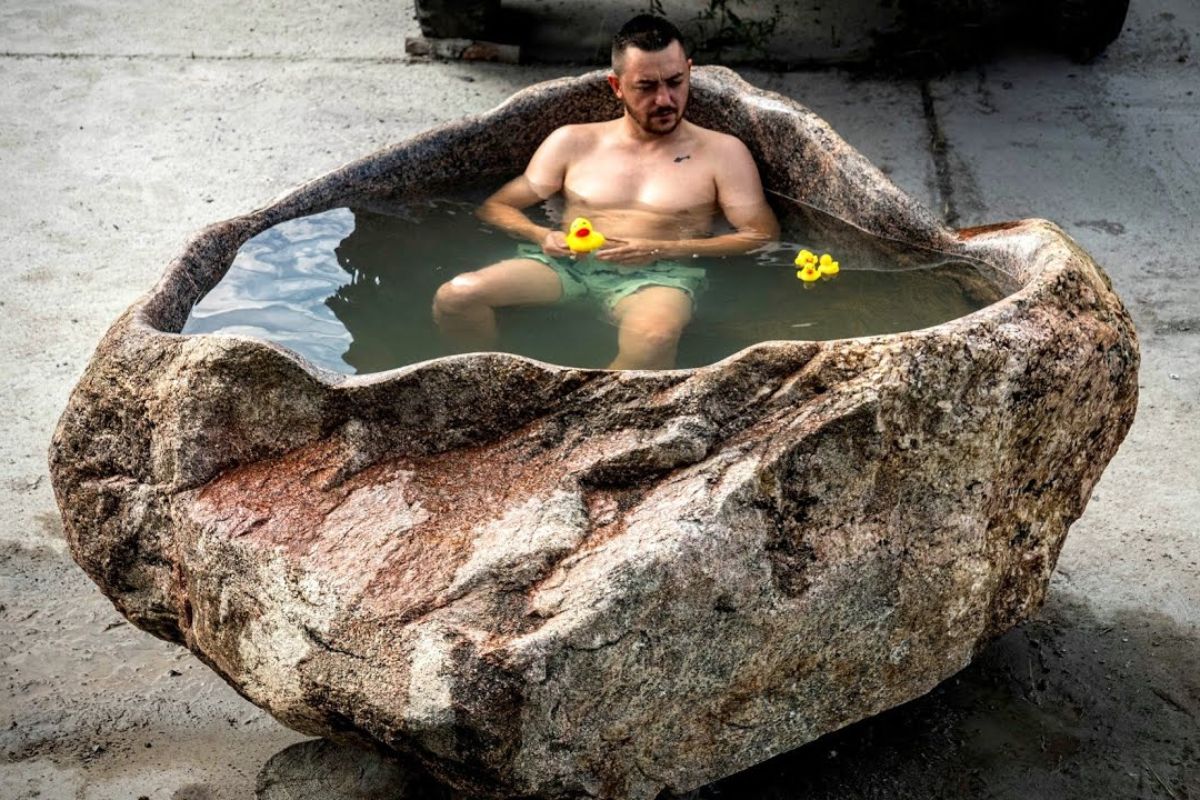
In an Outdoor Workshop, Next to a Trailer, a Craftsman Transformed a 10-Ton Block of Raw Granite Into a Stone Bathtub, Cutting the Base, Digging a Basin, Opening Drainage, and Polishing in Eight Stages, Even with a Blown Disc, a Fall, and Knee Pain Until the End
The stone bathtub was built in an outdoor workshop, next to a trailer, from a block of granite weighing 10 tons. The work was described as a long process, done with simple tools, without a crew and without machines dedicated to finishing, with the craftsman working amid intense dust, noise, and accident risks.
The idea was to “engrave a dream in stone,” but the execution took its toll: there was a cutting disc that broke, a fall with severe knee injury, and a constant routine of protection with a mask, goggles, and hearing protection. Still, the stone bathtub emerged from a raw block and became a deep basin, almost a pool, with an internal seat, drain, and final shine.
The Hidden Rock and the Beginning of the Challenge

The story begins with the search for the stone.
-
More tolls! The Anchieta-Imigrantes system will start implementing charges in both directions with free flow on July 1st, a fee of R$ 19.35 per segment, the end of toll plazas, and a project for a new 21.5 km lane.

-
A Brazilian city has a water park in the middle of the forest with tickets priced at R$ 29, over 300,000 m², 40 attractions, heated pools, and a record of 700,000 visitors in one year.

-
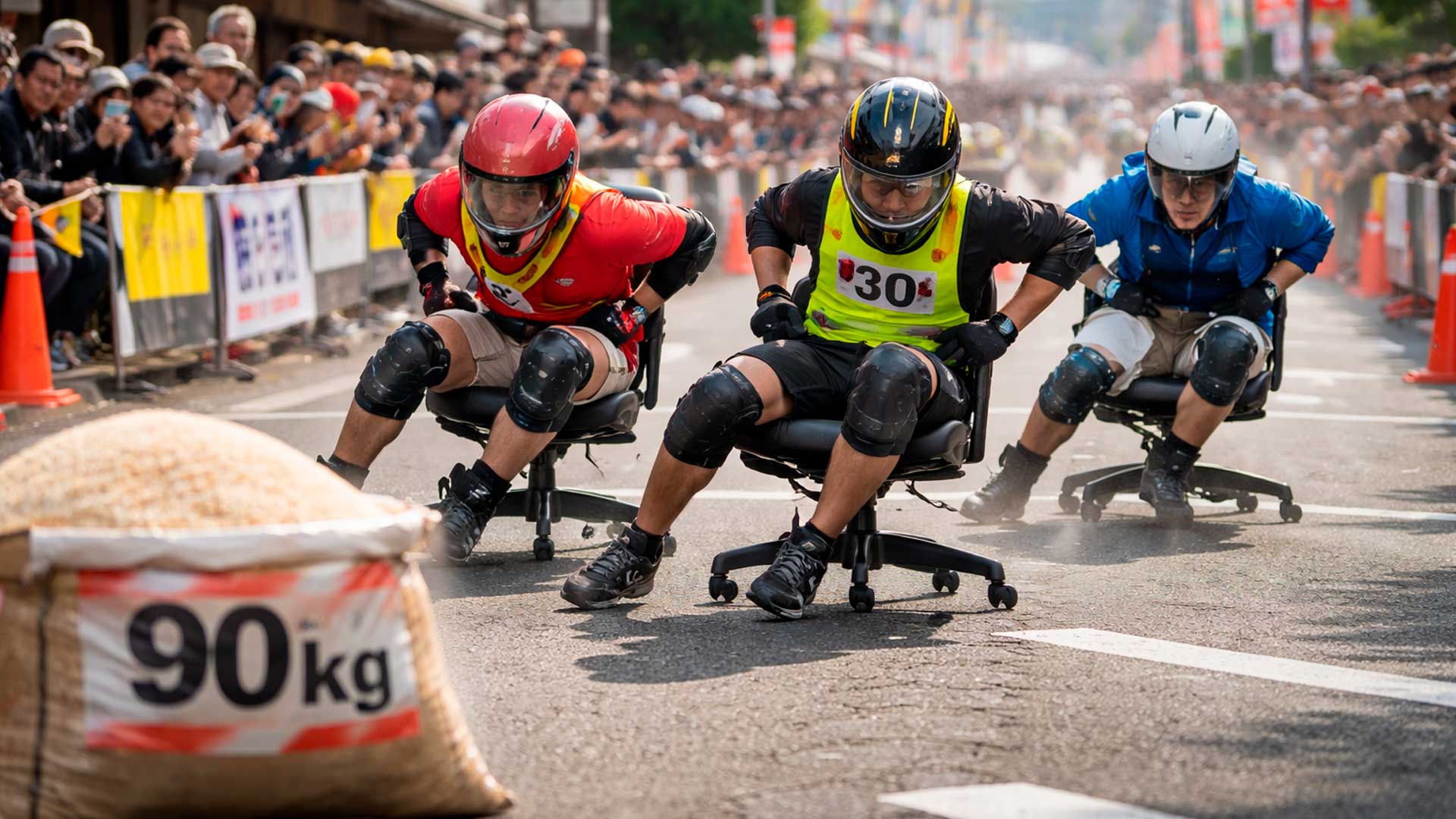
With an unusual prize, Japan transforms office chairs into a resistance race on the streets, ISU-1 Grand Prix grows, fills stages, and pays 90 kilograms of rice.
-
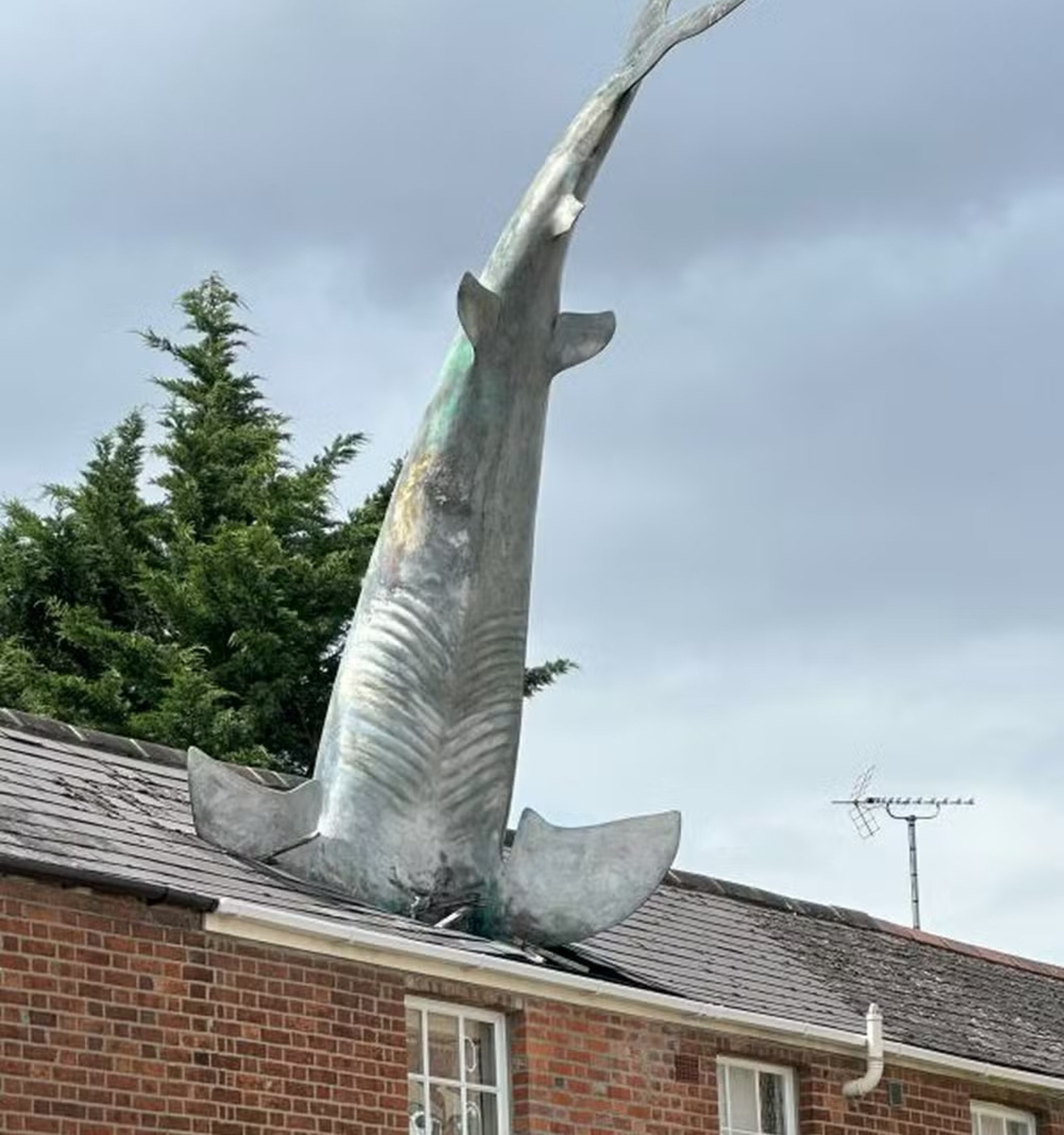
House in England with a 7.6-meter shark embedded in the roof attracts attention worldwide and becomes a curious attraction in Oxford.

The craftsman reports that he searched for the rock for months and only realized the real scale when he saw that a large part of the “giant” was buried.
When the excavator pulled the piece, the size became a practical question: where to start with a block weighing 10.5 tons.
At the unloading, the risk appeared early.
The box tilted, the stone collapsed, the pallet fell apart, and softened the fall.
The scene marked the project’s turnaround, as the rock ceased to be just raw material and became a physical and logistical obstacle even before the first cut.
Cutting the Base, Grinders, and Progressing Millimeter by Millimeter

The first step was leveling the base of the future stone bathtub.
The craftsman marked lines with a ruler, started cutting with a grinder and disk, and quickly realized that hard granite doesn’t yield easily.
The solution was to alternate a smaller grinder with a larger one and complete what the blade couldn’t resolve with chisel and hammer, removing excess in chips.
Where the direct cut failed, he opened notches, inserted wedges, and pounded until fragments broke free.
The rhythm was described as patient repetition, progressing centimeter by centimeter, until the stone finally stood on an almost flat surface.
Accident, Blown Disc, and Knee Injury

During the cutting of the base, a disc broke, and the craftsman slipped off the stone.
The fall resulted in a severe knee injury, with surgery reported as likely necessary.
The episode reinforced the internal alert from his own work: don’t neglect safety in a project of this weight and hardness.
Even with pain and limitations, he decided to continue.
The stone bathtub was treated as a technical obsession, with the routine of mask, goggles, and ear protection repeated as a condition of survival amid the granite dust.
Turning 10 Tons: When the Machine Can’t Handle It
Turning the rock was another bottleneck.
A forklift with a capacity of 5 tons, about 11,000 pounds, was insufficient: the forks bent, and the forklift itself started to tip over.
The message was clear: light equipment doesn’t work with 10 tons.
The turn only happened when he managed to get a more powerful machine, described as “Amkador.”
With the bucket, the rock was turned to the correct position, received planks underneath, and was carefully leveled, paving the way for the slowest stage, the excavation of the basin.
Excavating the Basin and Transforming the Stone Bathtub Into a Pool
To shape the form, the craftsman traced the future cavity with a small grinder and a 125 mm diamond disc, then used the larger one, with a 230 mm disc, to start deep cuts.
From there, the work became manual: hammer and chisel, chip by chip, for weeks.
After three weeks, it was already possible to see depth, but the difficulty increased.
The dust hung “like fog” inside the cavity, reducing visibility and clogging the space.
The compressor became a routine tool to clean the dust and allow continued digging.
At this point, the stone bathtub ceased to look like a simple basin and began to be described as a deep sink, almost a natural pool.
Bench for Three People, Drain, and the Rainy Phase
With the interior taking shape, he decided to open a step and carve a seat for three people.
The shaping of the seats repeated the same cycle: cutting, chipping, cleaning with a compressor, smoothing edges, and removing irregularities.
The drainage was done by drilling: first a fine drill to mark the drain point, then the long drilling, with debris clogging the drill and requiring manual cleaning until it penetrated the thickness. By the second month, the rainy season arrived, and the stone was outdoors.
The solution was to build a cover with planks and tarpaulin, to keep the stone bathtub in production even with the weather closing in.
Consumed Discs, Eight Stages of Polishing, and Shine at 80 Degrees
The finishing consumed material and time.
The craftsman reports that, even with professional stone discs, one disc lasted about 40 minutes.
He smoothed every millimeter until the final shape became clear. There was also a disc that broke during work, with a fragment flying off and opening a hole in the ceiling, serving as a reminder of the constant risk.
The polishing was described as a process of almost another month, using water to cool the tool and facilitate grinding. Eight gradations were cited: 0, 30, 100, 200, 400, 600, 800, and 1500.
At the final stage, diamond paste and felt discs were used, in small sections, with the stone heated to 80 degrees Celsius to trigger a reaction and generate a lasting shine, designed to reduce infiltration in the pores.
Washing, Signature, and the First Filling
At the close, the piece was washed inside and out to remove residues and reveal the pattern, texture, and color of the granite.
With pressurized water, the material “gains life,” and the stone bathtub ceases to be a worked block and becomes a functional object.
The craftsman finishes with a signature on the stone, a trademark as “Ringston,” puts in the plug, and makes the first filling.
The final scene is water running over natural stone, with the basin ready for use and the project concluded after months of physical wear and technical repetition.
If you had to bet, do you think a stone bathtub like this is worth more for the final result or for the story of risk, pain, and technique that was engraved in the granite?





-

-

-

-

-

-

117 pessoas reagiram a isso.