





 Portuguese
  English
  Spanish
  4 min of reading
  0 comments


In 1979, a bold offshore mining experiment changed the seafloor in order to study the extraction of mineral resources. Decades have passed, and now scientists are returning to the site to assess the effects of this intervention. The marks on the seafloor are still visible, revealing environmental impacts that persist 44 years later.
In 1979, a mining machine in offshore waters crossed a remote area of the Pacific Ocean. It was an experiment. The goal: to understand the impact of deep-sea mining.
Almost half a century later, the scar remains visible. And the consequences of it are only now beginning to be understood.
An Offshore Mining Test That Became A Reference
The affected area belongs to the Clarion-Clipperton Zone (CCZ), a vast expanse between Hawaii and Mexico. It is here that the manganese nodules, nicknamed “deep-sea potatoes”, are located.
-
After China, it’s now the turn of the USA to ‘secure’ a share of Brazil’s natural resources: the country buys critical rare earths for R$ 3 billion and enters the center of the global technology dispute.
-
Rare earths are in everything, from cell phones to bullet trains, and what almost no one realizes is why they have become the target of such a delicate global war.

-
Brazil extracts 26.3 million tons of ore from what was previously treated as waste, transforming residues into wealth, producing over 3 million tons of sand, and demonstrating how national mining is relearning to generate value.

-
A $3.5 billion megaproject in Latin America pumps desalinated seawater at 1,050 liters per second over 194 km to keep a copper supermine in the Andes operational for another 20 years.

They contain metals such as nickel and cobalt, essential for manufacturing batteries used in the energy transition.
In 1979, an experiment removed part of these nodules from the ocean floor. Now, 44 years later, scientists returned to the site to see what had changed. And they found still-fresh marks.
“The traces look almost as if they were made yesterday,” said Dr. Adrian Glover from the Natural History Museum in London.
This persistence is not surprising. Under the sea, biological processes are slow. Very slow. Yet, the clarity of the marks is alarming. The seafloor seems frozen in time.
Shy Recolonization, But Present
Despite the visible scar, life is starting to return. The study, conducted in partnership between the National Oceanography Centre and the Natural History Museum, analyzed the fauna that reappeared in the area.
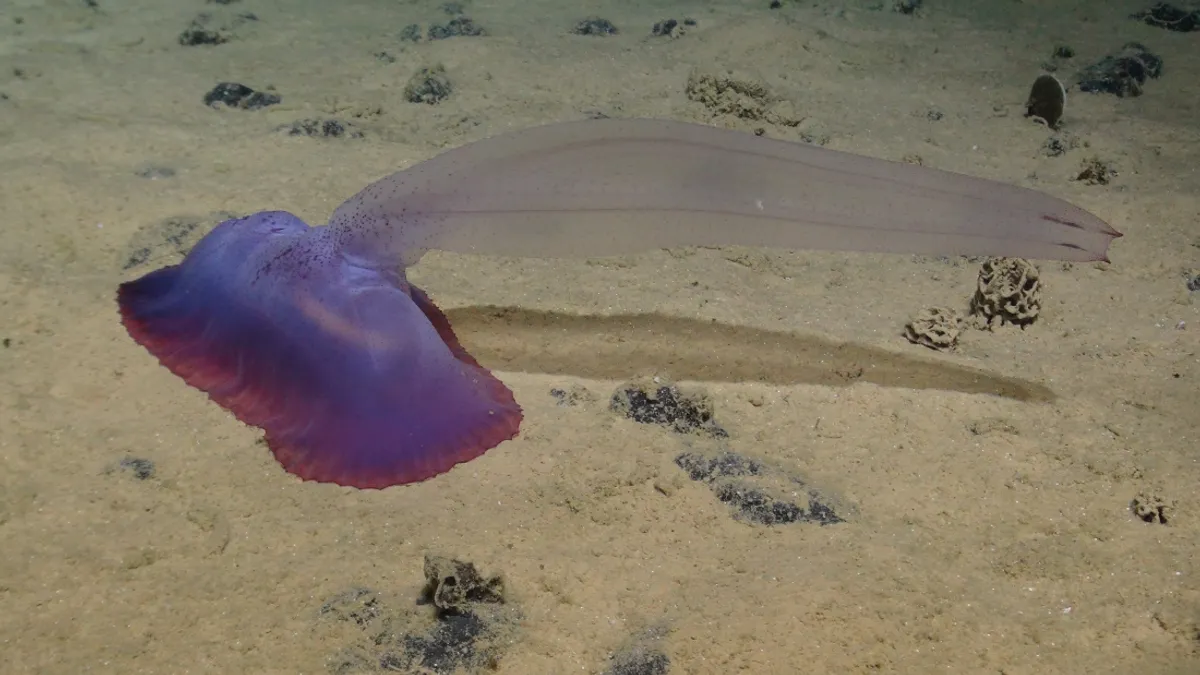
According to Glover, the data shows the first signs of biological recolonization. Small animals, such as the xenophyophore – a unicellular organism – are reemerging. They live on the sediment surface and are common in other areas of the CCZ.
However, larger animals that are fixed to the seafloor have almost not returned. Their presence is still rare. The reason for this is not yet clear, and scientists do not know what it might mean for the balance of the marine ecosystem.
The Scale Of The Impact Of Offshore Mining Is Still A Mystery
One of the challenges in assessing the risks of offshore mining lies in the size of the study area. The 1979 experiment occurred in a small portion of the seabed.
Compared to a commercial operation, it is like looking at a grain of sand.
A real mine can occupy up to 10,000 km². A single mining contract covers about 70,000 km². The CCZ itself is around 6 million km². And this represents only 2% of the global abyssal plain, which covers more than half of the planet’s solid surface.
Thus, scientists assert that it is practically impossible to use the experiment’s data to predict the impact on a global scale. Extrapolating would be too risky.
And The Sediment Plumes?
Another important point of the study was the analysis of sediment plumes. When mining occurs, particles are released into the water. This forms clouds that can suffocate organisms and alter the marine environment.
However, the 2023 study found no lasting negative effects in this regard. The presence of animals in the affected areas was similar to that of non-mined locations. According to the researchers, the impacts of the plumes appear to be more limited than previously thought.
Even so, Glover is cautious. The data is still insufficient for definitive conclusions. “It’s one step closer to understanding what might happen with offshore mining,” he said.
Partial Protection, Total Uncertainty
To attempt to reduce the risks, protected areas have been created in the CCZ. They cover about 2 million km², equivalent to 30% of the region under exploration. The idea is to ensure that, even with mining, part of the biodiversity is preserved.
The problem? We still do not know what lives in these areas. There are no comprehensive studies that allow comparisons between protected zones and explored areas. Thus, it is impossible to know whether this strategy truly works.
Glover explains that the focus now should be on understanding these protected regions. Knowing which species live there. And only then assess the risk of losing species forever.
A Warning About The Future
The study, published in the journal Nature, carries a clear message: the effects of offshore mining may last much longer than previously thought. Even after 44 years, the traces are still there. Clear, visible, unaltered.
And this is just the beginning. The industry is still in its early stages. Most commercial operations have not even begun. But the pressure for metals such as nickel and cobalt increases every year. The demand for batteries grows alongside the promise of a greener economy.
The dilemma is real. Extracting metals from the earth has immense environmental impacts. The seabed seems like an alternative. But we still do not know at what cost.
Dr. Glover’s research and his team is one of the first to show, with long-term data, what may be coming. And it points to what is still lacking in understanding: the risks to biodiversity, the recovery of ecosystems, the effectiveness of protected areas.
There is no ready answer. But time is running out. Because the traces of 1979 remain there. Intact. As a reminder of what can happen if the future arrives faster than knowledge.









Seja o primeiro a reagir!