





 Portuguese
  English
  Spanish
  9 min of reading
  0 comments


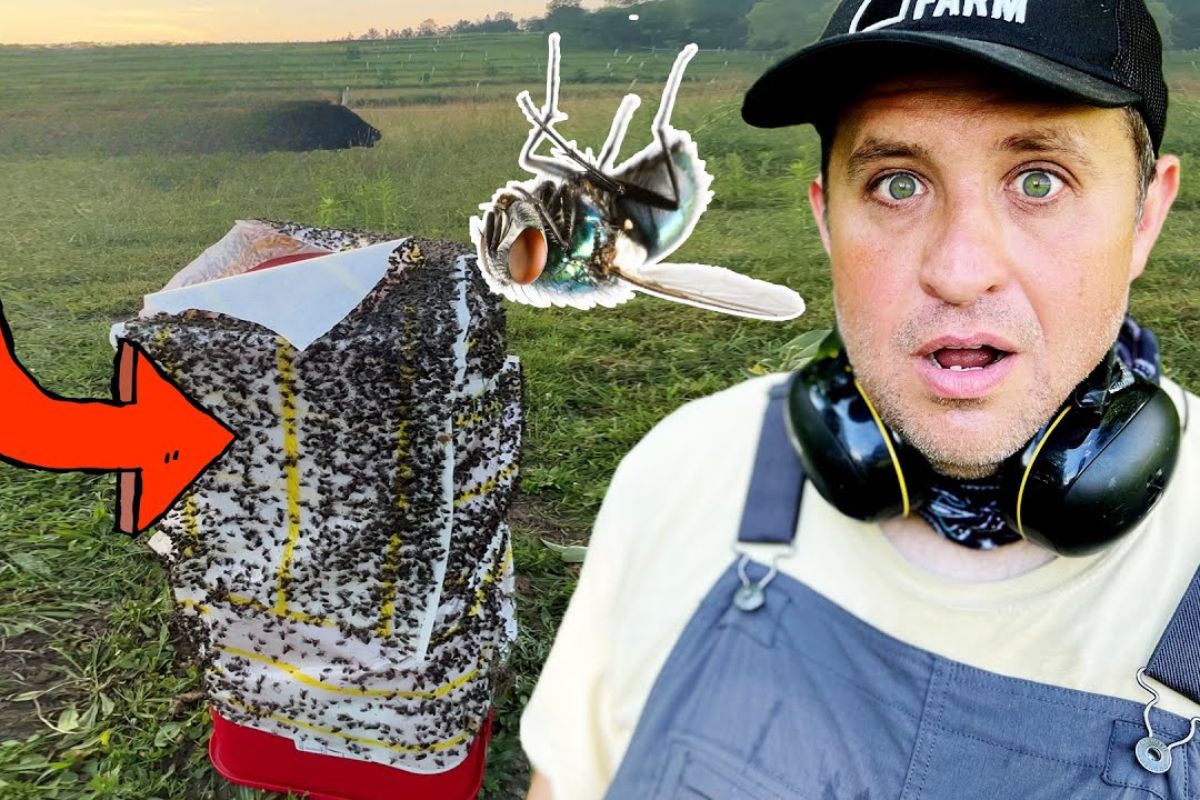
On a regenerative livestock farm, extreme fly infestation pressured nine Scottish Highland cattle, increasing stress, caloric expenditure, and the risk of pink eye. Without ivermectin or permethrin, the producer tested fly traps, pop traps, and fly paper, and saw a sharp decline in 48 hours in the same pasture.
The extreme fly infestation became a central problem in 2022 for a producer beginning his journey in regenerative livestock. The account begins with a detail that leaves no doubt about the pressure in the environment: a trap full of agitated, audible flies, as the cattle try to rid themselves of constant bites and discomfort.
On the farm, there are nine heads of Scottish Highland cattle: four cows, two heifers, two calves, and one bull. The proposal has been clear from the beginning: 100% pasture-based diet, no grains, and daily management with a paddock rotation to keep the animals in fresh pasture and away from their own manure. The extreme fly infestation tested this design in practice.
Daily Management and What Defines Regenerative Livestock in This Case

The described system bets on daily movement of the herd to new pastures, with days where the change occurs two or three times.
-
In France, a group of artisans spends 28 years building a medieval castle with 13th-century tools, without machines, without measuring tapes, and with almost zero carbon footprint, and the rediscovered techniques helped in the reconstruction of Notre-Dame.

-
Tourists on Everest were poisoned by guides who mixed substances in food to provoke false symptoms of altitude sickness while helicopter operators and hospitals charged inflated rescue fees to insurance companies.

-
Few people know this, but Neil Armstrong, one of the most famous NASA astronauts in history, survived the Korean War after jumping from the plane during his seventh combat mission aboard the USS Essex aircraft carrier of the United States.

-
Diving with a camera in Lake Furnas reveals a submerged city with an entire street, almost intact houses, a preserved bridge, a wood stove, a Kombi, and even a bus at the bottom of the largest lake in the Southeast.


The operational objective is twofold: maximize grass intake and reduce the animals’ stay in areas with accumulated manure, where part of the flies breed.
The producer also describes a cycle of intense grazing for one day followed by resting the pasture for about 60 days.
In one of the moves, he checks his phone records and finds a gap of 66 days since the last time that section had been grazed, pointing to May 18 as the reference date for the last use of that paddock.
The logic, within regenerative livestock, is to use manure as soil fertilizer and as food for a chain of insects and microorganisms that sustain the pasture.
From there, the extreme fly infestation becomes more than just an annoyance.
It turns into an element that interferes with weight gain, wellbeing, and health risks, especially in a model that relies on pasture stability and animals in good body condition.
Why Ivermectin and Permethrin Were Left Out of the Plan

The producer reports resistance to common chemical treatments on farms when the extreme fly infestation escalates.
He cites the usual examples of using products like ivermectin and permethrin, as well as strategies like ear tags with insecticide and spraying.
The justification presents itself in two fronts.
The first is consumption: he intends to eat part of the produced meat and therefore tries to avoid residues whenever possible, not treating these products as “villains” but not normalizing them as the first choice either.
The second is environmental and technical: he describes how such substances can affect the microbial life of the soil because part of the active ingredient passes through the animal’s body and exits in the feces and urine, reaching the ground, where the farm wants to stimulate insects, nematodes, and microbiology in the soil.
The tension increases because, at the end of winter, there was an outbreak of lice, and he tried to solve it with natural remedies, admitting it would have been “easier” to resort to chemical solutions.
This history of choices creates the background for the dilemma: how to control the extreme fly infestation without abandoning the premises of regenerative livestock.
What the Extreme Fly Infestation Provokes in the Cattle

In the account, the extreme fly infestation appears associated with stress and energy expenditure. The cattle begin to move, shake their skin, and contract muscles frequently, in a constant attempt to ward off the insects.
The practical effect is straightforward: more involuntary movement, more calories burned, which can result in leaner animals in worse condition.
He also mentions health risks, particularly pink eye and problems related to wounds and infestations in sensitive areas.
The herd consists of Scottish Highland, a breed described as having thicker skin and long eyelashes, characteristics that help with protection, but do not make the animals immune.
At the same time, the scenario is described as a mix of fly types, including flies associated with feces and grazing mammals, making the extreme fly infestation less predictable and more persistent over weeks.
Mitigation Routine with Birds and Why It Was Not Sufficient
Before intensifying the fly traps, the producer tried to reduce the pressure with two management fronts. The first is the rotation of the cattle, moving them away from recent manure.
The second involves birds.
He describes a mobile chicken coop and a plan where the chickens stay two to four days behind the cattle, being moved every few days.
The function is operational: the chickens peck, scratch, and break apart the manure piles, consuming larvae and reducing part of the reproductive cycle that feeds the extreme fly infestation.
In addition to the chickens, he mentions the presence of geese and ducks in the pasture, reinforcing the idea of birds working the area.
Even so, the fly explosion continued.
He recognizes a practical limit to increasing the number of chickens: there would be no market for so many eggs, which, in his view, could turn into waste.
The result is a key point of the case: management and birds reduced, but did not eliminate.
The extreme fly infestation persisted and required a strategy that acted directly on the adult population.
Fly Traps: Comparison Between Bucket, Bag, and Bait Models
The turning point in the account is the intensive use of fly traps as a non-chemical response.
He divides the universe into two groups: sticky traps and “bucket” traps, a term that includes cups, trays, bags, and even adaptations in large buckets.
A “fly bag” type trap is described as reasonably efficient and inexpensive, with the downside of a strong odor.
The adapted five-gallon bucket model, which he imagined would be the easiest and cheapest if it used homemade bait, captured little in testing and received a low rating.
He admits that a trial with Coca-Cola as bait did not deliver the expected result, which reinforces the variability of the method.
Among the commercial options, he mentions “fly buster traps,” which worked well, but were considered expensive and also had an unpleasant odor.
He then points out the “pop traps” as the best within the bucket group: they take a few days for the bait to activate, capture a lot, and end up gathering larvae and intense odor over time.
Still, the performance was sufficient to highlight them among the fly traps that depend on bait and container.
Even with these results, the account makes it clear that the real control of the extreme fly infestation did not come from the bucket. It came from the sticky material installed in the right place and changed with discipline.
Fly Paper in Barrel and the Decline in 48 Hours
The producer describes fly paper as the most effective tool. The mechanism is direct: adhesive paper that traps the fly when it lands.
He acknowledges the impact on the insect but prioritizes the protection of the animals, especially when the extreme fly infestation elevates stress and health risks.
The first test was to stick the fly paper on a mobile device used with the cattle, which brought the trap closer to the animals but exposed the material to wind and rain, leading to frequent tears and drops.
The alternative came from a livestock forum: buy the largest roll possible and wrap it around a garbage barrel, creating a large, stable surface that is easy to renew.
The described operation is repetitive and short.
He reports that at first, the impression was frustrating: even with new adhesive surfaces, the cattle still seemed burdened.
The change was not a slow and gradual decline. The described pattern is of high pressure for days, a subtle reduction, and then suddenly, an abrupt collapse of the fly population in about 48 hours.
He sets up the stations near the waterers.
In addition to these points, he keeps other traps distributed in the area as reinforcement, but emphasizes that the movable adhesive station, following the herd, was the most consistent element for reducing the extreme fly infestation in the short term.
He shifts the position with the cattle as the paddock advances and replaces the material when necessary. On one of the days, he observes the fly paper starting to catch flies in about two minutes. In another section, he claims that, overnight, the traps caught thousands.
The most relevant part is the response time:
The visual perception appears in concrete examples. He says one of the cows most affected by the plague was a black female, which, in his reading, could increase the attraction of the flies.
After the turning point, he looks at the animals and finds almost no flies: a single insect on a heifer’s nose is cited as an exception, in direct contrast to previous days.
After about two weeks of continuous pressure and especially in the last 48 hours, he notices an “insane” drop in the volume of flies, going from a heavy scenario to a level where only one or a few flies are seen on the animals. For him, it was the combination of pasture rotation, birds, and fly traps, with fly paper playing the decisive role in closing the cycle.
Cost, Waste Generated, and the Detail of Beneficial Insects
The effectiveness came with costs and side effects.
The producer reports that during the two most intense weeks, he spent about US$ 4 per day on fly paper, and that a 40-foot roll cost around US$ 8, yielding two barrels over two days.
The daily work, on the other hand, was described as light: approximately three minutes to change or adjust the traps.
The environmental impact appears in the volume of waste: used adhesive paper needs to be discarded frequently.
Even so, he projects a reduction in consumption when the extreme fly infestation drops, switching to changing the material once or twice a week instead of daily.
There is also a concern for beneficial insects.
He says he inspected the catches and did not see bees on the fly paper, while an alternative “wand”-shaped model, bought for about US$ 9, captured some bees and was considered inefficient.
This contrast reinforces a technical criterion for choosing fly traps: it is not enough just to catch a lot; it is necessary to not create collateral damage to species that are not part of the problem.
What Changes When Control Becomes Routine and Not Emergency
At the end of the account, the producer returns to management. With the cattle advancing from paddock to paddock, he adjusts the waterers, mobile equipment, and the fly traps themselves to keep up with the herd.
The logic, within regenerative livestock, is to prevent the problem from escalating again, maintaining a constant yet lighter pressure on the insect population.
He also signals the intention to keep testing bait traps, seeking a better formula than the initial attempts.
At the same time, the experience has become a kind of practical audit of the system: pasture rotation and birds help, but the quick control trigger of the extreme fly infestation was the fly paper applied with discipline and replacement.
In the context he describes, the learning is pragmatic: when the plague is already established, the response does not depend on a single trick.
It depends on a set of repeated decisions, focusing on reducing stress and health risks in the Scottish Highland herd without resorting to chemicals.
If you are dealing with an extreme fly infestation in regenerative livestock, it is worth recording in the field what changes when the fly traps become routine and when the fly paper becomes a maintenance tool, comparing cost, waste generated, and herd response.
In your experience, what non-chemical method quickly brought down an extreme fly infestation using fly traps and fly paper in regenerative livestock?









-

-

-

-

-

15 pessoas reagiram a isso.