





 Portuguese
  English
  Spanish
  4 min of reading
  0 comments


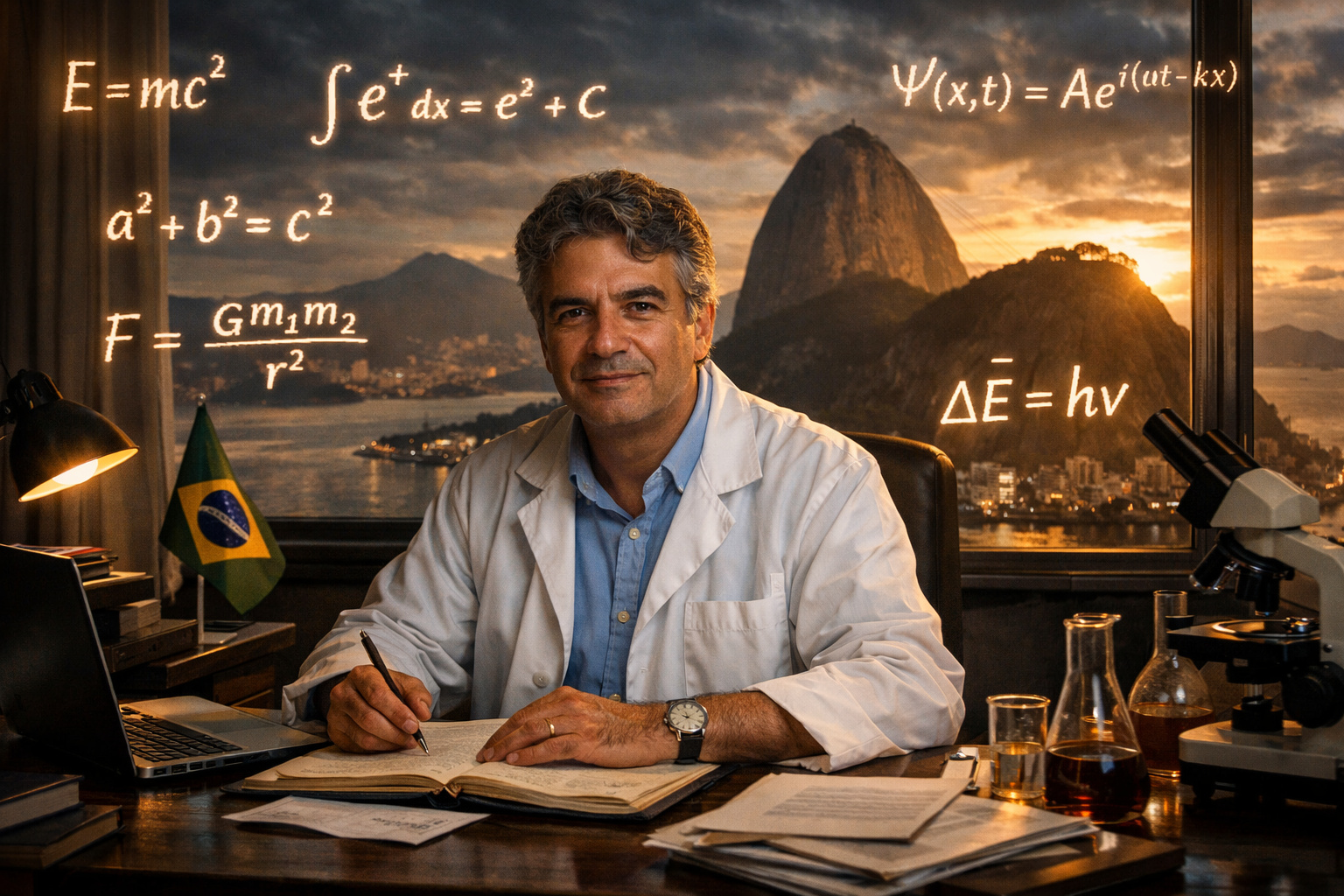
A silent discovery made in Brazil changed the way science understands complex systems and drew global attention decades later, putting the country at the center of the most advanced scientific discussions
For decades, world science advanced based on established theories that explain everything from the movement of common objects to the behavior of the universe on a large scale. However, a discovery made in Brazil, still little known to the general public, is profoundly changing this structure.
The information was released through widely recognized scientific records and gained even more relevance after the Nobel Foundation chose this theory as the central theme of an important symposium in 2027, an unprecedented achievement for a discovery born in Latin America.
But before understanding the impact of this Brazilian contribution, it is essential to comprehend the foundations that support all modern physics.
-
Brazilian city neighboring Paraguay becomes a ‘magnet’ for people seeking quality of life and high standards with exceptional growth and commutes of up to 15 minutes.

-
A rare storm transformed part of the Gulf into an unlikely scene of hail, extreme rain, and tornado risk in the middle of the desert, with volumes that exceeded the annual average in a single day.

-
Brazil catches the world’s attention with ships powered by ethanol and biodiesel that have lower emissions, an unprecedented certification with advantages in chartering, and a revolution in cabotage.

-
A couple who only has Sundays free has built a hand-dug pool, a hamburger joint, a dance hall, and a playground in their own home without hiring a mason, and even with breaks due to accidents and the pandemic, the work has never truly stopped.


The five pillars of physics that explain the universe


First of all, physics is not a random set of formulas. On the contrary, it is an organized structure that, over more than 300 years, has been built by some of the greatest scientists in history.
The first pillar is Newtonian mechanics, developed by Isaac Newton in the 17th century. This theory explains the everyday world, such as the movement of cars, falling objects, and simple trajectories. Moreover, its three laws of motion are fundamental to this day.
However, when it comes to extremely high speeds or gigantic masses, the second pillar comes into play: relativity, proposed by Albert Einstein. In this context, space and time cease to be absolute and form a unique structure called spacetime.
Additionally, the famous equation E=mc² revealed that mass and energy are equivalent, which is essential for understanding everything from the functioning of stars to modern technologies.
On the other hand, when we go down to the microscopic level, we find the third pillar: quantum mechanics. This area of physics describes a world where particles can exist in multiple states at the same time, completely challenging common sense.
Next, we have the fourth pillar: electromagnetism, unified by James Clerk Maxwell. His equations explain phenomena such as light, electricity, and magnetism, forming the basis of technologies like Wi-Fi, radio, and mobile networks.
Finally, we arrive at the fifth pillar: statistical mechanics, developed by scientists like Ludwig Boltzmann and Josiah Willard Gibbs. This theory allows the study of systems with billions of particles, using probabilities to describe collective behaviors.
The Brazilian discovery that expanded modern physics
Despite the success of traditional statistical mechanics, it had significant limitations. This is because its model works best in systems with short-range interactions.
It was at this point that the work of Constantino Tsallis emerged. In 1985, while working at the Brazilian Center for Physics Research (CBPF) in Rio de Janeiro, he proposed a revolutionary generalization of entropy.
Basically, Tsallis introduced a new parameter, known as q-index, which allows the description of complex systems with long-range interactions. When q = 1, his formula reduces to the classical Boltzmann-Gibbs model. However, when q ≠ 1, a new universe of possibilities opens up.
Thus, the so-called Tsallis statistics emerged, capable of explaining phenomena that could not be modeled correctly before.
Moreover, this approach began to be applied in various fields. For example:
- Astrophysics (dynamics of galaxies)
- Geophysics (earthquakes)
- Medicine (brain activity)
- Economics (financial markets)
- Social sciences (collective behavior)
Consequently, this theory has become a universal tool for studying complex systems.
International recognition and historical impact
The impact of the discovery can be measured in numbers. The article published by Tsallis in 1988 became the most cited Latin American scientific work in history, with tens of thousands of citations worldwide.
Furthermore, the choice of Tsallis statistics as the central theme of the 2027 Nobel Symposium represents a historical milestone. This is because it is the first time a theory developed in Latin America receives this level of recognition.
Meanwhile, the work continues to influence research in different fields of knowledge, showing that Brazilian science has a real capacity to impact the world.
On the other hand, this story also raises an important question: why are discoveries of this level still little known in their own country?
What this story reveals about the future of science in Brazil
In light of this, it is clear that Brazil has high-level scientific talent and capacity. However, it still faces challenges such as lack of investment and recognition.
Still, the trajectory of Constantino Tsallis shows that great ideas can arise even in adverse contexts. Therefore, investing in science is not just an academic issue, but an essential strategy for the country’s development.
Moreover, this discovery reinforces a fundamental point: science is in constant evolution. Just as Newton was expanded by Einstein, and classical physics by quantum physics, Tsallis statistics shows that there is always room for new ideas.
Finally, this story is not just about physics. It is about vision, curiosity, and the courage to question what already seemed definitive.
Had you heard that one of the most influential theories of modern physics was born here in Brazil?










Seja o primeiro a reagir!