





 Portuguese
  English
  Spanish
  4 min of reading
  0 comments


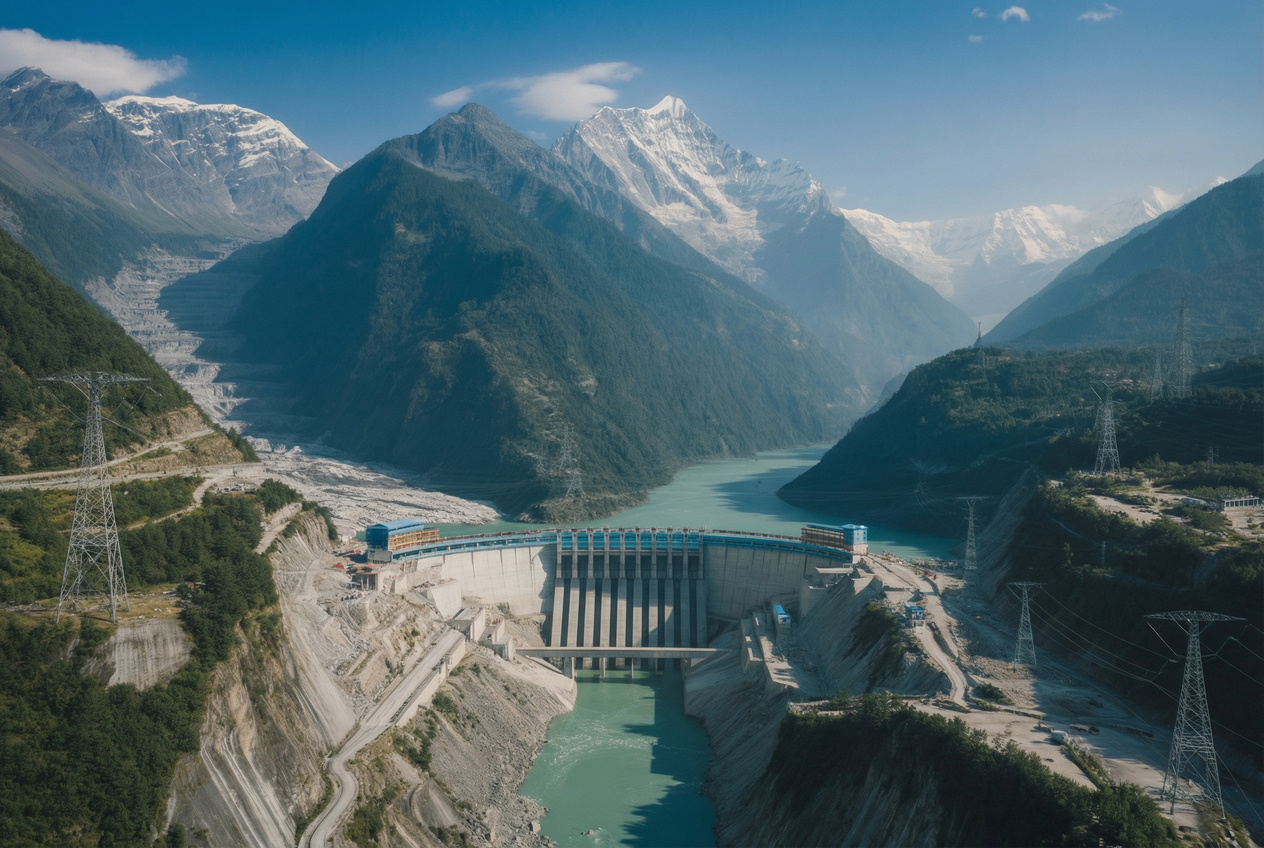
Amidst Himalayan Valleys, Nepal Raised the Upper Tamakoshi Hydroelectric Plant of 456 MW to Reduce Blackouts, Cut Energy Imports, and Redefine Its Electric Sovereignty.
On July 22, 2021, Nepal officially commenced commercial operation of the Upper Tamakoshi Hydroelectric Plant, located in the Tamakoshi River valley, in the Dolakha district, central region of the country, about 150 kilometers northeast of Kathmandu. The facility is operated by the Nepal Electricity Authority (NEA), the state body responsible for the national electric system, and integrates the energy policy of the Ministry of Energy, Water Resources, and Irrigation of Nepal.
With 456 megawatts of installed capacity, the project has become the largest hydroelectric plant ever constructed in the country and a historic milestone for being primarily financed with domestic capital, involving public pension funds, state banks, and direct government participation. Technical and institutional information can be found in official reports from the NEA, the World Bank, the Asian Development Bank (ADB), and public documents from the Nepalese government.
The Chronic Energy Dependency That Held Nepal Back
For decades, Nepal lived an energy paradox. Despite hosting some of the steepest and most powerful rivers on the planet, fed by Himalayan glaciers, the country faced daily blackouts, especially during the dry season. Until the mid-2010s, power cuts exceeding 12 hours per day were common in urban centers and practically constant in rural areas.
-
Church from 1888 becomes a mansion of over 330 m² in Canada after a renovation of R$ 3.4 million and is eventually sold for nearly R$ 4.3 million.

-
How an innovative city combines high technology, well-being, and sustainability to become the largest reference in clean energy on the planet.
-
Couple buys 1846 church in ruins for R$ 660,000, invests R$ 3.2 million in renovations, transforms it into a millionaire mansion, and even preserved a historic cemetery with over 300 graves.

-
He started running at 66 years old, broke records at 82, and is now a subject of study for having a metabolic age comparable to that of a 20-year-old, in a case that is intriguing scientists and inspiring the world.


To prevent system collapses, the country began to import electricity from India, creating a sensitive external dependency for an already weakened economy. According to official data from the NEA, prior to Upper Tamakoshi, over 30% of the energy consumed in winter came from abroad, straining public finances and limiting industrial growth.
It was in this context that the hydroelectric plant began to be treated as a national strategic project, not merely as infrastructure work.
Where Energy Is Born: The Tamakoshi River and Glacier Valley
The Tamakoshi River originates in glacial regions above 5,000 meters in altitude, in central Himalaya. Its abrupt elevation creates exceptional hydroelectric potential but also imposes extreme challenges on engineering. The valley is narrow, subject to landslides, avalanches, accelerated erosion, and permanent geological instability.

Instead of a conventional large reservoir dam, the engineers opted for a run-of-river type system, which reduces flooded areas and social impact but requires long tunnels and deep excavations in unstable rock. This decision shaped the entire technical complexity of the project.
Underground Engineering on an Extreme Scale
The core of Upper Tamakoshi is hidden beneath the mountain. Water from the river is captured by a relatively low intake structure and diverted into a conveyance tunnel approximately 8 kilometers long, excavated directly in fractured metamorphic rock.
This tunnel directs water to a completely underground power house, where six Francis turbines, each with an approximate capacity of 76 MW, are installed, totaling 456 MW. After generating energy, the water returns to the riverbed, minimizing downstream hydrological changes.
NEA technical reports indicate that excavation required continuous structural reinforcements, concrete injections, permanent drainage, and constant adaptation of the construction method as geological conditions varied along the route.
The 2015 Earthquake and the Near Collapse of the Project
On April 25, 2015, a 7.8 magnitude earthquake struck Nepal, causing more than 9,000 deaths and widespread devastation. The Tamakoshi valley was severely affected. Massive landslides buried access roads, damaged tunnels under construction, and compromised temporary structures of the plant.
Official documents indicate that the project suffered delays exceeding 18 months solely due to the earthquake, in addition to significant cost increases for slope stabilization and tunnel recovery. Nevertheless, the government decided to maintain the revised schedule, treating the project as a national priority.
Domestic Financing and Economic Sovereignty
Unlike many large projects in developing countries, Upper Tamakoshi was financed without concessions to foreign companies. More than 50% of the capital came from pension funds of public employees, armed forces, and state-owned enterprises. The remainder was covered by national banks and direct government funding.
This structure transformed the plant into a domestic strategic asset, whose profits return directly to the Nepalese public system. According to the Ministry of Energy, the plant has the potential to dramatically reduce electricity imports and, during periods of surplus, allow for seasonal exports to neighboring countries.
Direct Impact on the Electric Matrix and Blackouts
With the commencement of operations at Upper Tamakoshi, Nepal began to record energy surpluses during the rainy season, something unprecedented in the recent history of the country. The plant alone accounts for about one third of the national installed capacity, altering the balance of the system.

NEA data show a significant drop in power cuts and a reduction in the average generation cost, creating conditions for industrial expansion, rural electrification, and greater economic stability.
Why Upper Tamakoshi Redefines Nepal’s Future
More than a hydroelectric plant, Upper Tamakoshi represents a structural change. The project proved that Nepal is capable of executing heavy engineering in extreme environments, financing large works with its own capital, and transforming its natural resources into economic leverage.
In a mountainous country, poor in fossil fuels and highly vulnerable to external shocks, controlling its own energy means control over its own development. That is why, even in the face of earthquakes, delays, and high costs, the project has never been abandoned.






-

-

-

-

5 pessoas reagiram a isso.