Portuguese
 Spanish


Grupo RAS launched a $102 million freight train on Uruguay’s roughly 265-km Ferrocarril Central on Friday, November 20, 2026, in Progreso, with seven locomotives and plans to extend the service to Rivera, across the border from Santana do Livramento in Brazil’s Rio Grande do Sul state
Grupo RAS inaugurated a private freight train service in Uruguay on Friday, November 20, 2026. The ceremony took place at Ruta 5 Industrial Park in Progreso, Canelones, with President Yamandú Orsi in attendance.
The EFE news agency reported the launch that day in an article republished by Infobae. Uruguay’s Office of the President also published an official account of the ceremony on Friday, November 20.
The initial investment totals $102 million. The money is going toward locomotives, railcars, terminals, inland ports, technology and infrastructure.
-
CMA CGM removes Manaus from service via Panama Canal, rerouting Asia cargo to Free Trade Zone through Rio de Janeiro transshipment in 11 days

-
Brazil’s Sorghum Shipments to China Reach 1.64 Million Metric Tons from August to October, Boosting Demand for Panamax Ships as Santos Handles 46% of Cargoes
-
Maersk ends partnership with CMA CGM on Asia–East Coast South America route while maintaining direct service from Itapoá to Northern Europe
-
Hapag-Lloyd and CMA CGM increase Asia-to-South America’s East Coast freight rates by $1,000 per container from Dec. 1, affecting Santos, Paranaguá, and Itajaí


The first phase includes seven locomotives and a transfer terminal in Canelones, the department next to Montevideo.
Brazil is part of the plan through the border with Rio Grande do Sul. The next stage will extend the freight train service to Rivera, a city directly across the border from Santana do Livramento.
A terminal there would allow the company to handle Brazilian imports, with Montevideo serving as a shipping hub, according to a November 22 report by Infobae.
How Grupo RAS’s first freight rail phase works
Initially, the service will carry containers between the port of Montevideo and the company’s industrial park in Progreso, alongside Route 5.
Uruguay’s Ministry of Transport and Public Works (MTOP) says the park is 30 km from the port terminal.
The planned cargo includes forest products, containers and liquids. The group aims to combine rail service with trucking and port services to cut transportation costs and time.
Uruguayan broadcaster VTV Noticias posted a video of the inauguration on November 20, 2026, in Spanish.
In its description, the broadcaster says Grupo RAS has become the operator of Ferrocarril Central and that, according to officials, the connection will link Montevideo and Rivera.
Orsi, also according to the broadcaster’s text, wants to convince business leaders that “Uruguay is worth it”.


The group has invested $648 million in Uruguay across port infrastructure, free-trade-zone facilities, a truck fleet and a logistics park. EFE reported that it has more than 1,500 employees.
The Office of the President says the company’s projects support more than 13,000 direct and indirect jobs.
How the line to Rivera could affect Brazil
Rivera is where the Uruguayan line reaches Rio Grande do Sul. On the other side of the border is Santana do Livramento, which Uruguay’s government has identified as a destination for the corridor.
The route described by Infobae has four points. Rivera would be the freight concentration and transfer hub. Santana do Livramento would serve as the border link.
Cacequi, in Rio Grande do Sul, would connect the freight train to the state’s rail network. Montevideo would be the shipping platform.
A terminal in Rivera, the report said, would make it possible to handle Brazilian imports.
RAS wrote on LinkedIn on the day of the inauguration that the stages reaching Rivera and Salto should strengthen Uruguay’s links with Brazil, Argentina and Paraguay.
The RAS Group itself presented the project this way.
At the ceremony, the company cited the connection between the Port of Montevideo, the Progreso industrial park and the border with Brazil at Rivera and Santana do Livramento.
Different track gauges at the border with Santana do Livramento
There is a technical obstacle between the two countries. Uruguay’s rail network uses 1,435-mm track, known as standard gauge. On the Brazilian side of the border, the gauge is metric.
A third rail is already in place in the border area, however. It makes the two systems, Uruguayan and Brazilian, compatible on the section between Rivera and Santana do Livramento.
Port of Montevideo competes with southern Brazilian ports for cargo
Completing the corridors could affect competition between ports on the Río de la Plata and those in southern Brazil for cargo from the interior.
That is the assessment in Infobae’s November 22 report.
The article lists three conditions for that to happen. Progress depends on the pace of public works, coordination between the two governments at the border and the ability to offer freight rates competitive with trucking.
Ruben Azar, president of the RAS Group, told EFE that the project has “regional ambition.”
He said rail had taken a back seat in Uruguay’s logistics system and that the company wants to restore its role.
The Ferrocarril Central and the 265 km to Paso de los Toros
The RAS Group’s freight train runs on the Ferrocarril Central. The line spans about 265 km between Paso de los Toros and the Port of Montevideo.
It passes through Tacuarembó, Durazno, Florida and Canelones.
The line has an annual capacity of 4 million tons. It was authorized to operate on August 8, 2024.
Since then, it has recorded about 5,000 train movements and carried 8 million tons, based on figures from the MTOP cited by Infobae.
Of that total, 7 million tons were pulp and 1 million tons were production inputs. So far, demand has been concentrated in a single type of cargo.
Spanish company Sacyr celebrated the line’s opening in a post on X on April 17, 2024, in Spanish.
The company wrote that the new line is 265 km long, connects Paso de los Toros with the Port of Montevideo and required more than 3,500 workers.
Wabtec locomotives came from Brazil
The seven locomotives were built in Brazil by Wabtec. The first three arrived at the Port of Montevideo on November 17, 2025, a statement from Uruguay’s Ministry of Transport and Public Works (MTOP) said that Monday.

Each locomotive has 2,500 horsepower and weighs 102 metric tons. Together, they can haul freight trains with 20 to 25 railcars.
At the time, the ministry expected operations to begin in March or April 2026.
In March 2026, state-owned Servicios Logísticos Ferroviarios (SELF) moved the three locomotives from the port to the Peñarol workshops.
Wabtec technicians were brought in to carry out the final adjustments, a process expected to take about two months, another MTOP statement said.
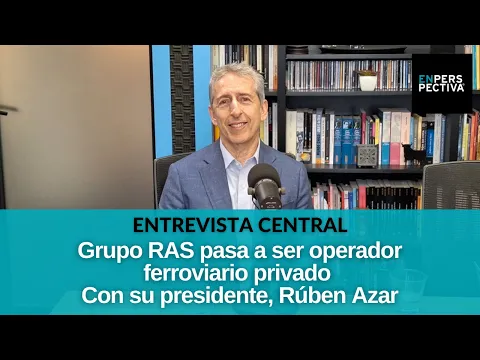
The week the locomotives arrived, Uruguay’s En Perspectiva program interviewed Ruben Azar. The interview, in Spanish, was published on November 20, 2025.
The channel’s description says the group would be the country’s second private rail operator, after the one dedicated to UPM.
What Orsi, Etcheverry and Ruben Azar said
Orsi defended continuing to bet on “Uruguayans who get things done” and on geographic diversification. “Diversification is the watchword,” he said.

He noted that China is the leading destination for Uruguayan goods, while the United States leads in service purchases.
Transportation and Public Works Minister Lucía Etcheverry said the rail infrastructure “is here to stay.” She said this is the first time Uruguay has had a railway development policy.
The train, she said, complements road transportation, a sector that will receive US$2.1 billion.
Azar reviewed the group’s history and announced new projects, including a specialized krill terminal at the Port of Montevideo.
He also welcomed the government’s decision to rehabilitate the bridge over the Negro River and maintain the route to Rivera.
Uruguayan newspaper la diaria led its November 20, 2026, news roundup with the inauguration, in a video in Spanish.
The presenters say Grupo RAS has begun operating freight service on the Ferrocarril Central, with an investment of US$102 million, and repeat Orsi’s line about diversification.

The Negro River bridge and public works still needed
The stretch to Rivera still depends on government work. Uruguay’s Ministry of Transport and Public Works (MTOP) contracted the rehabilitation of the railway bridge over the Negro River for US$1.8 million, with work expected to take about 10 months.
The bridge is the missing link connecting the main network to the Rivera line. That line will also receive track maintenance.
The MTOP has budgeted US$15 million for railway work in 2026, prioritizing the stretch north of Rivera.
The ministry is also preparing a Master Plan for rail transport. The study is funded by a regional development bank.
President Orsi’s government had already addressed the Ferrocarril Central project in May 2025. On May 19, the president’s office posted the agreement with the Grupo Vía Central consortium in Spanish on X.
Orsi said it was up to the government to find a way to honor the contracts and secure a future for the railway project and production.
Salto and the link to Argentina
The other route runs to Salto, on the border with Argentina. The railway bridge over the Salto Grande Dam, opened in 1981, connects Salto with Concordia.
The track gauge is the same, 1,435 mm, eliminating the need to transfer cargo at the border.
Some sections of the line to Salto have not yet been rehabilitated. Grupo RAS made the extension contingent on that work. Once completed, the corridor could carry Argentine and Paraguayan freight from Concordia to Uruguayan ports.
What still depends on construction and timing
Grupo RAS has not set dates for reaching Rivera or Salto. Both corridors are presented as future phases, with no timeline, in both EFE’s text and Infobae’s report.
For Brazil, the impact still depends on the bridge over the Negro River, the track to Rivera, and an arrangement at the Santana do Livramento border crossing, where the track gauges differ.