





 Portuguese
  English
  Spanish
  3 min of reading
  0 comments


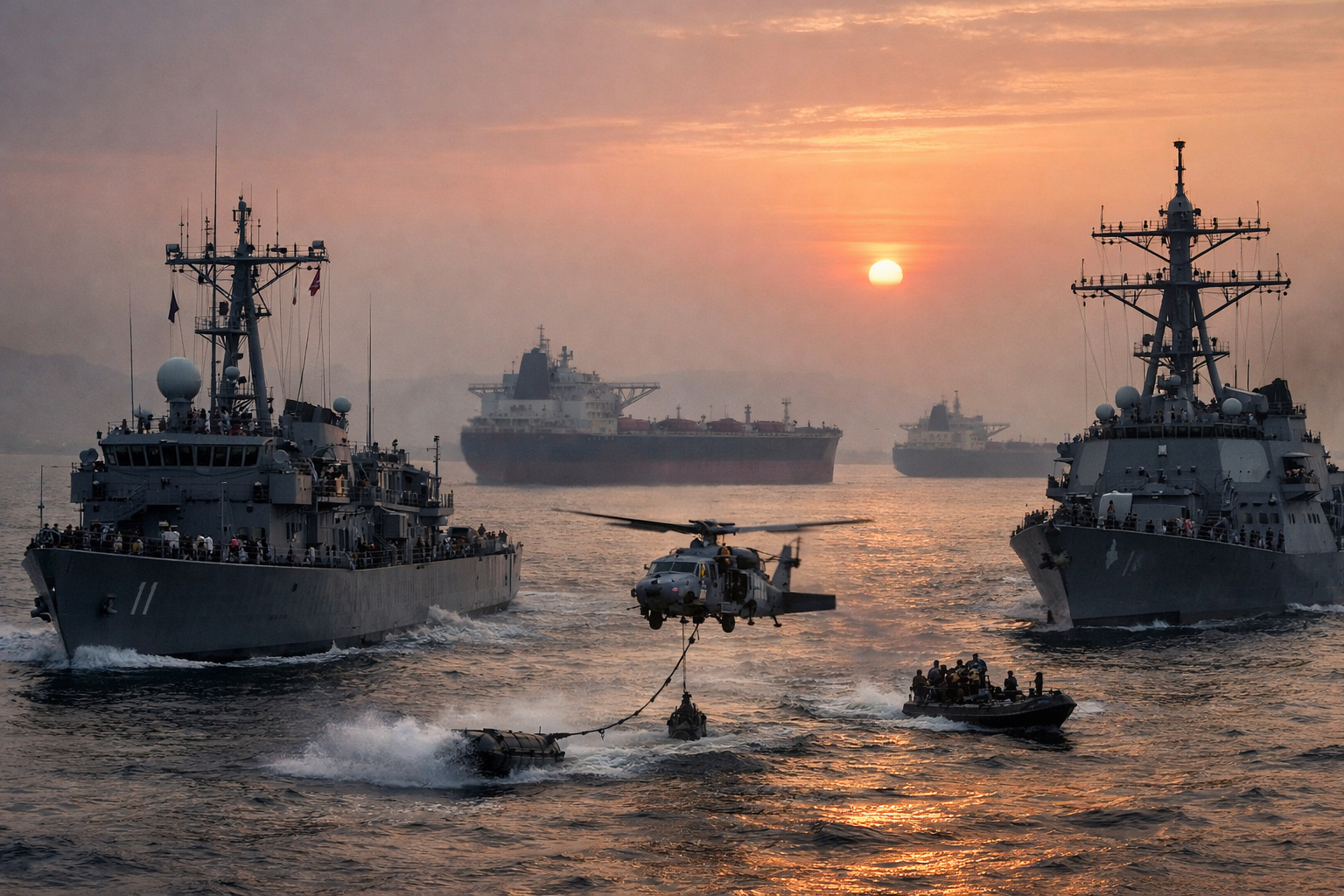
Military movement and strategic resumption of commercial ships reignite concern about global energy supply and impact on oil prices
Geopolitical tension has gained strength in the international scenario this Saturday, after the United States Armed Forces confirmed the deployment of two warships to the Strait of Hormuz. The operation is part of a strategic plan to begin the removal of mines from the channel, considered one of the most critical points for global oil transportation.
The information was disclosed by “Forbes”, based on official data from the U.S. Central Command, which stated that the mission aims to “establish conditions for the removal of mines in the Strait of Hormuz.” This movement, therefore, represents a decisive step to restore security in the region, especially after weeks of instability caused by conflicts involving Iran.
Strait of Hormuz concentrates 20% of global oil and becomes epicenter of energy crisis
Moreover, the Strait of Hormuz plays an absolutely strategic role in global trade, being responsible for about 20% of all global shipments of oil and liquefied natural gas. Thus, any disruption in the flow of the region has an immediate impact on international markets.
-
While $5.5 billion aircraft carriers dominate the seas with advanced technology, an $80 million submarine can simulate a devastating attack and expose strategic vulnerabilities that still challenge naval powers.
-
A country where no mother pays income tax if she has three children and still receives incentives, easy credit, and state support to increase births and try to reverse the population decline.

-
Is Brazil really safe? The global war scenario shows real risks for energy, food, the economy, and internal stability.

-
SUS surpasses Brazil and inspires a revolution in health: agreement with Mexico could bring universal, free, and more accessible care to millions of people outside the country.

In this context, Tehran’s decision to block passage caused a significant rupture in energy supply, which led to oil prices skyrocketing since the beginning of the war with Iran in late February. Consequently, the scenario increased pressure on economies dependent on fossil fuels and amplified the climate of global uncertainty.
However, with the recent ceasefire agreement between the United States and Iran, coupled with the start of peace negotiations in Pakistan, signs of normalization began to emerge. As a direct result of this new scenario, three supertankers crossed the Strait of Hormuz this Saturday, marking the first departures from the Gulf since the onset of the crisis.
Supertankers of 2 million barrels resume route and indicate possible normalization of the market
According to navigation data from LSEG, the ships Serifos, Cospearl Lake, and He Rong Hai made the crossing through the so-called “test anchorage of the Hormuz Passage,” which circumvents the Iranian island of Larak. Each of these vessels has an impressive transport capacity: up to 2 million barrels of oil.
The Serifos, flying the Liberian flag, carries crude oil from Saudi Arabia and the United Arab Emirates, with loading taking place in early March. According to data from LSEG and the analysis company Kpler, the ship is headed to the port of Malacca in Malaysia, with an expected arrival on April 21.
Meanwhile, the Cospearl Lake transports Iraqi oil, while the He Rong Hai carries Saudi oil. Both ships are chartered by Unipec, the trading arm of the Chinese giant Sinopec, reinforcing the involvement of major global players in the logistics resumption process.
On the other hand, despite this progress, diplomatic negotiations still face significant obstacles. According to the Iranian agency Tasnim, the Strait of Hormuz remains one of the main points of “serious divergences” between the delegations of Iran and the United States during talks in Islamabad.
Still, consultations continue to be ongoing. Iran, for example, insists on preserving its military gains, while the United States maintains demands considered excessive by the Iranians. Thus, the future of stability in the region still directly depends on the success of these negotiations.






Seja o primeiro a reagir!