





 Portuguese
  English
  Spanish
  6 min of reading
  0 comments


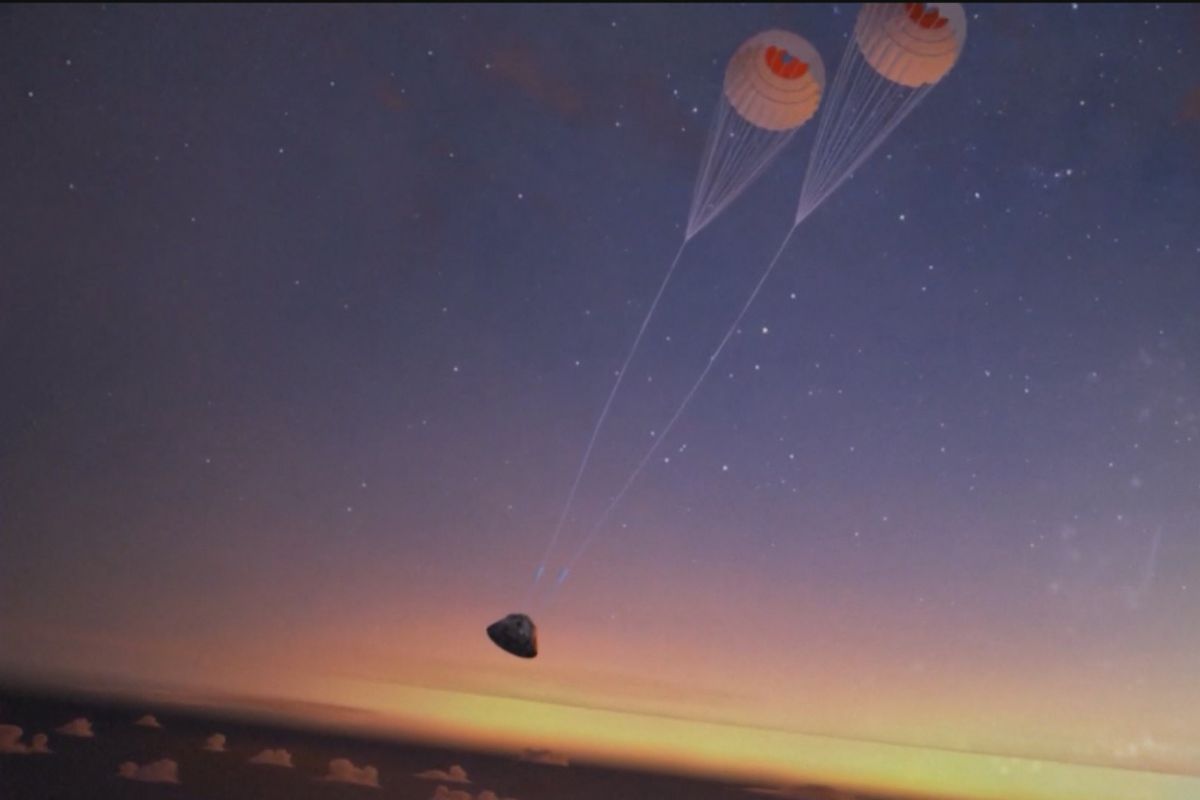
NASA confirmed the landing of the Orion capsule in the Pacific Ocean at 21:07 Brasília time this Friday (10), completing the Artemis II mission after 10 days and over 1.1 million kilometers traveled. The three main parachutes slowed the spacecraft from extreme speed to about 32 km/h for a safe splashdown off the coast of San Diego.
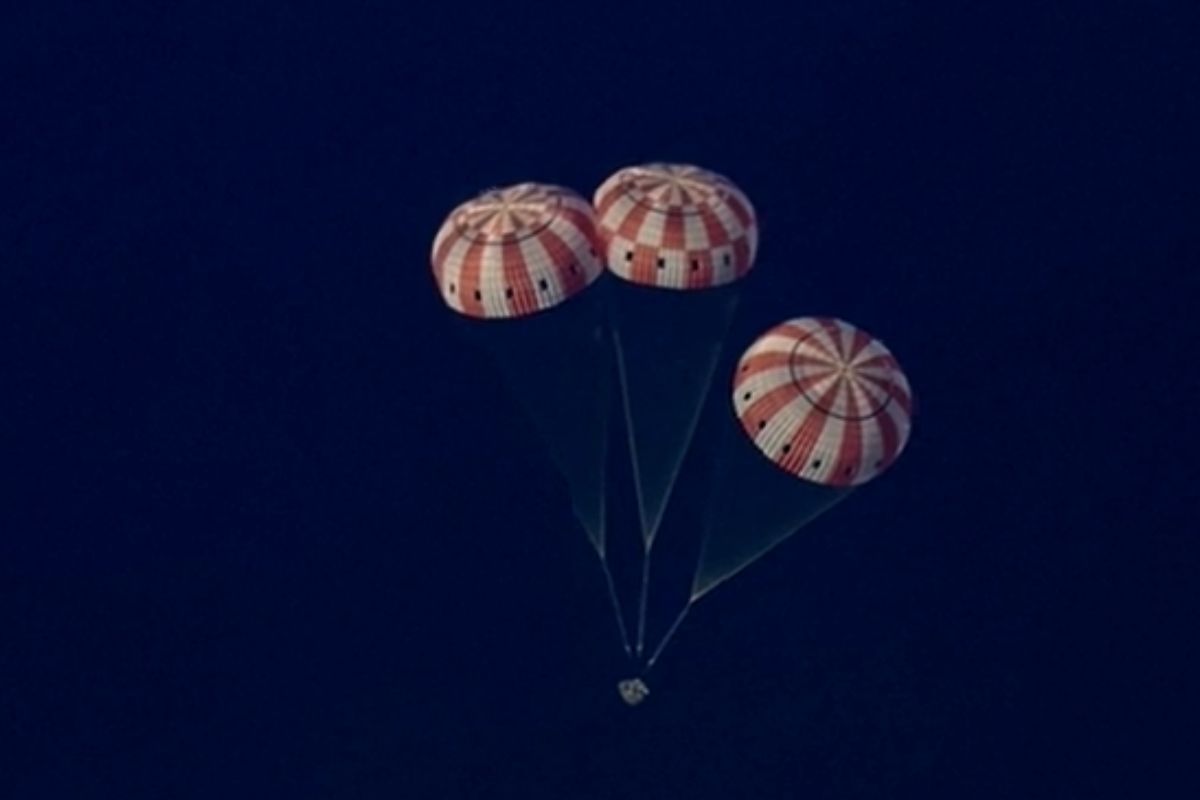
The NASA has just brought four astronauts back to Earth after the farthest journey that humans have ever made in space. The Orion capsule, named Integrity by the crew, touched the waters of the Pacific Ocean at 21:07 Brasília time this Friday (10), off the coast of San Diego, California. The three main parachutes deployed at approximately 1.8 kilometers altitude and reduced the spacecraft’s speed from thousands of kilometers per hour to about 32 km/h, enough for a controlled impact with the water that NASA commentators described as a “perfect bullseye.”
The landing concludes the Artemis II mission, which lasted 10 days and covered more than 1.1 million kilometers since the SLS rocket’s launch on April 1. The crew, NASA astronauts Reid Wiseman, Victor Glover, and Christina Koch, along with Canadian Jeremy Hansen, became the first to orbit the Moon in over 50 years and set the record for the farthest distance from Earth ever reached by humans, surpassing the Apollo 13 mark by reaching 406,777 kilometers from the planet. Now, NASA and U.S. Navy teams are working to extract the astronauts from the capsule and transport them by helicopter to the USS John P. Murtha ship.
How NASA brought Orion from 40,000 km/h to the ocean landing
The deceleration sequence of Orion is one of the most complex operations that NASA has ever executed with a crew on board. The capsule entered the Earth’s atmosphere at approximately 38,600 kilometers per hour, a speed that generates temperatures of about 2,800 degrees Celsius on the thermal shield. The friction with the air acts as a natural brake, but it is not enough alone. The combination of extreme heat, gravitational forces of up to 3.9 times body weight, and a six-minute communication blackout makes reentry the most dangerous phase of the entire mission.
-
Artemis II returns to the Pacific after 10 days and brings 4 astronauts back from the Moon, breaking the record for human distance and proving the reentry of Orion in a historic mission.
-
After decades of fear, Britons begin the removal of the masts from a sunken ship from World War II that holds 1,400 tons of explosives.
-
The Brazilian Army now has engineering machines with armor made in the country because the Rio de Janeiro War Arsenal, with over 250 years of history, delivered a backhoe with a customized ballistic protection kit and is already planning to armor other equipment.

-
Starlink’s satellite internet is now bundled with mobile service: US Mobile aims to revolutionize the American connectivity market with an integrated plan starting at $50, but still leaves many questions unanswered about how it will work.

After crossing the most intense part of the atmosphere, NASA triggered a precise sequence of 11 parachutes in stages. First, three parachutes removed the capsule’s forward cover. Then, two braking parachutes deployed at about 6.7 kilometers altitude to stabilize Orion and reduce its speed. Finally, the three main parachutes, each with a diameter of 35 meters, opened at approximately 1.8 kilometers from the ground, slowing the spacecraft to the 32 km/h needed for a safe impact with the water. NASA commentator Rob Navias described the descent as “perfect.”
The six minutes when NASA lost contact with the astronauts
According to the G1 portal, the most tense moment of the entire return occurred at 19:53 Brasília time when Orion entered the atmosphere at an altitude of 122 kilometers. At that moment, the air around the capsule compressed with such violence that it generated a plasma layer at 2,800 degrees Celsius, completely blocking all radio transmissions between the spacecraft and mission control in Houston. For six minutes, the astronauts were completely alone, without any communication with NASA.
This interval is also when the thermal shield of Orion does its most critical work. NASA knew that the shield had design issues identified during the uncrewed Artemis I mission in 2022, when over 100 points of unexpected erosion were found in the Avcoat material. To reduce the risk, the agency modified the reentry trajectory of Artemis II, making the capsule descend faster and at a steeper angle to minimize exposure time to maximum heat. When communications were restored and NASA confirmed that the crew was safe, the relief in mission control was visible.
What the astronauts saw and did during the 10 days in space
Artemis II was not just a round trip to the Moon. On April 6, the Orion capsule orbited the far side of the natural satellite, and the four astronauts became the first humans to see regions of the Moon that had never been observed under sunlight. During the six hours of lunar flyby, the crew documented craters, basins, and unprecedented geological formations while the spacecraft reached its maximum distance of 406,777 kilometers from Earth.
One of the most emotional moments of the mission occurred when Canadian astronaut Jeremy Hansen suggested that a lunar crater be named “Carroll,” in honor of the late wife of commander Reid Wiseman. The crew members were seen wiping away tears during the tribute. Wiseman called the moment “the most profoundly significant of the entire mission.” The crew also witnessed a solar eclipse seen from beyond the Moon, something no human had witnessed before. Pilot Victor Glover described the experience as “one of the greatest gifts” of the trip, and NASA released spectacular images captured by Orion’s cameras.
The rescue at sea and NASA’s next steps after the landing
As soon as Orion touched the water, combined teams from NASA and the U.S. Department of Defense began the rescue operation. U.S. Navy divers were the first to reach the capsule, photographing the thermal shield to assess its performance even before opening the hatch. The immediate inspection of the shield was one of NASA’s priorities, given the issues identified in Artemis I. The astronauts are to be extracted one by one and taken by helicopter to the USS John P. Murtha ship, where they will undergo initial medical evaluations.
Colonel Christopher Winn of the Marine Corps, who led the recovery planning, confirmed that the conditions at the landing site were ideal: scattered clouds, 10-knot winds, and waves of only 1.2 meters. NASA described the scenario as “a gentle day in the Pacific for the return of the astronauts from Integrity.” After evaluations aboard the ship, the crew will proceed to the Johnson Space Center in Houston for detailed post-mission follow-up. The Orion capsule will also be recovered and transported for thorough analysis, and the data collected during reentry and landing will be crucial for planning future missions.
What Artemis II means for the future of NASA’s lunar missions
Artemis II validates the systems that NASA intends to use to return astronauts to the lunar surface. The parachutes, thermal shield, return trajectory, and ocean splashdown were all tested with a crew on board for the first time, providing data that no simulation or uncrewed mission can replicate. If the results confirm that Orion and its systems function as designed, the agency can confidently move forward with the next steps of the program.
NASA anticipates that Artemis III, scheduled for early 2028, will include docking maneuvers in low Earth orbit. Artemis IV, at the end of 2028, will attempt to land two astronauts near the Moon’s south pole, the first crewed lunar landing since Apollo 17 in December 1972. The success of Artemis II’s landing in the Pacific this Friday is what makes these plans possible. NASA has proven it can send astronauts to the Moon and bring them back safely. Now, the next question is: can it land them there?
NASA has just completed the first return of astronauts from the Moon in over 50 years, and the three parachutes worked perfectly. Did you watch the landing live? What impressed you the most about Artemis II? Leave your opinion in the comments.






Seja o primeiro a reagir!