





 Portuguese
  English
  Spanish
  3 min of reading
  0 comments


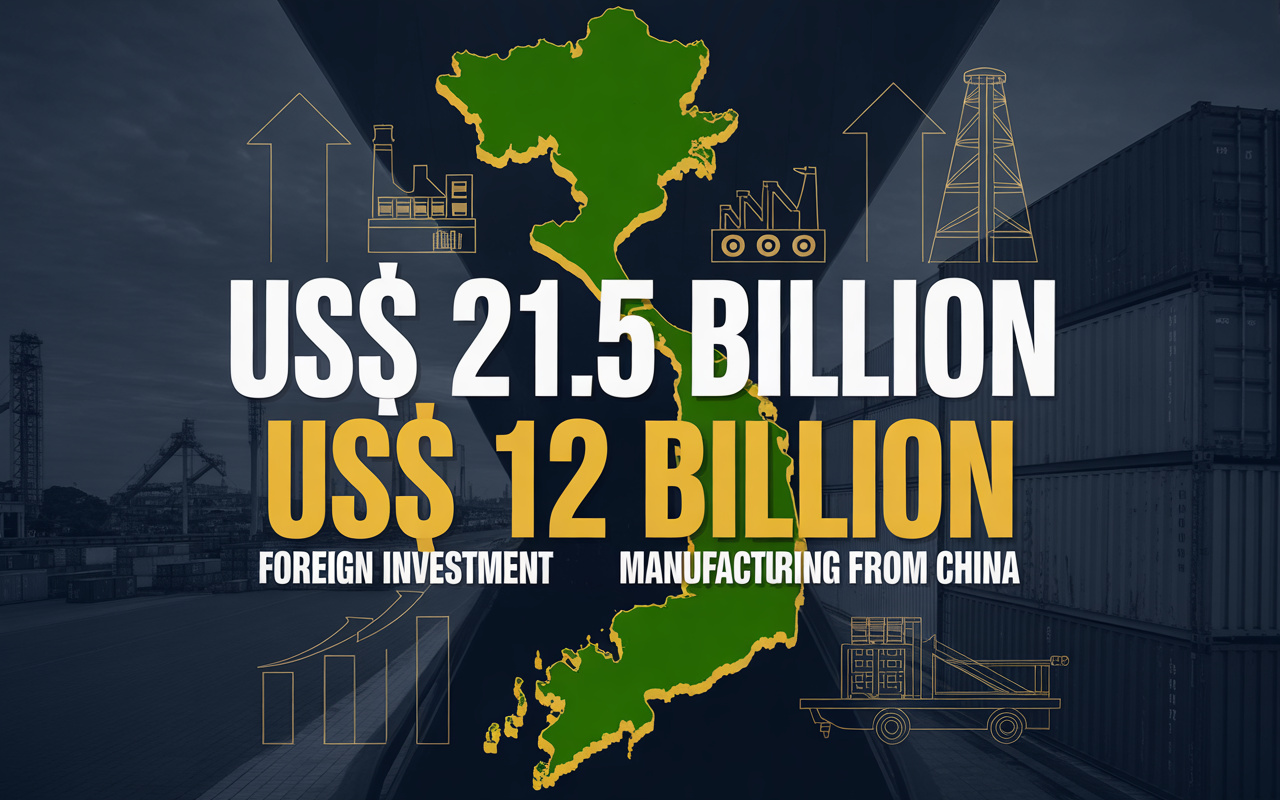
With Over US$ 21.5 Billion in Foreign Investments and Factories Leaving China, Vietnam Accelerates Industrialization and Emerges as an Alternative Manufacturing Hub in Asia.
For decades, China has held the role of “the world’s factory.” However, in recent years, a quiet shift has been redrawing the industrial map of Asia. Vietnam has started to attract a growing volume of productive investments and now occupies a strategic position in global manufacturing chains, especially as a direct alternative to excessive reliance on Chinese industry.
Billions in Foreign Capital and Industrial Focus
Recent data shows that Vietnam has already accumulated over US$ 21.5 billion in new foreign investments in a single year, with approximately US$ 12 billion directed specifically towards manufacturing. This figure reflects not only financial capital but also the concrete establishment of factories, industrial parks, and production lines aimed at export. Electronics, semiconductors, textiles, footwear, and electrical equipment lead this new industrial wave.


The “China + 1” Effect
The strategy known as China + 1 gained traction after trade tensions, the pandemic, and geopolitical risks. Instead of abandoning China, multinational companies began to diversify production, choosing a second Asian hub to mitigate risks. Vietnam has emerged as one of the most attractive destinations due to competitive costs, political stability, trade agreements, and a young and abundant workforce.
-
Historic bankruptcy of Centauro shocks the market, and the century-old company puts more than 500,000 products, machines, and complete infrastructure up for online auction.

-
New shoe factory in Ceará is expected to create 400 jobs and strengthen the local economy.
-
No one imagined it, but a mixture of sawdust with a mineral that fights fires surprises scientists with a result that changes the course of fire-resistant construction.

-
From empty land to a high-end house, wooden construction uses a lightweight system, metal structure for the foundation, ventilated ceramic cladding, and special windows to create an efficient and comfortable living space throughout the year.

Multinationals and Factories on a Continental Scale
Global industry giants are already operating in the country on a massive scale. Industrial complexes employ hundreds of thousands of workers and have transformed entire regions into manufacturing corridors.
In various sectors, Vietnam has stopped being just an assembly point and has begun to integrate more complex stages of the production chain, increasing the added value of its exports.
Rising Exports and Global Integration
Industrial growth is directly reflected in exports. Manufactured products account for an increasingly larger share of Vietnamese foreign trade, with a strong presence in markets in the United States, Europe, and Asia. This integration has solidified the country as a critical link in global supply chains, especially in cost-sensitive, logistics, and scale sectors.
To sustain this progress, Vietnam has expanded ports, highways, special economic zones, and planned industrial parks. These hubs concentrate suppliers, logistics, and labor, reducing operational costs and attracting new projects. The result is an industrial ecosystem that is growing in an organized manner, which is fundamental for maintaining long-term competitiveness.
Limits and Challenges of the Industrial Leap
Despite the rapid progress, Vietnam has not yet fully replaced China. The country faces challenges such as logistical bottlenecks, dependence on imported inputs, and the need for technological qualification. Still, the current movement indicates a structural repositioning, not just a one-time growth.

What the Vietnamese Case Reveals About the Global Economy
The rise of Vietnam shows that the global industry has entered a new phase. Instead of extreme concentration, production chains are becoming more distributed, with regional hubs gaining prominence. In this context, Vietnam does not aim to “be China,” but to occupy a strategic position as the primary manufacturing alternative in Asia.
A New Chapter in Asian Industrialization
With billions in investments, factories in full operation, and expanding exports, Vietnam positions itself as one of the countries that has best managed to leverage the reorganization of the global economy. The process is still underway, but the numbers already indicate that the country has transitioned from a supporting role to becoming one of the protagonists of the new industrial geography of the 21st century.









Seja o primeiro a reagir!