





 Portuguese
  English
  Spanish
  4 min of reading
  14 comments


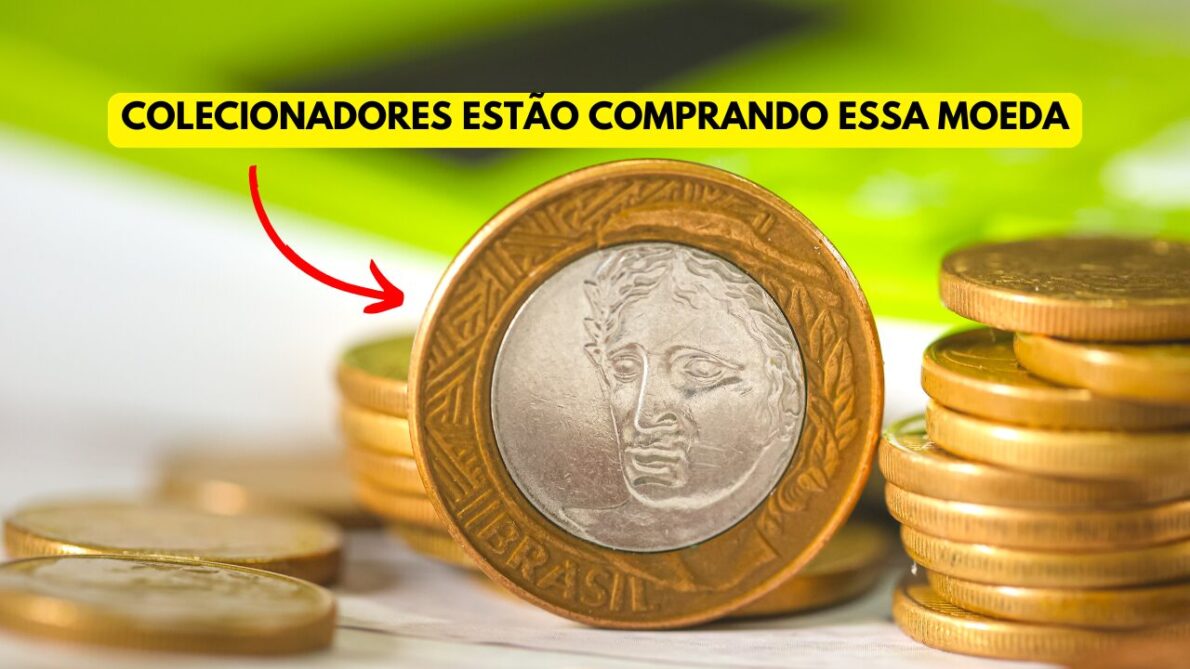


The 1 Real Coin from 1994, the First of the Real Plan, Can Be Worth Up to R$ 850 for Collectors If It Shows a Rare Defect Known as Inverted Reverse.
Launched on February 27, 1994, the Real Plan was a set of economic reforms that managed to control the hyperinflation that plagued the country for decades, stabilizing the economy and creating a new currency, the real. However, beyond the economic impact, the Real Plan also left an important legacy for coin collectors, the numismatists. Among the various coins issued over the years, the first 1 real coin issued in 1994 stands out for its historical value and potential appreciation. Today, this piece can be worth up to R$ 850 in the collector’s market.
The Historical Importance of the 1 Real Coin from 1994
The 1 real coin from 1994 is special not only for being the first 1 real coin issued after the implementation of the Real Plan but also because it represents a significant change in the Brazilian economy.
For economists, the Real Plan was essential for stabilizing the country, but for collectors, the issuance of these first coins brought forth a series of valuable pieces, some of which remain in circulation today.
-
Larger than entire cities in Brazil: BYD is building a 4.6 km² complex in Bahia with a capacity for 600,000 vehicles per year, but the discovery of 163 workers in conditions analogous to slavery has shaken the entire project.

-
With an investment of R$ 612 million, a capacity to process 1.2 million liters of milk per day, Piracanjuba inaugurates a mega cheese factory that increases national production, reduces dependence on imports, and repositions Brazil on the global dairy map.

-
Brazilian city gains industrial hub for 85 companies that is equivalent to 55 football fields.

-
Peugeot and Citroën factory in Argentina cuts production by half and opens a layoff program for more than 2,000 employees after Brazil drastically reduced purchases of Argentine vehicles.


This 1 real coin was produced from stainless steel, with a diameter of 20.0 mm, a weight of 2.96 g, and a thickness of 1.20 mm.
Its edge is smooth, and the axis follows the coin reverse standard, known as the horizontal axis (HA).
The obverse of the coin features the effigy of the Republic, accompanied by the inscription “BRASIL” and stylized laurel branches. On the reverse, we see the value, the issuance date, and more laurel branches.
Inverted Reverse
What makes the 1 real coin from 1994 especially valuable for collectors is the possibility of it showing a rare characteristic known as inverted reverse.
In simple terms, a coin with inverted reverse has its opposite side (reverse) aligned in the opposite direction than expected.
To check if a coin has this defect, just hold the coin with the face (obverse) facing you in a normal position and tilt it from bottom to top. If the other side is upside down, it is an inverted reverse.
This type of minting error, which occurred during the manufacturing process, makes the coin extremely rare and sought after by numismatists.
Coins with inverted reverse are considered anomalies, and their scarcity in the market is what greatly increases their value.
In the case of the 1 real coin from 1994 with inverted reverse, the value can reach R$ 850, depending on its condition.
How to Identify and Evaluate the 1 Real Coin from 1994?
For those who want to know if they have one of these rare coins, it is important to pay attention to some details.
In addition to checking the inverted reverse characteristic, other aspects like the coin’s state of preservation are crucial in determining its value.
Well-preserved coins, free from scratches or signs of wear, are more valuable in the market.
Although it is still possible to find the 1 real coin from 1994 in circulation, the task is not easy.
Over the years, many of these coins have been saved by collectors or have been withdrawn from circulation due to natural wear.
However, this does not prevent anyone, anywhere in the country, from having the luck of finding one of these historical pieces in their change.
The Appreciation of Rare Coins in the Market
The numismatic market is known for its volatility, and the value of rare coins can vary significantly over time.
Experts like Plínio Pierry point out that determining the commercial value of these coins is a challenge, as there are no precise records of the number of coins with defects such as inverted reverse that have been issued.
Additionally, the interest of collectors and conditions in the numismatic market can affect prices.
In any case, for collectors and numismatics enthusiasts, owning a 1 real coin from 1994 with inverted reverse is a true treasure. Not only for the monetary value it can reach but also for the historical and cultural value that this piece represents, being a symbol of one of the most important economic transformations in Brazil’s recent history.
How to Sell Rare Coins?
If you own rare coins and wish to sell them, it is essential to know the best places and strategies to obtain a good return. Below are some reliable options to sell your rare coins:
1. Online Platforms
- Mercado Livre: One of the largest marketplaces in Brazil, it allows you to advertise your coins to a broad audience.
- OLX: Similar to Mercado Livre, it enables direct sales to consumers, with the advantage of finding buyers in your region.
- Amazon: Although better known for books and electronics, Amazon also has a collectibles section, including coins.
2. Specialized Auction Houses
Tenor & Pellizzari: Another renowned auction house in the numismatic market, known for evaluating and selling rare coins. (Click here to access the site)
3. Numismatic Societies and Communities
- Brazilian Numismatic Society: Offers a platform to connect sellers and collectors, as well as providing valuable information about the market. (Click here to access).






Tenho a moeda de 1 Real de 1994. Se valer a pena eu vendo – deniskatten @gmail.com
Boa tarde tem a moeda de um real de 1994 vcs compra
Sim eu tenho a moeda de um real no ano de 1994 gostaria de vender ela