





 Portuguese
  English
  Spanish
  4 min of reading
  0 comments


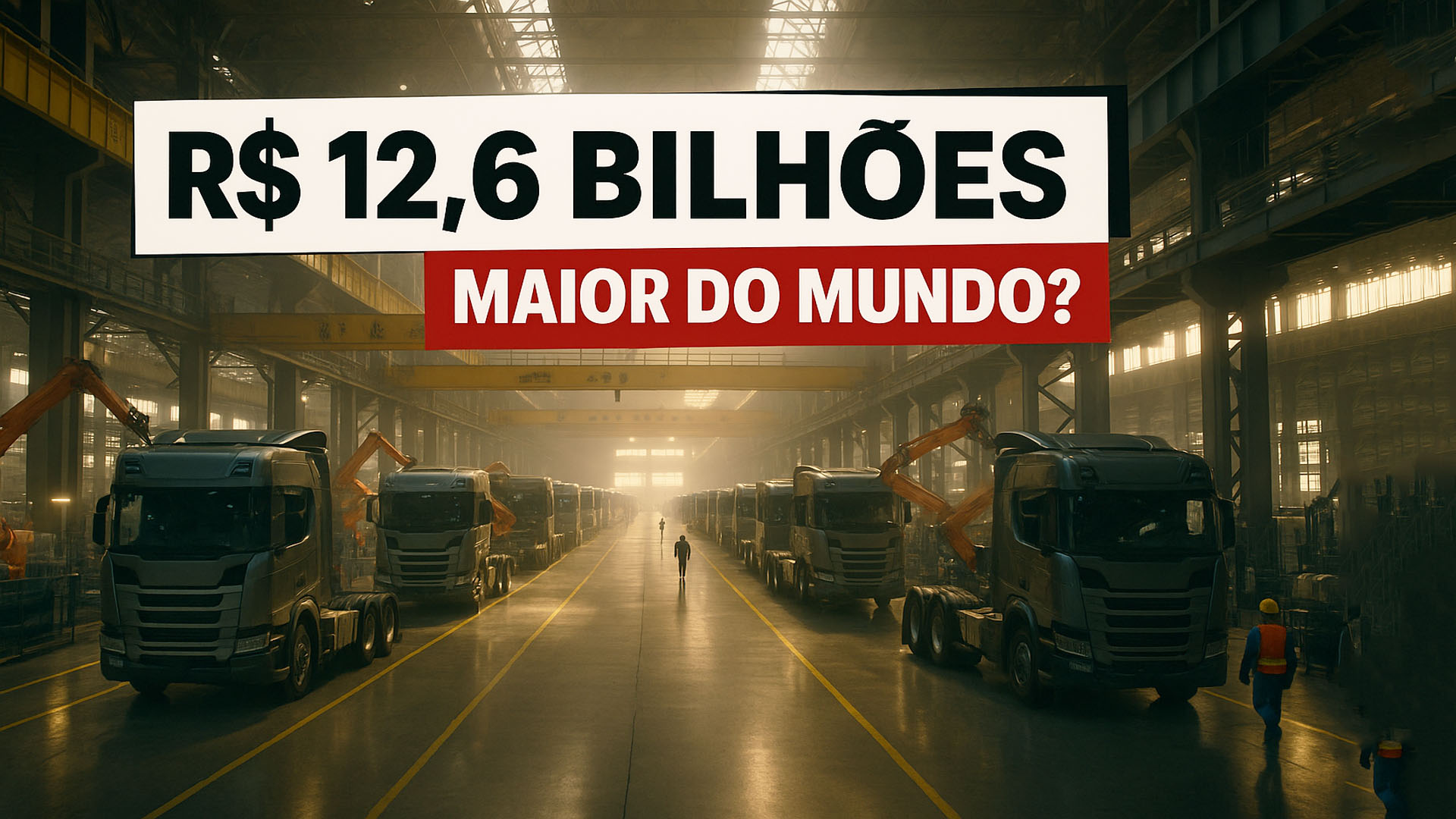
The Swedish Manufacturer Owned by the Volkswagen Group Opens Its First Fully-Owned Factory in the Asian Country, in a Strategic Move to Capture the World’s Largest Heavy Truck Market and Diversify Its Global Production
On October 15, Scania inaugurated its first fully-owned manufacturing unit in China, located in Rugao, Jiangsu province, about 200 kilometers from Shanghai. The robust investment of €2 billion (approximately R$ 12.6 billion) represents the largest industrial bet of the brand outside Europe and consolidates the Swedish manufacturer’s expansion strategy in the competitive Asian market.
The new factory has the capacity to produce 50,000 trucks annually and employs about 3,000 staff. This makes Rugao the third global industrial base of Scania, alongside Södertälje (Sweden) and São Bernardo do Campo (Brazil).
The Chinese plant has been designed to operate with renewable energy sources, including locally produced biogas and low-carbon electricity, aiming to achieve carbon neutrality.
-
“No one will make us change the Pix,” says Lula after the US report.

-
Lula responds directly to Trump and says that Pix is from Brazil and will not change under pressure from anyone, after a report from the United States pointed out the Brazilian payment system as an American trade barrier.

-
Amazon has just announced a new fee on all deliveries, and your online purchases will become more expensive starting April 17, including for those buying from the United States here in Brazil.

-
He sold his share for R$ 4 thousand, saw the company become a giant worth R$ 19 trillion, and missed the opportunity of a lifetime.


Why China Is Strategic for Scania
The Asian giant represents the world’s largest heavy truck market, with impressive figures. In 2024, China sold an average of 85,671 vehicles per day, and the country already accounts for almost one-third of the global production and trade of vehicles. For foreign manufacturers, this market has historically been challenging due to restrictions requiring partnerships with local companies.
The recent easing of Chinese economic policies has allowed foreign brands to build their own factories in the country without needing a partnership, opening a window of opportunity that Scania has strategically seized. According to Christian Levin, CEO of Scania, having local production means faster deliveries and products tailored to Asian needs.
The proximity to the consumer market also serves as a safeguard against geopolitical uncertainties and changes in international trade agreements. With the new unit, Scania can serve not only the Chinese market but also export to other countries in Asia and Oceania.
Exclusive Line Created for the Chinese Market
The Rugao factory produces two lines of trucks. The Global Super brings the R Line models, featuring 13-liter engines and a look similar to Brazilian Scania trucks. However, the highlight is the Next Era line, developed specifically for the launch of operations in China.
With a futuristic design, the Next Era features a completely redesigned grille and bumper, as well as LED headlights. An interesting detail: instead of the traditional logo, the name Scania is written in Chinese characters on the front of the vehicle. The available engines are the TD13 02 and TD13 01, with 460 hp and 500 hp, respectively.
In March 2025, the first prototype truck manufactured at the new plant rolled off the production line – a 500R tractor. The vehicles come equipped with a 360-degree camera system and level 2 autonomous driving, including adaptive cruise control and automatic braking. The line was developed for full integration into the local digital ecosystem, addressing the specific needs of long-distance transport in China.
Brazil Continues as a Global Strategic Base
Despite the new megafactory in China, the Brazilian operation remains relevant. The São Bernardo do Campo unit, inaugurated in 1962, was the first production line of Scania outside Sweden and has become a laboratory for regional technologies and a base for exports to Latin America.
In 2024, the Brazilian factory produced approximately 30,000 trucks and bus chassis, with 35% destined for other countries. The brand reached a historical milestone by manufacturing 500,000 trucks in Brazil since its arrival in the country in 1957. Currently, the plant has an annual capacity of 30,000 vehicles and employs nearly 6,000 staff.
Scania announced a new investment cycle of R$ 2 billion for the period from 2025 to 2028 in Brazil, focusing on decarbonization and preparation for the manufacture of electric bus chassis. The Brazilian factory will be the third global unit of the brand to produce electric vehicles, maintaining its position as the second-largest Scania plant in the world.
Sixty Years of History with China
The relationship between Scania and China began in 1965, with the import of L76 trucks for timber transport. An important chapter in this history occurred during the construction of the Tazara Railway, which links Tanzania and Zambia, between 1968 and 1975. The project, financed by China, used 200 Scania L76 “Jacaré” trucks that were later returned to the Asian country, where they enjoyed considerable success.
In 2002, Scania established an office in China, formalizing its entry into the market. In 2020, it acquired Nantong Gaokai Auto Manufacturing Co., kicking off local production plans that now come to fruition with the inauguration of the Rugao factory.
It’s worth noting that, since 2014, Scania has been fully owned by the Volkswagen Group through the holding Traton SE, which also manages brands like MAN and Navistar. As a privately-held company, the Swedish firm is part of the same conglomerate that oversees other major global automotive brands.
What do you think about Scania’s strategy to invest billions in China while maintaining operations in Brazil? Should other European manufacturers follow the same path? Share your opinion in the comments and join this discussion about the future of the global automotive industry!








Seja o primeiro a reagir!