Portuguese


Project Aman advances in Mauritania with up to 30 GW of renewables and aims for 6.6 million tons of green ammonia per year.
According to the Ministry of Energy and Petroleum of Mauritania, the country’s government and CWP Global have taken a decisive step in the Aman project by establishing a new long-term contractual framework for one of the largest green hydrogen ventures under development worldwide.
The scale puts pressure on countries that also want to sell green molecules to the international market: CWP presents the complex with potential for up to 30 GW of wind and solar generation, while the configuration announced by the government aims at 1.2 million tons of green hydrogen and 6.6 million tons of green ammonia annually. On the other side of the Atlantic, Brazil is trying to position Pecém in Ceará and Açu in Rio de Janeiro in the same race for buyers, investments, and export contracts.
An agreement lifts Aman from distant promises to reality
The project did not emerge recently. CWP started working on Aman in 2020. A memorandum of understanding was established in 2021, and the following year, the government and the company signed a structuring agreement.
-
Brazilian Municipality Prepares $45.6 Million Factory to Convert Renewable Energy into Hydrogen and Produce 2,000 Tons of Green Ammonia Annually

-
304 km Transmission Line with 611 500 kV Towers Begins Operations in Piauí, Strengthening Energy Transport in Northeast Brazil

-
US picks 21 geothermal projects for a $99 million push into hotter, harder-to-reach rock

-
Server Installed Next to Reservoir Heats Water in London Home, Helps Resident Save Up to £15 Monthly on Bills


The latest development is more concrete. The so-called Global Convention set the contractual, fiscal, economic, and development bases for the next stages. The document was signed in Nouakchott on September 16 and gained new international prominence in the following days.
CWP states that the venture has reached the FEED engineering phase, when the main systems begin to be detailed before the decision to invest billions of dollars in construction. The goal is to make this decision before 2030.
Up to 30 GW of sun and wind could support an entire industry
On the current project page, CWP presents Aman with a potential of up to 30 GW of combined generation, divided between solar and wind resources. The complex is expected to cover an area of approximately 8,500 km² in northern Mauritania.
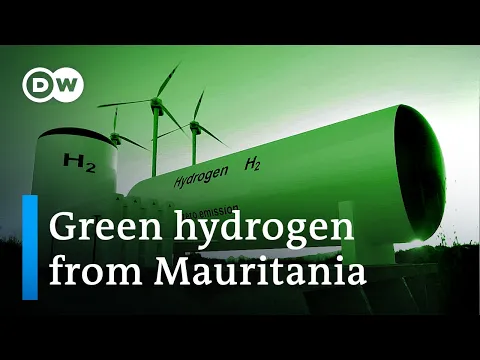

Thirty gigawatts would not be built solely to send electricity to the local grid.
The proposal is to use a large portion of this energy to power electrolyzers. These devices use electricity to separate water into hydrogen and oxygen.
When the electricity comes from renewable sources, the product is classified as green hydrogen.
The next step is to convert this molecule into something easier to transport.
The real export product could be ammonia
Transporting pure hydrogen over long distances is still expensive and technically complicated. Therefore, many of the world’s large projects are looking toward ammonia.
The hydrogen produced in the electrolyzers can be combined with nitrogen extracted from the air. The result is ammonia, a substance that already has a global transportation chain and is primarily used in fertilizer production.
In Aman, the current goal announced by the government is to produce 6.6 million tons of green ammonia annually, in addition to 1.2 million tons of hydrogen.
This is where the competition begins to directly overlap with Brazil.
Pecém also aims to sell green molecules abroad
In Ceará, the Pecém Complex is being prepared to function as a major hub for hydrogen and its derivatives.
The area designated for the project covers 1,855.1 hectares and includes industrial plants, a utility corridor, and infrastructure for storing ammonia. The current preliminary license is valid until October 2027.
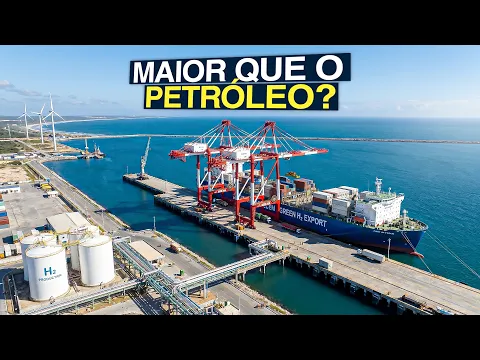
The port is also working on a commercial connection with Europe.
In May 2026, Pecém advanced in a partnership with the ports of Rotterdam and Duisburg to establish a route for green molecules between Ceará, the Netherlands, and Germany, aiming to enable supplies starting in 2029.
Brazil’s advantage lies in the most expensive resource in this equation: renewable electricity.
Ceará estimates an onshore wind potential of 94 GW, another 117 GW offshore, and solar potential of 643 GW.
However, having cheap sun and wind doesn’t solve everything.
Brazilian projects already total tens of billions of reais
The size of the national portfolio shows that Brazil is not starting from scratch.
A technical report published by ANP in 2026 outlines seven industrial projects that were expected to reach final investment decisions within the year, totaling R$ 63 billion and 6.15 GW of electrolysis capacity.
Pecém concentrates a significant portion of this activity.
The document cites projects from Fortescue, Casa dos Ventos, FRV, Quair, and Voltalia, with proposals to produce hydrogen, ammonia, and other derivatives.
Fortescue reports 1.2 GW of electrolysis and an estimated investment of R$ 18 billion. The Casa dos Ventos project also aims for 1.2 GW, with R$ 12 billion.
However, it’s not enough to simply announce capacity. Investment decisions must be reached, and buyers secured for millions of tons of product.
Açu aims to create another industrial corridor along the Brazilian coast
Further south, the Porto do Açu is building its strategy. The complex in Rio de Janeiro state has signed area reservations with Fuella, HIF Global, and Yamna for projects related to low-carbon hydrogen, ammonia, and e-methanol.
The Fuella project could reach 400,000 tons of green ammonia per year. Yamna aims for a capacity of up to 1 million tons annually, with initial molecules expected by 2030.
Açu’s vision extends beyond sending fuel to ships.
The complex seeks to connect renewable production, hydrogen, chemical derivatives, low-carbon steelmaking, and port infrastructure.
In May 2026, the Ministry of Ports and Airports highlighted Açu again as part of Brazil’s strategy for green corridors and low-carbon fuels starting in 2030.
Mauritania aims to do something similar, but at a scale that draws attention.
The African project intends to utilize hydrogen even for iron ore transformation
CWP does not plan to limit Aman to exporting ammonia. Mauritania has large iron ore reserves. With renewable electricity and abundant hydrogen, part of this ore could be processed within the country itself.
The goal is to create space for reduced iron and steel with significantly lower emissions.

The government also links the project to fertilizer production, food security, and clean fuels.
This changes the economic logic.
Instead of merely exporting electricity turned into hydrogen, the country is trying to attract industries that consume that energy within its own territory.
The exported product carries more value.
Brazil has an advantage that still needs to turn into manufacturing
Furthermore, the Northeast and other regions combine areas with strong solar and wind resources, major ports, and an industry that could consume hydrogen derivatives within the country.
The EPE presented this argument at the World Hydrogen Summit 2026. The Brazilian strategy presented in Rotterdam involves not only export but also industrial hubs capable of producing hydrogen, ammonia, synthetic fuels, and other derivatives.
The legal framework has also advanced.
Law No. 14,948 of 2024 established a national framework for low-emission hydrogen, and the ANP has begun to take on regulatory responsibilities regarding the authorization and operation of this new activity.
Now comes the hardest part: transforming projects into operational facilities.
Aman also needs to prove it can reach the construction phase
The 30 GW are not yet installed in the Mauritanian desert. There are no 6.6 million tons of green ammonia being shipped.
The project is in the development and engineering phase, while the final investment decision is expected before 2030.
CWP, on the other hand, has already conducted geological, geotechnical, hydrogeological, and bathymetric studies to support the design of structures onshore and offshore. The company has also accumulated over 30 months of solar and wind resource measurement in the area.
The next leap will be significantly more expensive.
Whoever arrives first can secure the most valuable contracts
Pecém, Açu, and Aman do not need to compete for every ton of the same market.
The potential demand includes fertilizers, steel, shipping, chemicals, and synthetic fuels.
However, buyers capable of signing billion-dollar long-term contracts are not infinite.
The new agreement in Mauritania gives Aman a clearer contractual base to advance. In Brazil, projects in Pecém and Açu are trying to follow the same path through licensing, land reservations, port infrastructure, and individual investment decisions.
The scale announced on the African coast serves as a warning.
As Brazil seeks to transform its enormous potential of solar and wind energy into a new export industry, other countries with similar resources are already preparing projects capable of delivering millions of tons of green ammonia to the Atlantic every year.
The race will not be won by those with the map showing the most gigawatts. It will be won by those who can turn those gigawatts into factories, contracts, and loaded ships.