





 Portuguese
  English
  Spanish
  5 min of reading
  0 comments


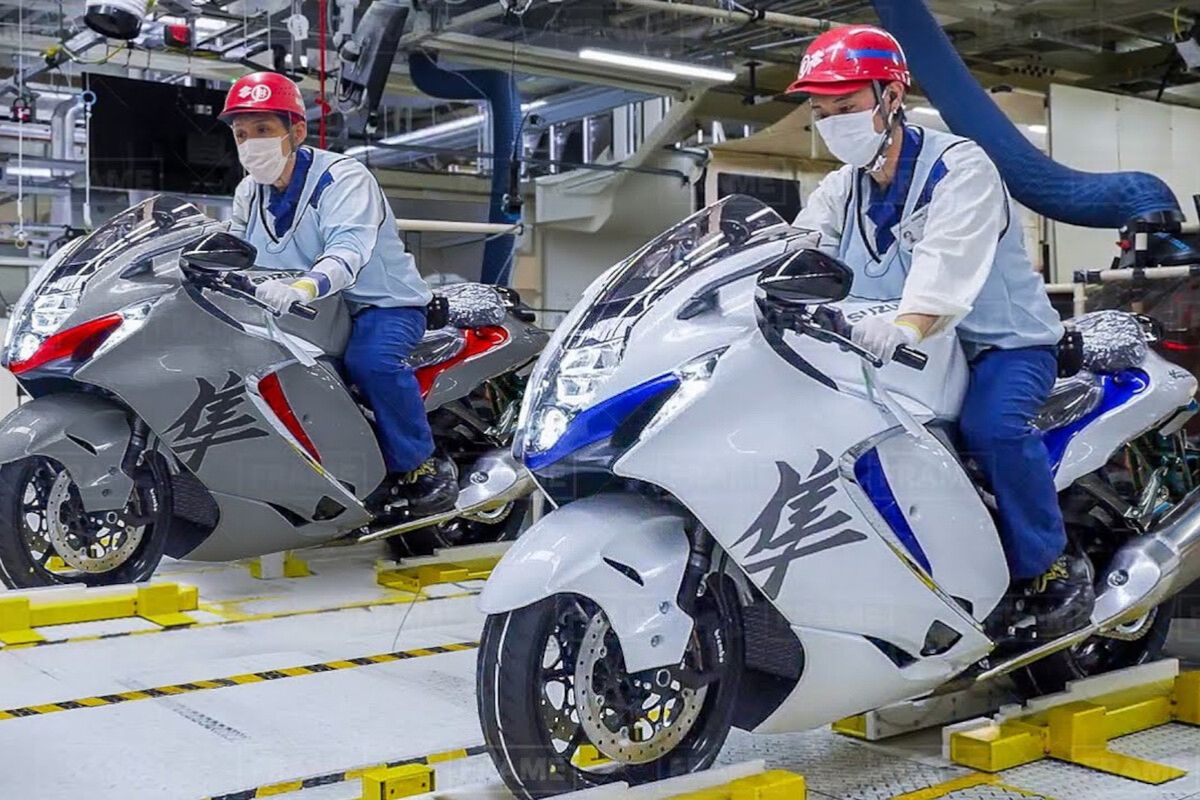
The Suzuki Hayabusa continues to be produced in Japan with a rare combination of handcrafted precision, manual steps, and rigorous checks, at a time when China is accelerating the manufacturing of motorcycles with increasingly automated lines.
The Suzuki Hayabusa shows that, even in an industry pressured by speed, scale, and automation, Japan still bets on a different logic. Instead of delivering just productivity, the factory seeks perfect repetition, zero tolerance, and absolute consistency in each assembled unit.
This choice helps explain why the motorcycle remains one of the most iconic in the industry. More than assembling a powerful hypersport, Suzuki maintains a process that tries to ensure that each unit leaves the line with the same standard, without deviations and without improvisation.
An industrial philosophy that resists the race for speed

While China advances with highly automated processes, Japan preserves an approach that values human intervention at decisive stages. In the case of the Suzuki Hayabusa, this is clearly seen in the assembly and also in how the factory handles inspection, fitting, and finishing.
-
GM celebrates 100 years in Brazil, changes president, and faces a tough mission: relies on a single platform, struggles with oil-soaked belts, launches the Sonic SUV, but still lacks a hybrid and direction.

-
It has a turbo engine with direct injection, a six-speed European transmission, and goes from zero to sixty in less than 10 seconds, but it’s a compact SUV that fits the budget of the average Brazilian, Renault Kardian.

-
Leapmotor C16 lands in Brazil in 2027 with electric and hybrid options, a futuristic design, interior for 6 people, and a range that can exceed 1,000 km in another Chinese offensive from Stellantis.

-
Why buying a car at a dealership is more expensive? New study reveals the factors that raise the price.

The contrast lies in the pace and method. On one side, Chinese automation allows for the production of motorcycles in less time. On the other, Suzuki maintains a line where each phase depends on the previous one and where manual work remains a central part of the final result.
The engine of the Suzuki Hayabusa starts piece by piece
In Hamamatsu, the construction of the Suzuki Hayabusa begins with the engine. The inline four-cylinder assembly of 1,340 cc does not arrive ready as a closed unit. It is assembled step by step, with components such as crankshaft, pistons, and camshaft being fitted in separate phases.
Each technician repeats the same function with extreme precision, reinforcing the idea of a less accelerated but highly controlled process. Even before moving to the main line, the engine already undergoes its own checks, like a kind of internal filter of the production process.
Only units that meet the exact required tolerances advance. In practice, the logic is simple: if it does not meet the standard, it does not proceed.
Chassis, suspension, and electronics enter in a controlled sequence

After the engine, the Suzuki Hayabusa begins to take shape with the integration of the chassis, suspension, brakes, electronics, and wiring. The aluminum twin-spar frame needs to combine rigidity and flexibility just right to ensure stability at high speeds without compromising control.
This balance depends not only on the design but also on execution. Each stage of assembly requires precise fitting and continuity between one phase and another, with no room for variations that could alter the feel of the finished motorcycle.
The production line operates with separate tasks, carried out manually by qualified professionals. This reinforces the factory’s proposal to maintain consistency unit after unit.
Quality control determines whether the motorcycle leaves the factory or not
If there is one point where everything is decided in the Suzuki Hayabusa, it is quality control. Each unit undergoes several checks before leaving the factory, including analysis of component fitting, engine operation, electronic systems, and finishing.
The rule is strict and straightforward: either it is perfect, or it does not leave the factory. This requirement helps sustain the Hayabusa’s reputation as a motorcycle that does not rely solely on power or fame, but also on consistency in what it delivers to the rider.
In a global scenario where production speed has become a competitive advantage, Suzuki insists on a different logic. The priority here is not just to assemble faster, but to ensure that each unit functions exactly as it should.
The Hayabusa has become a symbol of a Japanese manufacturing standard

Since the late 1990s, the Suzuki Hayabusa has established itself as one of the most iconic motorcycles in the industry. The model not only redefined the idea of straight-line performance but also began to require a manufacturing process compatible with that promise.
It is not just about joining parts, but about integrating design, engineering, and manufacturing with a very clear goal from the start.
This logic explains why the factory combines automation and human labor. There is technology in the process, but it does not eliminate the operator. On the contrary. Each person on the line has a specific and decisive role in the final product, which differentiates this environment from a plant dominated solely by robots.
The contrast with China helps explain the value of the motorcycle
The comparison with China serves not only to oppose two production styles. It helps to understand why the Suzuki Hayabusa continues to be seen as something special.
On one side, there are faster and more aggressive lines in productivity. On the other, there is a construction that tries to preserve precision, repetition, and absolute control.
This contrast shows that efficiency is not the only measure of value within the industry. In some cases, what sustains the reputation of a product is precisely the ability to maintain a rigid standard, even if it requires more time, more steps, and more human intervention.
This is what keeps the Hayabusa relevant. It does not represent just a high-performance motorcycle, but a specific way of understanding how a machine should be built.
Suzuki Hayabusa maintains the strength of an industry that has not given up on precision
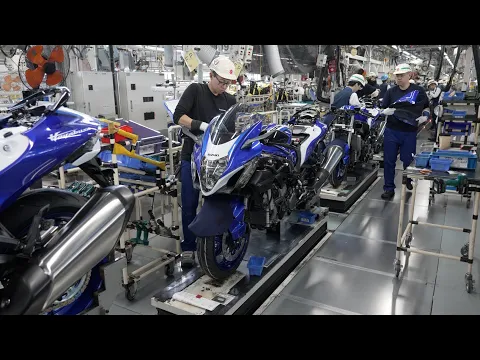

In the midst of the era of automated factories, the Suzuki Hayabusa continues to show that Japan still bets on extreme precision, strict quality control, and careful assembly as real differentiators.
The motorcycle continues to be produced with a level of attention that transforms each unit into a direct result of a very clear industrial philosophy.
In the end, what comes off the line is not just a famous hypersport. It is a machine built to repeat exactly what it promises, piece by piece, unit after unit.
And for you, does this almost manual care of the Suzuki Hayabusa still make more of a difference than the speed of automated factories?









Seja o primeiro a reagir!